Medical Design and Outsourcing

  • Home
  • Medical Device Business
    • Mergers & Acquisitions
    • Financial
    • Regulatory
  • Applications
    • Cardiovascular
    • Devices
    • Imaging
    • Implantables
    • Medical Equipment
    • Orthopedic
    • Surgical
  • Technologies
    • Supplies and Components Index
    • Contract Manufacturing
    • Components
    • Electronics
    • Extrusions
    • Materials
    • Motion Control
    • Prototyping
    • Pumps
    • Tubing
  • MedTech Resources
    • Medtech Events in 2026
    • The 2026 Medtech Big 100
    • Medical Device Handbook
    • MedTech 100 Index
    • Subscribe to Print Magazine
    • DeviceTalks
    • Digital Editions
    • eBooks
    • Educational Assets
    • Manufacturer Search
    • Podcasts
    • Webinars / Digital Events
    • Whitepapers
    • Voices
    • Views
    • Video
  • 2026 Leadership
    • 2025 Winners
    • 2024 Winners
    • 2023 Winners
    • 2022 Winners
    • 2021 Winners
  • Women in Medtech
  • Advertise
  • Subscribe

This Shifamed startup shares the shape memory secret behind its nitinol heart failure implant

December 1, 2025 By Jim Hammerand

Adona Medical co-founder and CEO Brian Fahey explains how his novel nitinol implant can be safely adjusted inside a patient.

Adona Medical's Delphi adjustable heart shunt implant with a quarter for scale.

Adona Medical’s Delphi adjustable heart shunt implant is shown here with a quarter for scale. [Photo courtesy of Adona Medical]

When we first interviewed Adona Medical co-founder and CEO Brian Fahey in 2023, the Shifamed startup’s use of shape memory nitinol had obvious potential, even if he wouldn’t explain exactly how the new heart failure technology worked for competitive reasons.

But we recently reunited near his company’s Los Gatos, California headquarters at DeviceTalks West in October 2025 to discuss the latest from the Adona team’s efforts to develop and commercialize their Delphi adjustable interatrial shunt.

“It’s noncontact heat. That’s the key thing,” Fahey said. “That’s probably the most important thing that we’ve developed.”

Many medical devices use nitinol for its superelastic properties, including cardiac implants for replacing or repairing heart valves, therapeutic catheters for cardiac ablation and renal denervation, and even a new birth control device.

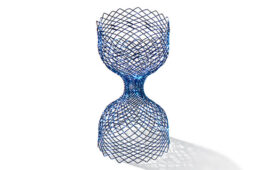
An illustration of Adona Medical's adjustable heart shunt implant.

Adona Medical’s adjustable heart shunt implant is made of ePTFE-coated nitinol and has pressure sensors on both sides of the heart. [Illustration courtesy of Adona Medical]

Superelasticity allows a nitinol device to spring back to its shape after being squeezed into a catheter and into a patient.

Shape memory, on the other hand, uses shape-setting to form a nitinol device in a particular geometry that it can return to after it’s been deformed by force. The shape-setting process during manufacturing uses heat, and so does the process to trigger that shape memory and return a nitinol device to its predetermined shape.

Nitinol innovation: Download our free special report featuring nitinol expertise and tips from medical device OEMs

Adona Medical uses shape memory nitinol to adjust the size of its novel interatrial shunt any time after implantation.

“We can make it bigger, we can make it smaller, and we can go back and forth thousands of times if we really needed to,” Fahey said. “That lets you dial in the size of the hole that you need for that particular patient. You’re no longer moving at one-size-fits-all medicine. And that hole may change over time, so you can then follow the patient.”

The video clip from Adona below shows the adjustment:

The nitinol device is coated with ePTFE (expanded polytetrafluoroethylene) and has sensors that capture pressure readings from the left and right atria multiple times each day.

The Delphi Shunt was implanted in the first human patient in October 2024. Adona completed enrollment for that first-in-human trial in June 2025 with ten patients and 100% procedural success. Of the nine patients who returned for follow-up, Adona said all of the implants were able to be adjusted to increase and/or decrease the size of the flow channel months after implantation.

But how do they apply enough heat to trigger shape memory nitinol inside a patient without cooking them?

First, Adona uses a proprietary shape memory nitinol formulation and manufacturing process, Fahey said.

“I believe we’re the only company in the world using [it, and it] probably took us the better part of a year to figure out,” he said. “But now that we have it, it’s really got a lot of utility [as a] platform technology.”
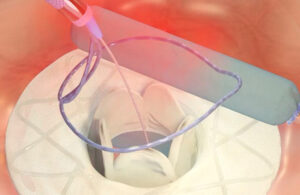
An image of Adona Medical's interatrial shunt and the induction catheter used for post-implantation adjustments.

Adona Medical’s Delphi interatrial shunt is adjusted after implantation using an induction catheter to heat the shape memory nitinol. [Illustration courtesy of Adona Medical]

After implantation, heat is delivered to the shunt in the form of electromagnetic energy, similar to wireless charging of a smartphone, he said.

“We’ve got a catheter that is inductively coupled to our implant when it’s placed close to it [and] heats our implant from the inside out,” Fahey said. “The part that actually gets hot is targeted. It’s below several layers of thermal insulation.”

The patient’s blood recirculating inside their heart acts as a quench for the heat, he said. “You just need to make sure the heat is wicked off by the circulating blood in the heart faster than it can diffuse through your thermal insulation. The targeting makes a big difference.”

MDO Min-Vasive Medtech: Download our free 72-page special report featuring interviews with minimally invasive device development experts and engineers at major OEMs and groundbreaking startups

Adona Medical makes all of its catheters in-house, Fahey said. “We have braiders, we have laminators. We don’t do extrusions, we don’t make our own raw materials, but we do everything else in-house.”
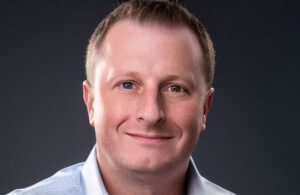
A portrait of Adona Medical co-founder and CEO Brian Fahey.

Adona Medical co-founder and CEO Brian Fahey [Photo courtesy of Adona Medical]

And he offered advice to inspire and empower other device developers to take risks.

“Don’t be scared of a huge project or a big swing. … An easier project oftentimes will be just as hard, but for different reasons. At the end of the day, if you’re struggling but you’re trying to solve a really hard, ambitious problem, I think for a lot of us that’s an easier struggle to deal with emotionally than [a different struggle like] figuring out paperwork.

“Don’t be scared of big stuff,” he continued. “Take a big swing. Aim for it. People generally will applaud that level of ambition. Incremental innovation really doesn’t move the needle for the world. There’s nothing wrong with it. Our society benefits from it. But there’s nothing wrong with taking a big swing once in a while.”

Watch for more from Fahey and his fellow DeviceTalks West panelists —  Foldax CEO Ken Charhut and Tioga Cardiovascular VP of R&D Tom McNatt — in upcoming issues of Medical Design & Outsourcing’s free email newsletter.


About The Author

Jim Hammerand

Jim Hammerand is the managing editor of Arrowfly's Medical Design & Outsourcing, where he leads coverage of medtech innovation, design, engineering and manufacturing. He also reports breaking news at Arrowfly's MassDevice and contributes to our DeviceTalks podcasts and live events. Hammerand has more than two decades of journalism experience spanning newspapers, magazines, websites, live events, radio and TV news. For nearly a decade, Hammerand reported and edited business news for American City Business Journals as a reporter and digital editor at the Minneapolis/St. Paul Business Journal and then as managing editor of the Puget Sound Business Journal in Seattle. He holds degrees in journalism and management from the University of Minnesota and has won journalism awards from the Society of Professional Journalists, American Society of Business Publication Editors, and Trade, Association, Business Publications International. Connect with him on LinkedIn or by email at [email protected].

Related Articles Read More >

An illustration showing Corcym's Memo 4D Curve's laser-cut nitinol core.
Laser-cut nitinol and a layered design let these cardiac implants flex
A photo of Edwards Lifesciences' Autus size-adjustable heart valve.
A heart valve that grows with children shows what pediatric devices can become
An image of VahatiCor's A-Flux implant.
Nitinol outsourcing made VahatiCor’s new cardiac implant possible
An image of the September 2026 Medical Design & Outsourcing magazine featuring the Medtech Big 100 ranking of the world's largest medical device companies.
September 2026 issue: The MDO Medtech Big 100 breaks $500 billion
“mdo
EXPAND YOUR KNOWLEDGE AND STAY CONNECTED
Get the latest medical device business news, application and technology trends.

DeviceTalks Weekly

See More >

MDO Digital Edition

Digital Edition

Subscribe to Medical Design & Outsourcing. Bookmark, share and interact with the leading medical design engineering magazine today.

MEDTECH 100 INDEX

Medtech 100 logo
Market Summary > Current Price
The MedTech 100 is a financial index calculated using the BIG100 companies covered in Medical Design and Outsourcing.

New MedTech Resource

Medical Tubing

MassDevice

Mass Device

The Medical Device Business Journal. MassDevice is the leading medical device news business journal telling the stories of the devices that save lives.

Visit Website
MDO ad
Medical Design and Outsourcing
  • MassDevice
  • DeviceTalks
  • MedTech100 Index
  • Medical Tubing + Extrusion
  • Medical Design Sourcing
  • Drug Delivery Business News
  • Drug Discovery & Development
  • Pharmaceutical Processing World
  • R&D World
  • About Us/Contact
  • Advertise With Us
  • Subscribe to Print Magazine
  • Subscribe to our E-Newsletter
  • Listen to our Weekly Podcasts
  • Join our DeviceTalks Tuesdays Discussion

Copyright © 2026 Arrowfly, LLC. All Rights Reserved. The material on this site may not be reproduced, distributed, transmitted, cached or otherwise used, except with the prior written permission of Arrowfly LLC. Site Map | Privacy Policy | RSS

Search Medical Design & Outsourcing

  • Home
  • Medical Device Business
    • Mergers & Acquisitions
    • Financial
    • Regulatory
  • Applications
    • Cardiovascular
    • Devices
    • Imaging
    • Implantables
    • Medical Equipment
    • Orthopedic
    • Surgical
  • Technologies
    • Supplies and Components Index
    • Contract Manufacturing
    • Components
    • Electronics
    • Extrusions
    • Materials
    • Motion Control
    • Prototyping
    • Pumps
    • Tubing
  • MedTech Resources
    • Medtech Events in 2026
    • The 2026 Medtech Big 100
    • Medical Device Handbook
    • MedTech 100 Index
    • Subscribe to Print Magazine
    • DeviceTalks
    • Digital Editions
    • eBooks
    • Educational Assets
    • Manufacturer Search
    • Podcasts
    • Webinars / Digital Events
    • Whitepapers
    • Voices
    • Views
    • Video
  • 2026 Leadership
    • 2025 Winners
    • 2024 Winners
    • 2023 Winners
    • 2022 Winners
    • 2021 Winners
  • Women in Medtech
  • Advertise
  • Subscribe