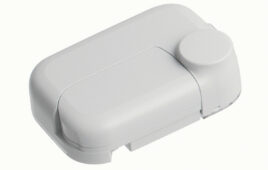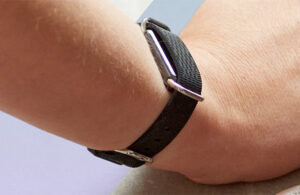
The Aktiia G0 Blood Pressure Monitoring System (sold as the Hilo Band) is worn on a user’s wrist. [Photo courtesy of Aktiia]
Aktiia co-founder and CTO Josep Solà discusses the Hilo Band’s technology, development challenges and potential applications.
This year, Aktiia won the first FDA 510(k) clearance for over-the-counter use of a cuffless blood pressure monitor, the G0 Blood Pressure Monitoring System (branded as the Hilo Band).
“Hypertension affects over 1.3 billion people and is still the leading risk factor for cardiovascular disease, yet most cases go undiagnosed or are poorly managed. That has to change,” Aktiia co-founder and CTO Josep Solà said in a Medical Design & Outsourcing interview.
“The future of medtech is moving toward continuous, seamless and invisible monitoring, especially at home,” he continued. “We need technologies that fit into people’s lives without asking them to become medical experts. That means smarter algorithms, better signal processing, fully automated workflows, and user interfaces that are intuitive for everyone, not just tech-savvy users.”
We asked Solà about the technology that makes the Hilo Band possible, product development challenges and solutions, and other applications of the technology.
“At Aktiia, we believe cuffless, effortless blood pressure monitoring is the foundation,” he said. “But it’s just the beginning. As we integrate this into more wearable form factors and combine it with other vital signs and AI-driven insights, we can move from occasional diagnosis to proactive, personalized hypertension management on a global scale.”
MDO Min-Vasive Medtech: Registration is now open for our minimally invasive webinar series featuring experts from OEMs
MDO: What’s the big advance that makes your monitoring technology possible?
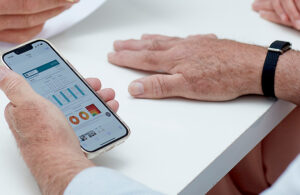
The Aktiia Hilo Band works with the Hilo smartphone app. [Photo courtesy of Aktiia]
“On the automation side, we’ve fully integrated the measurement and calibration process into a seamless flow. The user doesn’t need to push buttons, follow complex steps, or even think about how the system works. It just works. That includes signal quality checks, measurement timing, and even calibration reminders, all managed in the background. It’s designed to be completely lay-user proof, which is essential for OTC use.
“On the technology side, we’ve developed a new generation of pulse wave analysis algorithms that simply didn’t exist before. They’re trained and validated on data from over 130,000 users across Europe, giving us a depth and diversity that’s unmatched. These algorithms adapt to real-world conditions far beyond what traditional methods could handle. It’s not just more data; it’s a fundamentally smarter way of interpreting the optical signal.”
“That combination — automated user experience and truly adaptive algorithms — is what makes cuffless, OTC blood pressure monitoring finally possible.”
What was the biggest technical challenge in the development of this device/system, and what was the solution?

The Aktiia Hilo Band has a rechargeable battery that lasts 15 days. [Photo courtesy of Aktiia]
“Our solution was to fully integrate an oscillometric cuff into the product itself, not as an accessory, but as part of the system’s core workflow. That allowed us to handle calibration silently in the background, without asking the user to switch devices or follow complicated instructions. It made the entire process seamless, consistent and invisible to the end user, which is essential for OTC use.
“But that wasn’t enough on its own. Existing clinical standards weren’t designed for this type of hybrid device. So we had to design new types of clinical studies, going beyond current publications, to demonstrate both accuracy and usability in real-world, unsupervised settings. That meant working closely with the FDA to align on methods that had never been reviewed before.
“The third piece was data. To train the underlying machine learning algorithms, we needed high-quality, diverse, real-world data, not just from lab environments. We’ve now collected data from over 130,000 users across Europe, which has been critical for building and validating a new generation of pulse wave analysis algorithms that can truly adapt to people’s lives, not just test benches.
“In short, we had to reinvent how calibration works, rethink how to validate it, and build the data foundation to make it real.”
Does that have potential applications for other devices, systems or conditions?
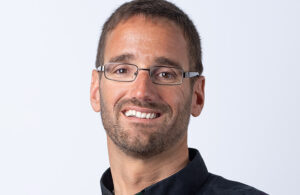
Aktiia co-founder and CTO Josep Solà [Photo courtesy of Aktiia]
“The calibration automation, signal processing pipeline, and the AI algorithms we’ve developed are modular. They can be integrated into other platforms and adapted to new use cases, whether that’s long-term cardiovascular risk monitoring, hypertension management, or even early detection of other conditions.”
“So while this clearance is just the beginning, the underlying technology is already built to scale across multiple devices and clinical applications.”
What are the safety risks of this device, and how does your design minimize those risks?
Solà: “The amazing aspect of our device is that it was designed to be an inherently low-risk device. It is not required to be sterile and is not an implantable. It’s a simple wearable worn on the user’s wrist, similar to a smart watch. The primary risk is associated with the device providing inaccurate blood pressure values. We have mitigated this through multiple design mitigations ranging from ensuring that the signal is taken when the patient is not moving to incorporating noise filtration in our algorithm. We’ve even ensured that the optical light exposure from the PPG sensor has passed the applicable safety standards.
“With any electronics device, there is always the risk of electrical shock and EMC interference. This has been mitigated through standard IEC 60601 safety testing.
“Lastly, with any continuously worn device, there is always the risk of skin irritation, which has been mitigated through biocompatibility testing.”
What are you working on for the next generation of this technology?
Solà: “Of course, but we cannot disclose this yet. Have a look at our European offering today to understand how far away we are planning to go.”
Look for more from our interview with Solà in the weeks ahead, including advice for device developers seeking OTC clearances and what he would do differently if he could do it again.