Aqua Medical is investigating a new diabetes procedure called proximal intestinal mucosal ablation. [Illustration courtesy of Aqua Medical]
The Pleasanton, California-based company’s flagship investigational approach aims to deliver endoscopic metabolic restoration with a novel outpatient procedure called proximal intestinal mucosal ablation (PIMA).
During this procedure, Aqua Medical’s expandable device deploys through an endoscope to deliver circumferential ablation to the duodenum without the need for fluoroscopy or surgical incisions. The system ablates up to 70 cm of proximal intestine.
Aqua Medical’s minimally invasive RFVA system could offer an alternative for patients with type 2 diabetes. The company hopes to help clinicians move beyond chronic management toward disease modification, reducing reliance on lifelong medications and avoiding invasive surgery.
Related: Diabetes device developers turn their sights to type 2
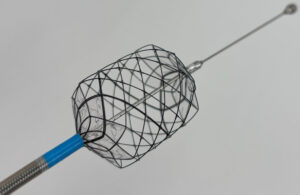
An Aqua Medical radiofrequency vapor ablation catheter [Photo courtesy of Aqua Medical]
Related: MedTech Innovator names 2025 Grand Prize finalists
Aqua Medical’s RFVA clinical data for diabetes
Safety and effectiveness have not yet been established, but Aqua Medical recently shared early clinical results that indicate a favorable safety profile and the clinical benefit of the PIMA procedure using the RFVA system.
“This is the most encouraging data yet for our investigational platform,” Aqua Medical CEO Lloyd Mencinger told Medical Design & Outsourcing in a prepared statement. “For decades, patients and physicians have faced a binary choice between drugs or surgery. Our goal is to investigate whether PIMA can ultimately provide a safe, effective, and durable alternative, empowering physicians and patients alike with an option that is both minimally invasive and impactful.”
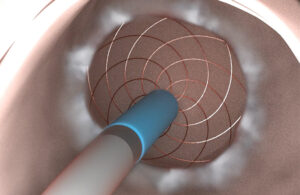
This illustration shows a view from the endoscope of the Aqua Medical radiofrequency vapor ablation catheter deploying steam inside the duodenum. [Illustration courtesy of Aqua Medical]
Norton reported preliminary outcomes from three cohorts totaling 39 patients treated with the PIMA procedure. He said the study demonstrated 100% technical success in ablating an average of approximately 58 cm of mucosa. Investigators also saw no serious adverse events related to the device or procedure.
“These early results add to the growing body of evidence that remodeling the proximal intestine can deliver profound metabolic improvements,” Norton said. “For patients struggling with type 2 diabetes, especially those inadequately controlled on medications or insulin, preliminary PIMA results support a promising new therapeutic pathway.”
The study’s oral therapy cohort saw an average 2% HbA1C reduction at six months. In the insulin cohort, 100% of patients saw the elimination of moderate-dose insulin therapy while maintaining improved glycemic control without the addition of GLP-1 receptor agonists. The retreatment cohort evaluated patients who did not respond to prior short-length duodenal ablation (12-15 cm), with subjects achieving a 1.8% HbA1C reduction at six months.
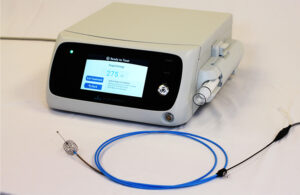
Aqua Medical’s radiofrequency vapor ablation generator and catheter [Photo courtesy of Aqua Medical]
Related: This minimally invasive diabetes device delivers pulsed field energy in the gut
The RF vapor ablation system and other applications
Aqua Medical’s RFVA system comprises of the Aqua RF Vapor Generator, Aqua RF Vapor Catheters and saline delivery tubing and syringe, according to records filed with the FDA. The generator delivers bipolar RF energy to the single-use catheter, which has silicone-coated nitinol discs that create an ablation zone for heated saline vapor.
The Aqua Medical RFVA system is not for sale and not authorized for diabetes patients.
MDO Min-Vasive Medtech: Watch on-demand interviews with minimally invasive device engineers in pediatrics, structural heart and catheter tech

This illustration depicts Aqua Medical’s technology being ablating a precancerous pancreatic lesion. [Illustration courtesy of Aqua Medical]
Aqua Medical says its RFVA technology might one day also be used for nonsurgical ablation of precancerous pancreatic cysts. For that application, an endoscope could deploy a probe through the wall of the GI tract and into the cyst, delivering RFVA directly inside the target to prevent the progression to pancreatic cancer.
— Managing Editor Jim Hammerand contributed to this report.