Medical Design and Outsourcing

  • Home
  • Medical Device Business
    • Mergers & Acquisitions
    • Financial
    • Regulatory
  • Applications
    • Cardiovascular
    • Devices
    • Imaging
    • Implantables
    • Medical Equipment
    • Orthopedic
    • Surgical
  • Technologies
    • Supplies and Components Index
    • Contract Manufacturing
    • Components
    • Electronics
    • Extrusions
    • Materials
    • Motion Control
    • Prototyping
    • Pumps
    • Tubing
  • MedTech Resources
    • Medtech Events in 2026
    • The 2026 Medtech Big 100
    • Medical Device Handbook
    • MedTech 100 Index
    • Subscribe to Print Magazine
    • DeviceTalks
    • Digital Editions
    • eBooks
    • Educational Assets
    • Manufacturer Search
    • Podcasts
    • Webinars / Digital Events
    • Whitepapers
    • Voices
    • Views
    • Video
  • 2026 Leadership
    • 2025 Winners
    • 2024 Winners
    • 2023 Winners
    • 2022 Winners
    • 2021 Winners
  • Women in Medtech
  • Advertise
  • Subscribe

Artificial spider silk: Why you should care about it

January 10, 2017 By Danielle Kirsh

artificial spider silk

[Photo courtesy unsplash.com]

A spider expert and a chemist walk into a lab at the University of Nottingham. No, this isn’t how the next Spider-Man movie begins. It is, however, how a group of scientists developed an antibiotic synthetic spider silk that can be used in a variety of medical applications.

Neil Thomas, professor of medicinal and biological chemistry, and Sara Goodacre, lead researcher in the “SpiderLab” at Nottingham and associate professor of medicine and health sciences, led a team of PhD students to use click chemistry to attach antibiotics to artificially produced spider silk that has been synthesized by E.coli to be used in drug delivery, regenerative medicine and wound healing.

Silk proteins had to be created in a bacterium where amino acids in proteins were not normally found. The amino acid had an azide group that is used in click chemistry reactions that only happen at that position in the protein.

Chosen molecules, like antibiotics or fluorescent dyes, can be attached to soluble silk protein. The research team discovered that when the silk fibers are coated in the antibiotic levofloxacin, the antibacterial properties are held on to for at least five days.

“Our technique allows the rapid generation of biocompatible, mono or multi-functionalized silk structures for use in a wide range of applications. These will be particularly useful in the fields of tissue engineering and biomedicine,” said Thomas.

Spider silk has strong, biocompatible and biodegradable properties and is a protein-based material that does not have any allergens or cause immune or inflammatory reactions. The research team developed a way to have the artificial spider silk have the same properties while being a replacement for the cellular matrix that human cells create and accelerate the growth of new cells while slowly releasing antibiotics.

“There is the possibility of using the silk in advanced dressings for the treatment of slow-healing wounds such as diabetic ulcers. Using our technique, infection could be prevented over weeks or months by the controlled release of antibiotics. At the same time tissue regeneration is accelerated by silk fibers functioning as a temporary scaffold before being biodegraded,” said Thomas.

Spider silk is the strongest known natural fiber and has been used in medical applications for centuries. It was known to ease healing and connect the skin. It was also believed that spider silk had antiseptic properties and was effective in clotting blood because of its high vitamin K content. Greek and Roman soldiers used to ball up spider webs and put them in open wounds to stop bleeding.

Thomas and Goodacre met at a University of Nottingham meeting five years ago when Goodacre showed the audience a picture of spider silk and told them that she wanted to figure out how it works and recreate it. Thomas approached her and said that he thought his research team could create the synthetic spider silk with added, useful compounds.

The research was funded by Biotechnology and Biological Science Research Council and was published in the online Advanced Materials journal.

About The Author

Danielle Kirsh

Danielle Kirsh is an award-winning journalist and senior editor for Medical Design & Outsourcing, MassDevice, and Medical Tubing + Extrusion, and the founder of Women in Medtech and lead editor for Big 100. She received her bachelor's degree in broadcast journalism and mass communication from Norfolk State University and is pursuing her master's in global strategic communications at the University of Florida. You can connect with her on Twitter and LinkedIn, or email her at [email protected].

Comments

  1. Rebeccah Mildenstein says

    January 14, 2017 at 7:27 pm

    Wow this is incredible! I love medical science!

Related Articles Read More >

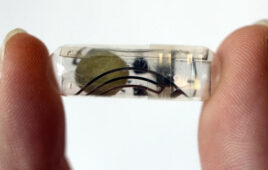
The 1.84 volt paper battery (brown circle structure) was tested in pigs with a bioabsorbable radio-frequency identification (RFID) device.
MIT researchers develop bioresorbable batteries for ingestible medical devices
A photo of Conexeu Sciences co-founder and Chief Scientific Officer Dr. Claudia Chavez-Munoz.
This tissue engineering scientist is bioprinting next-gen absorbable implants
An image of the September 2026 Medical Design & Outsourcing magazine featuring the Medtech Big 100 ranking of the world's largest medical device companies.
September 2026 issue: The MDO Medtech Big 100 breaks $500 billion
A photo of disposable syringes for insulin.
How to make smarter polymer choices for disposable drug delivery devices
“mdo
EXPAND YOUR KNOWLEDGE AND STAY CONNECTED
Get the latest medical device business news, application and technology trends.

DeviceTalks Weekly

See More >

MDO Digital Edition

Digital Edition

Subscribe to Medical Design & Outsourcing. Bookmark, share and interact with the leading medical design engineering magazine today.

MEDTECH 100 INDEX

Medtech 100 logo
Market Summary > Current Price
The MedTech 100 is a financial index calculated using the BIG100 companies covered in Medical Design and Outsourcing.

New MedTech Resource

Medical Tubing

MassDevice

Mass Device

The Medical Device Business Journal. MassDevice is the leading medical device news business journal telling the stories of the devices that save lives.

Visit Website
MDO ad
Medical Design and Outsourcing
  • MassDevice
  • DeviceTalks
  • MedTech100 Index
  • Medical Tubing + Extrusion
  • Medical Design Sourcing
  • Drug Delivery Business News
  • Drug Discovery & Development
  • Pharmaceutical Processing World
  • R&D World
  • About Us/Contact
  • Advertise With Us
  • Subscribe to Print Magazine
  • Subscribe to our E-Newsletter
  • Listen to our Weekly Podcasts
  • Join our DeviceTalks Tuesdays Discussion

Copyright © 2026 Arrowfly, LLC. All Rights Reserved. The material on this site may not be reproduced, distributed, transmitted, cached or otherwise used, except with the prior written permission of Arrowfly LLC. Site Map | Privacy Policy | RSS

Search Medical Design & Outsourcing

  • Home
  • Medical Device Business
    • Mergers & Acquisitions
    • Financial
    • Regulatory
  • Applications
    • Cardiovascular
    • Devices
    • Imaging
    • Implantables
    • Medical Equipment
    • Orthopedic
    • Surgical
  • Technologies
    • Supplies and Components Index
    • Contract Manufacturing
    • Components
    • Electronics
    • Extrusions
    • Materials
    • Motion Control
    • Prototyping
    • Pumps
    • Tubing
  • MedTech Resources
    • Medtech Events in 2026
    • The 2026 Medtech Big 100
    • Medical Device Handbook
    • MedTech 100 Index
    • Subscribe to Print Magazine
    • DeviceTalks
    • Digital Editions
    • eBooks
    • Educational Assets
    • Manufacturer Search
    • Podcasts
    • Webinars / Digital Events
    • Whitepapers
    • Voices
    • Views
    • Video
  • 2026 Leadership
    • 2025 Winners
    • 2024 Winners
    • 2023 Winners
    • 2022 Winners
    • 2021 Winners
  • Women in Medtech
  • Advertise
  • Subscribe