International Space Station astronauts used Auxilium’s orbital biomanufacturing technology to bioprint the first liver tissue in space. [Photo courtesy of Auxilium]
The San Diego-based biotech and device developer used its Auxilium Microfabrication Platform (AMP-1) 3D bioprinter for the first-of-its-kind mission, which also included orbital bioprinting of cartilage tissue and nerve repair implants. The bioprinted tissues and implants splashed down off the California coast on June 17.
Auxilium previously announced successful orbital printing of its miniature implants in 2025.
The latest mission is “a significant milestone for both Auxilium and the future of space biomanufacturing,” Auxilium CEO Jacob Koffler said in a statement shared with Medical Design & Outsourcing ahead of the official announcement. “For the first time, we successfully bioprinted kidney and liver tissues in space, demonstrating that complex biological products can be manufactured in orbit. We also produced cartilage tissue and 28 nerve repair implants during the same mission using the same manufacturing platform.
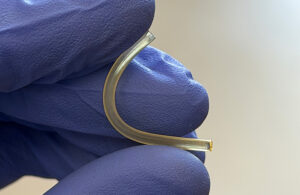
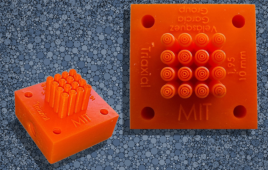
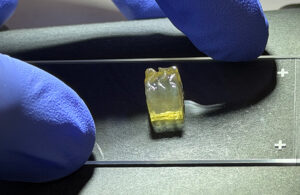
International Space Station astronauts used Auxilium’s orbital bioprinter to make nerve repair implants like this one. Auxilium designed its investigational NeuroSpan Bridge implants to accelerate nerve regeneration and nerve targeting after debilitating nerve injuries to extremities. [Photo courtesy of Auxilium]
Auxilium collaborated with the Wake Forest Institute for Regenerative Medicine (WFIRM) on this mission, using cells and tissue designs from WFIRM researchers to support their work.
“The uniform cell distribution achieved aboard the space station points to real possibilities for manufacturing medical devices and tissues in space,” said WFIRM Director Dr. Anthony Atala, who is a practicing surgeon, regenerative medicine researcher and professor at Wake Forest University School of Medicine.
Auxilium offered organoid production as one potential application. Those miniature 3D tissue models replicate structural and functional characteristics of human organs for pharmaceutical research.
“Today, organoids used for space-based research are manufactured on Earth and transported to orbit,” the company said. “The ability to manufacture these biological models directly in space could provide researchers with on-demand access to experimental systems while reducing dependence on launch schedules and Earth-based supply chains. As commercial space stations begin supporting larger research programs, in-space production of organoids will create new opportunities for drug discovery, disease modeling, precision medicine, and human health research in microgravity.”
Auxilium also said it is working toward biomanufacturing on Vast and Starlab’s next-gen orbital platforms while developing manufacturing capabilities for sustained human presence on the moon and deep-space exploration missions.
“As governments and commercial providers expand humanity’s reach beyond Earth, the ability to manufacture critical medical products and biological materials on demand will become an increasingly important component of space infrastructure,” the company said.