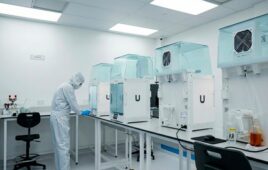
NASA astronaut Butch Wilmore holding an Auxilium bioprinter aboard the International Space Station. [Photo courtesy of NASA]
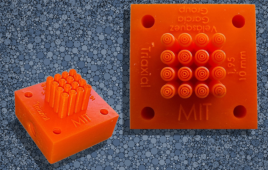
San Diego-based Auxilium Biotechnologies uses 3D printing to manufacture its investigational NeuroSpan Bridge device, which is designed to accelerate nerve regeneration and nerve targeting after debilitating nerve injuries to extremities.
Earlier this year, the company announced successful 3D printing of its miniature implants aboard the ISS using Auxilium’s proprietary biomaterial and 3D bioprinter, the Auxilium Microfabrication Platform (AMP-1).
“On this mission, we plan to print up to 18 of the implants and anticipate using them in preclinical studies on the ground in 2026 and 2027,” Auxilium Biotechnologies CEO Jacob Koffler said in a NASA news release ahead of the launch, which is expected sometime in late August.

Auxilium Biotechnologies designed its NeuroSpan Bridge implant for nerve regeneration. [Image courtesy of Auxilium Biotechnologies]
3D printing in low-earth orbit offers benefits such as increased stability without density gradients or particle settling, Koffler said in a description of the ISS experiment.
“The devices are 3D-printed, and part of the project involves the adaptation of the 3D-printer to operate in microgravity,” he explained. “This is the first time a fast high-resolution 3D-bioprinter is deployed to the space station. The platform allows for single-micron resolution with a printing rate on the scale of minutes (rather than hours/days) to fabricate full scale medical devices. The internal printing components and cartridge have been redesigned to enable printing in microgravity conditions while maintaining adequate containment of the bioink in order to ensure safe operations in space.”
The experiment is expected to run at least to July 2026 on ISS Expedition 73 (currently ongoing) and Expedition 74.
Medical Design & Outsourcing interviewed Koffler about the additive manufacturing technology and its nerve regeneration device in May, shortly after his company enrolled the first patient in the NeuroSpan-1 pivotal study.
Learn more about medtech 3D printing benefits, challenges and applications in this free webinar with me — MDO Managing Editor Jim Hammerand — and my Engineering.com colleague Ian Wright.