Medical Design and Outsourcing

  • Home
  • Medical Device Business
    • Mergers & Acquisitions
    • Financial
    • Regulatory
  • Applications
    • Cardiovascular
    • Devices
    • Imaging
    • Implantables
    • Medical Equipment
    • Orthopedic
    • Surgical
  • Technologies
    • Supplies and Components Index
    • Contract Manufacturing
    • Components
    • Electronics
    • Extrusions
    • Materials
    • Motion Control
    • Prototyping
    • Pumps
    • Tubing
  • MedTech Resources
    • Medtech Events in 2026
    • The 2025 Medtech Big 100
    • Medical Device Handbook
    • MedTech 100 Index
    • Subscribe to Print Magazine
    • DeviceTalks
    • Digital Editions
    • eBooks
    • Educational Assets
    • Manufacturer Search
    • Podcasts
    • Webinars / Digital Events
    • Whitepapers
    • Voices
    • Views
    • Video
  • 2026 Leadership
    • 2025 Winners
    • 2024 Winners
    • 2023 Winners
    • 2022 Winners
    • 2021 Winners
  • Women in Medtech
  • Advertise
  • Subscribe

Battlefield MRI named Top 10 Breakthrough of 2015

December 15, 2015 By DOE/Los Alamos National Laboratory

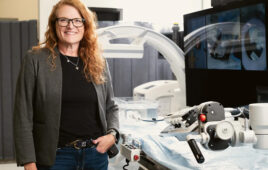
This is Michelle Espy, project leader at Los Alamos National Laboratory, in front of the battlefield MRI, which uses ultra-low-field magnetic resonance imaging to create images of injured soft tissues, such as the brain. (Credit: Los Alamos National Laboratory)

Los Alamos National Laboratory’s portable MRI was named one of the Top 10 Breakthroughs of the Year by Physics World, the member magazine of the Institute of Physics. Portable MRI, also called Battlefield MRI (bMRI), uses ultra-low-field magnetic resonance imaging to create images of injured soft tissues, such as the brain.

“Hospital-based MRI devices are big and expensive,” said Michelle Espy, the bMRI project leader. “And they require considerable infrastructure, like large quantities of liquid nitrogen and helium, and a lot of energy. bMRI doesn’t have those same requirements, making it a much lighter, less expensive and low-power alternative that can be deployed to hard-to-reach places like the battlefield and remote hospitals in poor countries.”

Currently, soldiers wounded in battle must be flown to a large hospital to undergo an MRI, and most people in emerging nations don’t have access to MRI at all. “We’ve been in contact with doctors who routinely work in the Third World and report that MRI would be extremely valuable in treating pediatric encephalopathy, and other serious diseases in children,” said Espy.

Conventional MRI machines use very large magnetic fields that align the protons in water molecules to then create magnetic resonance signals, which are detected by the machine and turned into images. The large magnetic fields create exceptionally detailed images, but they are difficult and expensive to make.

Espy and her team wanted to see if images of sufficient quality could be made with ultra-low-magnetic fields, similar in strength to the Earth’s magnetic field. To achieve images at such low fields they use exquisitely sensitive detectors called Superconducting Quantum Interference Devices, or SQUIDs.

SQUIDs are among the most sensitive magnetic field detectors available, so interference with the signal is the primary stumbling block. “SQUIDs are so sensitive they’ll respond to a truck driving by outside or a radio signal 50 miles away,” said Al Urbaitis, a bMRI engineer. The team’s first generation bMRI had to be built in a large metal housing in order to shield it from interference.

By the end of the internally funded project the Los Alamos team was also working in the open environment without the large metal housing using a lightweight series of wire coils that surround the bMRI system to compensate the Earth’s magnetic field. In the future, the field compensation system will also function similar to noise-cancelling headphones to eradicate invading magnetic field signals on-the-fly.

“We’re very honored that Physics World has recognized bMRI as a Breakthrough of the Year,” said Per Magnelind, a scientist at Los Alamos who works on bMRI. “We’re hopeful that, with additional development through external follow-on funding, bMRI systems could become relatively easy and inexpensive to deploy.”

Related Articles Read More >

A photo of the Paradromics Connexus brain-computer interface on a fingertip.
How Paradromics designed its Connexus brain-computer interface system
A photo of Conexeu Sciences co-founder and Chief Scientific Officer Dr. Claudia Chavez-Munoz.
This tissue engineering scientist is bioprinting next-gen absorbable implants
An image of the September 2026 Medical Design & Outsourcing magazine featuring the Medtech Big 100 ranking of the world's largest medical device companies.
September 2026 issue: The MDO Medtech Big 100 breaks $500 billion
A photo of Capstan Medical CEO Maggie Nixon posing with the structural heart startup's robotic catheter delivery system.
Capstan Medical CEO Maggie Nixon’s career advice, travel tips and how she starts her day
“mdo
EXPAND YOUR KNOWLEDGE AND STAY CONNECTED
Get the latest medical device business news, application and technology trends.

DeviceTalks Weekly

See More >

MDO Digital Edition

Digital Edition

Subscribe to Medical Design & Outsourcing. Bookmark, share and interact with the leading medical design engineering magazine today.

MEDTECH 100 INDEX

Medtech 100 logo
Market Summary > Current Price
The MedTech 100 is a financial index calculated using the BIG100 companies covered in Medical Design and Outsourcing.

New MedTech Resource

Medical Tubing

MassDevice

Mass Device

The Medical Device Business Journal. MassDevice is the leading medical device news business journal telling the stories of the devices that save lives.

Visit Website
MDO ad
Medical Design and Outsourcing
  • MassDevice
  • DeviceTalks
  • MedTech100 Index
  • Medical Tubing + Extrusion
  • Medical Design Sourcing
  • Drug Delivery Business News
  • Drug Discovery & Development
  • Pharmaceutical Processing World
  • R&D World
  • About Us/Contact
  • Advertise With Us
  • Subscribe to Print Magazine
  • Subscribe to our E-Newsletter
  • Listen to our Weekly Podcasts
  • Join our DeviceTalks Tuesdays Discussion

Copyright © 2026 Arrowfly, LLC. All Rights Reserved. The material on this site may not be reproduced, distributed, transmitted, cached or otherwise used, except with the prior written permission of Arrowfly LLC. Site Map | Privacy Policy | RSS

Search Medical Design & Outsourcing

  • Home
  • Medical Device Business
    • Mergers & Acquisitions
    • Financial
    • Regulatory
  • Applications
    • Cardiovascular
    • Devices
    • Imaging
    • Implantables
    • Medical Equipment
    • Orthopedic
    • Surgical
  • Technologies
    • Supplies and Components Index
    • Contract Manufacturing
    • Components
    • Electronics
    • Extrusions
    • Materials
    • Motion Control
    • Prototyping
    • Pumps
    • Tubing
  • MedTech Resources
    • Medtech Events in 2026
    • The 2025 Medtech Big 100
    • Medical Device Handbook
    • MedTech 100 Index
    • Subscribe to Print Magazine
    • DeviceTalks
    • Digital Editions
    • eBooks
    • Educational Assets
    • Manufacturer Search
    • Podcasts
    • Webinars / Digital Events
    • Whitepapers
    • Voices
    • Views
    • Video
  • 2026 Leadership
    • 2025 Winners
    • 2024 Winners
    • 2023 Winners
    • 2022 Winners
    • 2021 Winners
  • Women in Medtech
  • Advertise
  • Subscribe