Medical Design and Outsourcing

  • Home
  • Medical Device Business
    • Mergers & Acquisitions
    • Financial
    • Regulatory
  • Applications
    • Cardiovascular
    • Devices
    • Imaging
    • Implantables
    • Medical Equipment
    • Orthopedic
    • Surgical
  • Technologies
    • Supplies and Components Index
    • Contract Manufacturing
    • Components
    • Electronics
    • Extrusions
    • Materials
    • Motion Control
    • Prototyping
    • Pumps
    • Tubing
  • MedTech Resources
    • Medtech Events in 2026
    • The 2026 Medtech Big 100
    • Medical Device Handbook
    • MedTech 100 Index
    • Subscribe to Print Magazine
    • DeviceTalks
    • Digital Editions
    • eBooks
    • Educational Assets
    • Manufacturer Search
    • Podcasts
    • Webinars / Digital Events
    • Whitepapers
    • Voices
    • Views
    • Video
  • 2026 Leadership
    • 2025 Winners
    • 2024 Winners
    • 2023 Winners
    • 2022 Winners
    • 2021 Winners
  • Women in Medtech
  • Advertise
  • Subscribe

Noninvasive sepsis SaMD developed at Johns Hopkins offers early warnings

It's the first FDA-cleared system for continuous AI/machine learning-based sepsis monitoring.

July 17, 2026 By Skyler Rivera

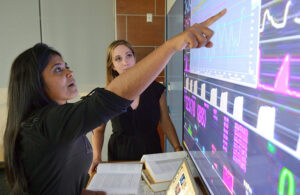
A photo of Suchi Saria pointing at the Bayesian Health Sepsis Flagging Device technology.

Bayesian Health co-founder and CEO Suchi Saria (left) began working on sepsis technology after her nephew died of sepsis in 2017. [Photo courtesy of Johns Hopkins University]

An early warning system for sepsis developed by Johns Hopkins University researchers was commercialized by Bayesian Health and cleared by the FDA.

The software as a medical device (SaMD) is the first continuous artificial intelligence/machine learning-based sepsis monitoring system to earn FDA clearance. The system detects sepsis hours faster than doctors and has reduced deaths by nearly 20%, according to a research study published in Nature Medicine.

“Pre-suspicion screening is what creates lead time, and lead time is what changes outcomes in sepsis. Once a clinician already suspects sepsis, the clock has been running — often for hours or even days,” lead researcher and Bayesian Health co-founder and CEO Suchi Saria said in a news release. “No other cleared test or device monitors for sepsis prior to clinician suspicion.”

She and her team designed the Bayesian Health Sepsis Flagging Device to assist clinicians in early sepsis detection and/or risk prediction of a patient developing sepsis within 24-hours by analyzing patient data from electronic health records, according to their FDA submission.

The 2026 MDO Medtech Startups Special Report: Technical tips and actionable advice for device startups

The system uses a machine learning algorithm to analyze patient data from health records, such as comorbidities, chief complaint, lab measurements, vital signs, procedures, medications and consult orders. If the patient is at risk of developing sepsis within 24 hours, it displays a “Sepsis Risk High” flag in the patient’s electronic health record.

The software provides a summary of clinical factors potentially contributing to the patient being flagged for sepsis risk for a healthcare provider to incorporate into their clinical decision-making.

Other FDA-cleared sepsis technologies require a clinician to suspect sepsis first before using biomarker-based diagnostic blood tests or calculating sepsis risk using software and the blood test results.

“Catching sepsis before a clinician suspects it is a needle-in-a-haystack problem. Sepsis prevalence in acute care is just 2 to 4 percent, while traditional diagnostic tests run at 20 to 40 percent on patients already suspected of having it. Missing a single case is catastrophic, and that demands a level of precision most AI can’t meet, even tools that look promising in preliminary studies,” Bayesian Health Head of Clinical Enterprise Dr. Neri Cohen said in a news release.

“Few companies have done the rigorous data science and independent validation required to meet that bar,” he continued. “Fewer still have done the equally rigorous work that has to follow: building it into clinical workflows, earning clinician adoption at the bedside, and measuring outcomes long enough to know it’s still working.”

MDO Contribution: Designing SaMD for safety and rethinking risk management through system architecture

Saria began working on sepsis technology after her nephew died of sepsis in 2017. Soon, Saria and her team at Johns Hopkins created a version of the sepsis monitoring tool (then called the Targeted Real-Time Early Warning system), which integrated electronic health records with advanced clinical AI to help clinicians detect sepsis cases nearly two to 48 hours earlier than traditional methods, the university said.

The system earned FDA Breakthrough Device designation in 2013 and was integrated in select U.S. hospitals, “where it significantly reduced in-hospital mortality, morbidity, and length of stays for patients with sepsis,” Johns Hopkins said.

With FDA clearance, Bayesian Health can begin commercialization, and hospitals using the system could receive Medicare and Medicaid reimbursement under the New Technology Add-on Payment program starting in October 2026.

“FDA [clearance] is a regulatory first that shifts what the standard of care can be for a condition associated with roughly one in three in-hospital deaths,” Saria said. “This represents decades of clinical AI research at Johns Hopkins translated into practice — not just models built in the lab, but technology delivered where it matters: at the bedside.”

About The Author

Skyler Rivera

Skyler Rivera is an associate editor at Arrowfly, covering medical device industry news and technology at MassDevice and Medical Design & Outsourcing. She began her career covering sports at The Athletic and MLB before transitioning to medical writing at Edwards Lifesciences. Based in Southern California, she holds a master's degree in science writing from Johns Hopkins University and a bachelor’s in broadcast journalism from Syracuse University. Connect with her on LinkedIn or email at [email protected].

Related Articles Read More >

The 1.84 volt paper battery (brown circle structure) was tested in pigs with a bioabsorbable radio-frequency identification (RFID) device.
MIT researchers develop bioresorbable batteries for ingestible medical devices
A photo of an Oura Ring 5.
Oura discloses pay packages for top executives ahead of IPO
Johnson & Johnson MedTech's Ottava in a mock OR
J&J’s standardized surgical site classification system may improve patient outcomes
MIT researchers create breathable hydrogel for less irritation and longer wear 
“mdo
EXPAND YOUR KNOWLEDGE AND STAY CONNECTED
Get the latest medical device business news, application and technology trends.

DeviceTalks Weekly

See More >

MDO Digital Edition

Digital Edition

Subscribe to Medical Design & Outsourcing. Bookmark, share and interact with the leading medical design engineering magazine today.

MEDTECH 100 INDEX

Medtech 100 logo
Market Summary > Current Price
The MedTech 100 is a financial index calculated using the BIG100 companies covered in Medical Design and Outsourcing.

New MedTech Resource

Medical Tubing

MassDevice

Mass Device

The Medical Device Business Journal. MassDevice is the leading medical device news business journal telling the stories of the devices that save lives.

Visit Website
MDO ad
Medical Design and Outsourcing
  • MassDevice
  • DeviceTalks
  • MedTech100 Index
  • Medical Tubing + Extrusion
  • Medical Design Sourcing
  • Drug Delivery Business News
  • Drug Discovery & Development
  • Pharmaceutical Processing World
  • R&D World
  • About Us/Contact
  • Advertise With Us
  • Subscribe to Print Magazine
  • Subscribe to our E-Newsletter
  • Listen to our Weekly Podcasts
  • Join our DeviceTalks Tuesdays Discussion

Copyright © 2026 Arrowfly, LLC. All Rights Reserved. The material on this site may not be reproduced, distributed, transmitted, cached or otherwise used, except with the prior written permission of Arrowfly LLC. Site Map | Privacy Policy | RSS

Search Medical Design & Outsourcing

  • Home
  • Medical Device Business
    • Mergers & Acquisitions
    • Financial
    • Regulatory
  • Applications
    • Cardiovascular
    • Devices
    • Imaging
    • Implantables
    • Medical Equipment
    • Orthopedic
    • Surgical
  • Technologies
    • Supplies and Components Index
    • Contract Manufacturing
    • Components
    • Electronics
    • Extrusions
    • Materials
    • Motion Control
    • Prototyping
    • Pumps
    • Tubing
  • MedTech Resources
    • Medtech Events in 2026
    • The 2026 Medtech Big 100
    • Medical Device Handbook
    • MedTech 100 Index
    • Subscribe to Print Magazine
    • DeviceTalks
    • Digital Editions
    • eBooks
    • Educational Assets
    • Manufacturer Search
    • Podcasts
    • Webinars / Digital Events
    • Whitepapers
    • Voices
    • Views
    • Video
  • 2026 Leadership
    • 2025 Winners
    • 2024 Winners
    • 2023 Winners
    • 2022 Winners
    • 2021 Winners
  • Women in Medtech
  • Advertise
  • Subscribe