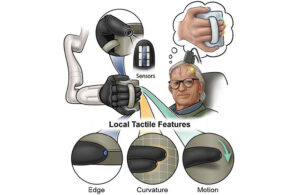
Pitt researchers are working on technology for prosthetics that enable confident handling of everyday objects and responses to shifting stimuli. [Image courtesy of Pitt]
The BCI technology could enable people to feel the shape and movement of objects over the “skin” of a bionic hand. Researchers published their study findings in Nature Biomedical Engineering and Science. The outcomes demonstrate the progress of a technology designed to recreate realistic tactile feedback to prosthetic hands by direct, carefully timed electrical stimulation of the brain.
Researchers from the University of Chicago lead the group. It also includes scientists and engineers at Northwestern University, Case Western Reserve University and BCI maker Blackrock Neurotech. The University of Pittsburgh RNEL have teamed up before on BCI work, working on a BCI for remote trials back in 2022.
Together, the scientists and engineers are designing, building, implementing and refining BCI devices and robotic prosthetic arms. These technologies could restore both movement control and sensation in those who lost significant limb function.
“We hope to integrate the results of these two studies into our robotics systems, where we have already shown that even simple stimulation strategies can improve people’s abilities to control robotic arms with their brains,” said co-author Robert Gaunt, associate professor of physical medicine and rehabilitation and lead of the stimulation work at Pitt.

BCI study co-author Robert Gaunt, associate professor of physical medicine and rehabilitation and lead of the stimulation work at Pitt [Image courtesy of Pitt]
Testing revealed that participants felt a stronger, clearer touch when the system stimulated two closely spaced electrodes. This improved their ability to locate and gauge pressure on the correct part of the hand. The complementary paper published in outlined how scientists identified pairs or clusters of electrodes whose “touch zones” overlapped. The scientists activated them in carefully orchestrated patterns, generating sensations that progressed across the sensory map. This created sensations that let users feel the boundaries of an object or the motion of something sliding along their skin.
The researchers hope that the advancements could pave way for prosthetics that enable confident handling of everyday objects and responses to shifting stimuli.




