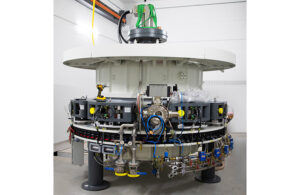
BGS said its newest e-beam accelerator offers “precision beam current, higher sustainability, and utmost reliability, enabling precise dosing at high throughput rates.” [Photo courtesy of BGS]
Starting in mid 2025, the 100,000-ft² plant will offer fully automated electron-beam (e-beam) sterilization in Imperial, Pennsylvania, near Pittsburgh International Airport. The facility will serve manufacturers of medical devices, pharmaceutical packaging, and biotechnology products.
Crews lowered the e-beam accelerator through the roof of the facility with a crane (you can watch video of that process at the end of this post). BGS said the unit offers “precision beam current, higher sustainability, and utmost reliability, enabling precise dosing at high throughput rates.”
The accelerator consumes 30% less energy than other high voltage accelerators when converting electricity into e-beam power, BGS said, which “makes electron sterilization an efficient, environmentally friendly, and economical sterilization method.”
“Installation of the accelerator brings us closer to becoming operational,” BGS US GM Leonard Zuba said in a news release. “It also demonstrates our team’s ability to work together to achieve goals according to plan. The collaborative approach we used to ensure timely installation of the accelerator is the same one that we will use to serve customers from throughout the Northeast, Midwest, and South.”

BGS Beta-Gamma-Service is opening an electron-beam (e-beam) sterilization facility for medical devices in Imperial, Pennsylvania. [Photo courtesy of BGS]
E-beam sterilization is one of the least-used but fastest-growing medical device sterilization methods due to its speed, effectiveness and relative safety. It’s an alternative to ethylene oxide (EtO or EO), which is by far the most common sterilization method but has come under new rules and regulations due to the risk of EtO emissions to facility workers and neighbors.
Related: Steris discloses hundreds of ethylene oxide lawsuits over device sterilization plant
Gamma ray sterilization is another radiation sterilization alternative to EtO, but it requires Colbalt-60. That isotope’s radioactivity makes it a sabotage target and key ingredient in a hypothetical dirty bomb, a terror risk that spurred the Department of Energy’s National Nuclear Security Administration to encourage non-radioactive alternatives for medical device sterilization. Gamma ray sterilizers need Cobalt-60 replenishment annually, and it can take years to obtain for a new facility.
“For decades, ethylene oxide (EtO) sterilization has been the preferred sterilization method of medical device manufacturers,” BGS said in the news release. “In recent years, growing awareness of the environmental hazards associated with the technology, along with an increasingly difficult-to-obtain supply of Cobalt-60 for gamma sterilization, have threatened domestic sterilization capacity. Technologies such as E-Beam sterilization that use concentrated beams of electrons to sterilize products are practical alternatives that can alleviate supply chain bottlenecks.”
The privately held company says it has more than 200 employees and three facilities in Germany: Bruchsal in Baden-Wuerttemberg, Saal an der Donau in Baviaria, and its Wiehl headquarters in North Rhine-Westphalia.