Profiling the genes of lung-tumor cells from patient blood samples may be a cheap, noninvasive way to help doctors choose the right treatments, according to a study led by researchers at the Stanford University School of Medicine.
The new findings strengthen the hope that evaluating the genetic profiles of tumor cells circulating in the bloodstream could transform cancer care: first, by indicating the next chemotherapy or targeted therapy to use when tumors evolve resistance to previous drugs; and, second, by providing a way to study how tumors change over time.
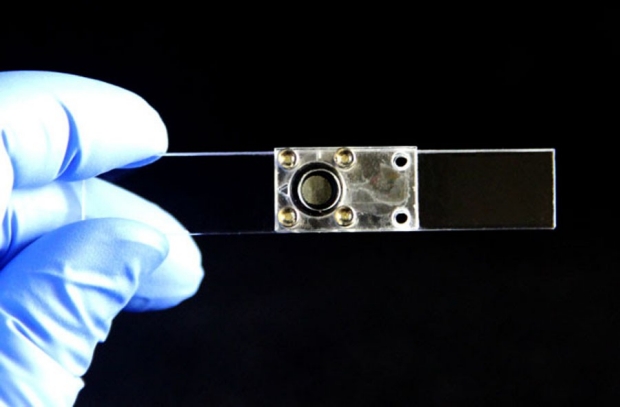
A MagSifter chip, shown here fastened to an acrylic holder, can purify circulating tumor cells from the blood of cancer patients. (Credit: Seung-min Park)
The new blood test is safer, cheaper, faster and more effective than alternative diagnostic approaches, said the researchers.
The researchers created a system for isolating circulating tumor cells from the blood of cancer patients and reading a handful of genes from inside each tumor cell. Thus, they were able to obtain genetic information about the original cancer tumor that resides deep in the lungs without doing a biopsy, which can be dangerous for the patient.
“We are trying to make minimally invasive technology that allows us to continuously monitor one person’s health over time,” said radiology instructor Seung-min Park, PhD, a lead author of the new study, which was published online Dec. 12 in the Proceedings of the National Academy of Sciences. Park shares lead authorship of the study with former Stanford graduate students Dawson Wong, PhD, and Chin Chun Ooi.
Tumor changes
It’s common for cancer therapies to fail after a few months, often because the cancer evolves resistance to the treatment. At that point, it’s important to understand how the patient’s tumor is changing. “Without a biopsy and genetic profiling, we are flying blind, trying to select a second or third option for therapy and hoping it works,” Park said. But repeated lung biopsies are too hard on patients. Even CT scans, performed to see whether a tumor is shrinking or growing, increase the body’s exposure to damaging X-rays. “Blood-based monitoring would allow us to select the right second and third therapies instead of flying blind,” he said.
Finding a way to look at circulating tumor cells, or CTCs, in the blood has been a goal of oncologists for years. When people die of cancer, it’s usually from metastasis, the spread of tumors throughout the body. Part of metastasis is the entry of tumor cells into the bloodstream, where they circulate along with normal blood cells, eventually landing in other organs and initiating tumors there. In general, the presence of CTCs in the blood of cancer patients predicts patients will live for a shorter time.
“This work fits well into our bigger vision of using blood-based diagnostics to detect and manage disease, including cancer,” said Sanjiv “Sam” Gambhir, MD, PhD professor and chair of radiology and the Virginia and D.K. Ludwig Professor in Cancer Research. “By being able to characterize single CTCs, we believe cancer management, including predicting response to therapy, will be much better optimized.”
Gambhir shares senior authorship of the study with Shan Wang, PhD, professor of materials science and engineering and of electrical engineering, and Viswam Nair, MD, clinical assistant professor of medicine and of radiology.
How it’s done
The blood typically contains very few CTCs, so one of the challenges for oncologists has been to separate them from ordinary blood cells. The new technique involves taking blood from lung cancer patients and then attaching antibodies to circulating tumor cells. Once the cancer cells are labeled, the team introduces magnetic nanoparticles designed to attach to the antibodies labeling the cancer cells. With each individual cancer cell labeled with a magnetic nanoparticle, the researchers can then use a device called a magnetic sifter, or MagSifter, previously developed by Wang.
The MagSifter is an electromagnetic sieve that can be turned on and off. When the MagSifter is on, it pulls the nanoparticle-labeled CTCs from the blood sample and allows the rest of the blood to flow through the sifter. The CTCs pulled from the blood are then deposited into a flat array of tiny wells, each large enough for only one cell. Now the tumor cells are ready for genetic analysis. Each flat of 25,600 wells looks like a miniature muffin tin, with room for a lot of tiny muffins.
The new technique serves as a proof of concept for collecting and analyzing lung cancer cells from blood samples. If the technique receives approval from the Food and Drug Administration, it could be used to tell how cancer cells have evolved in response to chemotherapy and which drug is the best to use next in individual patients.
In principle, the technique should work just as well with other kinds of cancers, Wong said. “We validated our device on lung cancer because of the difficulties of doing lung biopsies,” he said. “But the technology is not limited to profiling lung cancer. We could swap out markers and adapt the technique to other types of cancers.”
Cost of less than $30
The approach that the team developed could be used to look at mutations in three or four genes, and it requires no more than 2 milliliters of blood — about half a teaspoon. The test can be completed in about five hours, the researcher said, and costs less than $30. For comparison, a single state-of-the art biopsy of lung tissue with DNA sequencing costs about $18,000 and takes as long as three weeks to furnish results. Johnson & Johnson’s CellSearch — another blood test, already approved by the FDA — costs about $900 and takes a week to deliver results.
“We feel that we have solved a lot of the technical hurdles,” said Wong. “The blood draw is cheap enough and noninvasive enough that it could be done on a weekly basis throughout treatment.”
The team’s work is an example of Stanford Medicine’s focus on precision health, the goal of which is to anticipate and prevent disease in the healthy and precisely diagnose and treat disease in the ill.
Other Stanford co-authors are graduate students David Kurtz, MD, Amin Aalipour and Jacob Chabon; postdoctoral scholar Ophir Vermesh, MD, PhD; research assistants Kelsey Pian and Justin Carter; former research assistant Susie Suh; instructor of radiology Mehran Jamali, MD; clinical research associate Carmen Say; professor of medicine Ware Kuschner, MD; professor of medicine Erich Schwartz, MD; professor of cardiothoracic surgery Joseph Shrager, MD; assistant professor of medicine Joel Neal, MD, PhD; associate professor of medicine Heather Wakelee, MD; and assistant professor of radiation oncology Maximilian Diehn, MD, PhD.



