Medical Design and Outsourcing

  • Home
  • Medical Device Business
    • Mergers & Acquisitions
    • Financial
    • Regulatory
  • Applications
    • Cardiovascular
    • Devices
    • Imaging
    • Implantables
    • Medical Equipment
    • Orthopedic
    • Surgical
  • Technologies
    • Supplies and Components Index
    • Contract Manufacturing
    • Components
    • Electronics
    • Extrusions
    • Materials
    • Motion Control
    • Prototyping
    • Pumps
    • Tubing
  • MedTech Resources
    • Medtech Events in 2026
    • The 2026 Medtech Big 100
    • Medical Device Handbook
    • MedTech 100 Index
    • Subscribe to Print Magazine
    • DeviceTalks
    • Digital Editions
    • eBooks
    • Educational Assets
    • Manufacturer Search
    • Podcasts
    • Webinars / Digital Events
    • Whitepapers
    • Voices
    • Views
    • Video
  • 2026 Leadership
    • 2025 Winners
    • 2024 Winners
    • 2023 Winners
    • 2022 Winners
    • 2021 Winners
  • Women in Medtech
  • Advertise
  • Subscribe

Body Heat as a Power Source: Wearable Integrated Thermocells Based on Gel Electrolytes Use Body Heat

September 1, 2016 By Huazhong University of Science and Technology

Electronics integrated into textiles are gaining in popularity: Systems like smartphone displays in a sleeve or sensors to detect physical performance in athletic wear have already been produced. The main problem with these systems tends to be the lack of a comfortable, equally wearable source of power. Chinese scientists are now aiming to obtain the necessary energy from body heat. In the journal Angewandte Chemie, they have introduced a flexible, wearable thermocell based on two different gel electrolytes.

Our muscle activity and metabolism cause our bodies to produce constant heat, some of which is released through the skin into the environment. Because of the relatively small temperature difference between skin (approximately 32°C) and the temperature of our surroundings, it is not so easy to make use of body heat. Previous thermoelectric generators, such as those based on semiconductors, produce too little energy, are costly, or are too brittle for use in wearable systems. Thermocells with electrolyte solutions are difficult to integrate into extensive wearable systems. A team led by Jun Zhou at Huazhong University of Science and Technology (Wuhan, China) has now found a solution to this problem: thermocells with gel-based electrolytes.

The researchers are making use of the thermogalvanic effect: if two electrodes in contact with an electrolyte solution—or an electrolyte gel—are kept at different temperatures, a potential difference is generated. The ions of a redox pair in the electrolyte can rapidly switch between two different charge states, accepting or releasing electrons at electrodes with different temperature. In order to use this to produce a current, the scientists combined two types of cells containing two different redox pairs. Each cell consists of two tiny metal plates that act as electrodes, with an electrolyte gel in between. The first cell type contains the Fe2+/Fe3+ redox pair. The second type of cell contains the complex ions [Fe(CN)6]3−/[Fe(CN)6]4−. Because of the choice of these redox pairs, in cell type 1, the cold end gives a negative potential, while in type 2, the cold end gives a positive potential.

The researchers arranged many of these two types of cells into a checkerboard pattern. The cells were connected to each other by metal plates alternating above and below, to link them into a series. They then integrated this “checkerboard” into a glove. When the glove is worn, the desired temperature difference results between the upper and lower plates. This produces a voltage between neighboring cells, and the voltage adds up. This makes it possible to generate current to power a device or charge a battery.

In an environment at 5 °C, it was possible to produce 0.7 volts and about 0.3 µW. By optimizing this system, it should be possible to improve the power, even with smaller temperature gradients.


Related Articles Read More >

The most innovative medical devices of 2026
Reconstructed 3D fluorescence image of the stained biohybrid mesh-tissue integration. The red, green, and blue colors correspond to the mesh, F-actin, and nuclei, respectively.
Researchers mesh electronics with human cells to develop living battery
A photo of the Paradromics Connexus brain-computer interface on a fingertip.
How Paradromics designed its Connexus brain-computer interface system
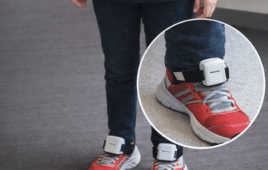
A photo of the wearable gait sensors used in the study.
Yale-led study finds wearable sensors match motion capture for gait tracking in knee osteoarthritis
“mdo
EXPAND YOUR KNOWLEDGE AND STAY CONNECTED
Get the latest medical device business news, application and technology trends.

DeviceTalks Weekly

See More >

MDO Digital Edition

Digital Edition

Subscribe to Medical Design & Outsourcing. Bookmark, share and interact with the leading medical design engineering magazine today.

MEDTECH 100 INDEX

Medtech 100 logo
Market Summary > Current Price
The MedTech 100 is a financial index calculated using the BIG100 companies covered in Medical Design and Outsourcing.

New MedTech Resource

Medical Tubing

MassDevice

Mass Device

The Medical Device Business Journal. MassDevice is the leading medical device news business journal telling the stories of the devices that save lives.

Visit Website
MDO ad
Medical Design and Outsourcing
  • MassDevice
  • DeviceTalks
  • MedTech100 Index
  • Medical Tubing + Extrusion
  • Medical Design Sourcing
  • Drug Delivery Business News
  • Drug Discovery & Development
  • Pharmaceutical Processing World
  • R&D World
  • About Us/Contact
  • Advertise With Us
  • Subscribe to Print Magazine
  • Subscribe to our E-Newsletter
  • Listen to our Weekly Podcasts
  • Join our DeviceTalks Tuesdays Discussion

Copyright © 2026 Arrowfly, LLC. All Rights Reserved. The material on this site may not be reproduced, distributed, transmitted, cached or otherwise used, except with the prior written permission of Arrowfly LLC. Site Map | Privacy Policy | RSS

Search Medical Design & Outsourcing

  • Home
  • Medical Device Business
    • Mergers & Acquisitions
    • Financial
    • Regulatory
  • Applications
    • Cardiovascular
    • Devices
    • Imaging
    • Implantables
    • Medical Equipment
    • Orthopedic
    • Surgical
  • Technologies
    • Supplies and Components Index
    • Contract Manufacturing
    • Components
    • Electronics
    • Extrusions
    • Materials
    • Motion Control
    • Prototyping
    • Pumps
    • Tubing
  • MedTech Resources
    • Medtech Events in 2026
    • The 2026 Medtech Big 100
    • Medical Device Handbook
    • MedTech 100 Index
    • Subscribe to Print Magazine
    • DeviceTalks
    • Digital Editions
    • eBooks
    • Educational Assets
    • Manufacturer Search
    • Podcasts
    • Webinars / Digital Events
    • Whitepapers
    • Voices
    • Views
    • Video
  • 2026 Leadership
    • 2025 Winners
    • 2024 Winners
    • 2023 Winners
    • 2022 Winners
    • 2021 Winners
  • Women in Medtech
  • Advertise
  • Subscribe