
Boston Scientific’s investigational Farawave Ultra pulsed-field ablation (PFA) and mapping catheter is shown here in the flower configuration. [Image courtesy of Boston Scientific]
The device developer plans to launch its third-generation Farawave Ultra PFA catheter in the first half of 2027, following up on the Farawave PFA ablation catheter that won FDA approval in January 2024 and the Farapoint PFA catheter that was approved in January 2026.
MDO Min-Vasive Medtech: Join us Aug. 18-20 to learn minimally invasive medtech tips and tricks from experts in robotics, imaging and cardiac devices
Boston Scientific is also developing the investigational Faraflex PFA catheter that combines ablation and mapping, with the goal of making it commercially available in 2028.
“Electrophysiologists love mapping,” Boston Scientific EVP and Atrial Fibrillation Solutions President Nick Spadea-Anello said in a Medical Design & Outsourcing interview.
“They love to map because it gives them more information, and they feel like they get more precision in being able to ablate these arrhythmia,” he continued. “The next-gen Farawave Ultra will have higher-definition fidelity for mapping as well as the excellence and the experience we’ve seen with hundreds of thousands of patients.”
Boston Scientific will soon — if it hasn’t already — hit 1 million patients treated with its PFA technology. The company’s Farawave device is the most prescribed catheter in the world for PFA, a minimally invasive catheter procedure EPs use to treat atrial fibrillation (AF or AFib) by scarring heart tissue to block irregular heart signals. The nitinol-enabled catheter uses the nickel-titanium alloy’s superelastic properties to deploy inside the heart in the shape of a flower or a basket.
MDO Nitinol Innovations Special Report: Pulsed-field ablation tech and tips from Boston Scientific, Medtronic, J&J and Abbott
PFA is one of the fastest growing medtech markets and still relatively new. Medtronic’s PulseSelect PFA system won the race to FDA approval in December 2023 and added to its portfolio with Affera catheters as Johnson & Johnson MedTech and Abbott developed and launched their own systems.

The investigational third-gen Farawave Ultra PFA catheter is similar in appearance to the Boston Scientific Farawave PFA catheter pictured here. [Image courtesy of Boston Scientific]
The following has been lightly edited for length and clarity.
MDO: You’re selling PFA catheters against competing technology. Why should EPs pick yours?

Boston Scientific EVP and Atrial Fibrillation Solutions President Nick Spadea-Anello [Photo courtesy of Boston Scientific]
“Why us? We’ve done the most. We were the pioneer of the technology. We were the first in the world to offer it to patients and it’s the most studied device in the world. It’s not just the catheter and the energy, but the waveform in the generator that actually allows that to work differently. All RF energy pretty much works the same in terms of the energy, but the catheters may be slightly different and the mapping may be slightly different. We’ve disrupted the space because it was primarily RF with some cryo, and now you’re looking at high percentages — we think 70% plus to be PFA, and that’s going to be probably approaching 80% plus PFA in the U.S. here in the coming year or two. We’re excited because we were behind all of that and we transformed the space. We like for people to believe that what we know in creating the waveform that’s safe and effective is truly differentiating, and the body of evidence that we have that supports that.”
Everyone likes to keep the details of their waveform secret, but what’s special about yours?

Boston Scientific is also developing the investigational Faraflex PFA and mapping catheter pictured here. [Image courtesy of Boston Scientific]
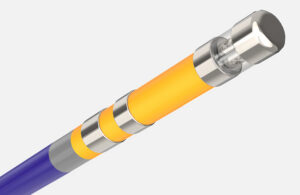
The Boston Scientific Farapoint PFA catheter won FDA approval in January 2026. [Image courtesy of Boston Scientific]
Previously: Brad Sutton on Boston Scientific’s PFA advantage and advice for medtech pros