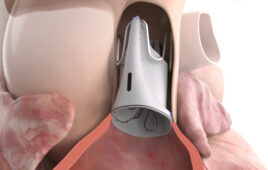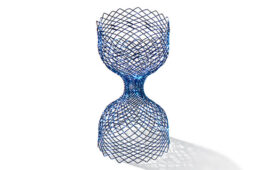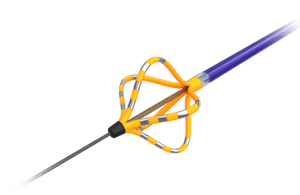
Part of the Farapulse pulsed-field ablation system, the nitinol-enabled Farawave single-shot catheter is designed to create durable and circumferential lesions. [Image courtesy of Boston Scientific]
They won the award for their development and commercialization of the Farapulse pulsed-field ablation (PFA) system to treat atrial fibrillation, now owned, manufactured and sold by Boston Scientific.
Earlier this year, Medical Design & Outsourcing interviewed Dr. Brad Sutton, the chief medical officer of Boston Scientific’s AF Solutions business, about PFA technology (read our earlier articles about Boston Scientific’s next-gen Faraflex PFA and mapping catheter and PFA safety).
Boston Scientific isn’t the only player in the PFA game, with competition from Medtronic, Johnson & Johnson MedTech and Abbott as well as smaller PFA developers such as Pulse Biosciences and Field Medical, which was founded by Farapulse co-founder Dr. Steven Mickelsen.
In this final article from our interview, Sutton explains why he thinks Boston Scientific has an advantage in PFA and offered advice for medical device designers and engineers. The following has been lightly edited for space and clarity.
MDO: What’s Boston Scientific’s advantage in PFA?

Boston Scientific AF Solutions Chief Medical Officer Dr. Brad Sutton [Photo courtesy of Boston Scientific]
“All of those things are variables that result in the safety and efficacy of the therapy. What you’ll see if you look at the specs head-to-head of Farawave versus the other first-gen PFA catheters is many are repurposed radiofrequency (RF) catheters that are loop catheter designs. There are inherent physics properties that limit what you can do with a loop catheter. The physics say you’re going to get a concentrated area of high electrical fields on the inner ring of a loop catheter that predisposes to thermal effect and potentially char, and that can cause strokes.
“At the end of the day, that’s the design, and the Farapulse team — long before Boston Scientific was involved — went through a lot of iterations of design form factors, did a lot of preclinical work. That preclinical to human journey didn’t go well, and they had to refine the waveform. And ultimately they did some really aggressive but critical work. In their early human work, they did three-month validation remaps. [When you] go in and do an ablation, it looks great acutely — they all do with with PFA — but then you don’t really know when you’re developing a waveform how good it’s going to look over time. How durable is the lesion? How long is the effect? Is it a permanent ablation that you’ve done that has permanent effect? And so three months later, they went back in and they electrically mapped the heart again and proved what they did is still durably isolated, still has chronic effect.
“All of those things took a decade to perfect. The notion that you’re going to pull an RF catheter that’s been taken off the market or shelved and not commercially viable as an RF catheter, put some insulation in the shaft, shove 2,000 volts through it and call it PFA, it just doesn’t work very well. And I think that’s what you’re seeing playing out on the market. Then there’s this race of what’s next.
“All those things led to the incredible, purpose-built PFA story of Farapulse and the incredible advantage we have over the competition. I think that’s true in terms of safety. I think it’s true in terms of lesion durability and we have tens of thousands of patients worth of real world evidence to back up what our sponsored trials have shown us. And everybody’s going to continue to get better. We’re learning, the competition’s learning, patients will benefit because we’re collectively getting better as a field. It’s a really exciting time. At the end of the day, what we’re leaving behind is this risk of collateral damage that thermal ablation had as part and parcel of the procedure. Esophageal fistula is hopefully a thing of the past. Pulmonary vein stenosis is hopefully a thing of the past. And that’s good for patients.”
Nitinol innovation: Download our free special report featuring nitinol expertise and tips from medical device OEMs
What advice would you offer to device designers and engineers?
Sutton: “I’m a big fan of design-based thinking and getting out and understanding the customer and their needs. The biggest piece of advice I could offer is to build relationships with physicians or the people using your products, get in cases, talk to them about their daily workflow and the unmet clinical needs, and then work backward from a design standpoint.
“Where I’ve seen our company fail is you’ve got insulated engineers who are the smartest people on the planet developing really cool, sophisticated tools and techniques, and then trying to convince the world that they need them. And the world’s like, ‘Nah, I really don’t need them.’ It has to be the other way around. You have to solve somebody’s problem and design backward from the clinical need.
“The secret sauce of success is to listen to your customer and understand their needs. But also, what I’ve seen is the way companies interact with physicians in the company — employed physicians — varies a lot from company to company. And the physician’s ability to influence the strategic direction of the company and the R&D portfolio varies a lot from company to company.
“When it works best, the clinical team and the engineering team are in lockstep, making one another better and driving one another to be better. You’re really synced in with the early clinical work you’re going to do to validate design or to inform design iterations in addition to the device approval strategy. And then hopefully you have somebody internally who’s a good clinical voice to help guide that journey as you’re bringing things through the development pipeline. If you’re an engineer and you don’t have a good clinician nearby to ping ideas off of, you should find one.”
More from Sutton: What is minimally invasive medtech? Device experts weigh in