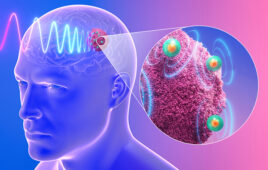
Core symptoms of anorexia nervosa, including the urge to restrict food intake and feeling fat, are reduced after just one session of a non-invasive brain stimulation technique, according to King’s College London research published recently in PLOS ONE.
This new study is the first randomized control trial to assess whether repetitive transcranial stimulation (rTMS), already an approved treatment for depression, is also effective in reducing symptoms of anorexia.
Up to 20 percent of people with anorexia die prematurely from the disorder and treatments in adults are moderately effective, with only 20-30 per cent of people recovering from the best available talking therapies.
Given the urgent need to improve treatments, researchers are increasingly looking towards emerging neuroscience-based technologies that could target the underlying neural basis of anorexia.
Dr. Jessica McClelland, Post-doctoral Researcher at the Institute of Psychiatry, Psychology & Neuroscience (IoPPN), King’s College London, and first author of the study, said: “With rTMS we targeted the dorsolateral prefrontal cortex, an area of the brain thought to be involved in some of the self-regulation difficulties associated with anorexia. This technique alters neural activity by delivering magnetic pulses to specific regions of the brain, which feels like a gentle tapping sensation on the side of the head.
“We found that one session of rTMS reduced the urge to restrict food intake, levels of feeling full and levels of feeling fat, as well as encouraging more prudent decision-making. Taken together, these findings suggest that brain stimulation may reduce symptoms of anorexia by improving cognitive control over compulsive features of the disorder.”
In the study, 49 people completed food exposure and decision-making tasks, both before and after a session of either real or placebo rTMS. Symptoms of anorexia were measured immediately prior to and following rTMS, as well as 20 minutes and 24 hours after the session.
The food exposure task sought to provoke anorexia symptoms by asking participants to watch a two-minute film of people eating appetizing food, such as chocolate and crisps, while the same items were in front of them. They then had to rate the perceived smell, taste, appearance and urge to eat these foods.
For the decision-making task participants had to choose between a smaller, variable amount of money (£0-£100) available immediately and a larger, fixed amount (£100) available after four different time points (a week, month, year or two years).
Compared to the placebo group, they found that participants who had real rTMS showed a tendency for more prudent decision-making – that is, they waited for larger, later rewards (i.e. delayed gratification), rather than choosing the more impulsive smaller, sooner option.
The study authors point out that although these findings were only a statistical trend, there is a clear improvement in symptoms and decision-making abilities following just one session of rTMS. It is likely that with a larger sample and multiple sessions of rTMS these effects would be even stronger.
Professor Ulrike Schmidt, senior author of the study, from the IoPPN at King’s College London, added: “Anorexia nervosa is thought to affect up to 4 per cent of women in their life-time. With increasing illness duration, anorexia becomes entrenched in the brain and increasingly difficult to treat. Our preliminary findings support the potential of novel brain-directed treatments for anorexia, which are desperately needed.
“Given the promising findings from this study, we are now assessing whether rTMS has longer-lasting therapeutic benefits in a world-first clinical trial of rTMS treatment, involving 20 rTMS sessions, in people with anorexia nervosa.”
This study represents independent research part-funded by the National Institute for Health Research (NIHR) Biomedical Research Centre (BRC) at South London and Maudsley NHS Foundation Trust and King’s College London.
The IoPPN’s Eating Disorders Research Group at King’s College London is currently recruiting for a longer-term study of rTMS to examine the neural mechanisms underlying the effects of rTMS. Find out more about the TIARA study: Transcranial magnetic stimulation and Imaging in AnoRexia nervosa.