Medical Design and Outsourcing

  • Home
  • Medical Device Business
    • Mergers & Acquisitions
    • Financial
    • Regulatory
  • Applications
    • Cardiovascular
    • Devices
    • Imaging
    • Implantables
    • Medical Equipment
    • Orthopedic
    • Surgical
  • Technologies
    • Supplies and Components Index
    • Contract Manufacturing
    • Components
    • Electronics
    • Extrusions
    • Materials
    • Motion Control
    • Prototyping
    • Pumps
    • Tubing
  • MedTech Resources
    • Medtech Events in 2026
    • The 2026 Medtech Big 100
    • Medical Device Handbook
    • MedTech 100 Index
    • Subscribe to Print Magazine
    • DeviceTalks
    • Digital Editions
    • eBooks
    • Educational Assets
    • Manufacturer Search
    • Podcasts
    • Webinars / Digital Events
    • Whitepapers
    • Voices
    • Views
    • Video
  • 2026 Leadership
    • 2025 Winners
    • 2024 Winners
    • 2023 Winners
    • 2022 Winners
    • 2021 Winners
  • Women in Medtech
  • Advertise
  • Subscribe

Breakthrough Could Lead to ‘Artificial Skin’ that Senses Touch, Humidity and Temperature

July 16, 2013 By Kevin Hattori, Technion-Israel Institute of Technology

(Illustration courtesy of Prof. Hossam Haick, et al. Technion-Israel institute of Technology)Using tiny gold particles and a kind of resin, a team of scientists at the Technion-Israel Institute of Technology has discovered how to make a new kind of flexible sensor that one day could be integrated into electronic skin, or e-skin. If scientists learn how to attach e-skin to prosthetic limbs, people with amputations might once again be able to feel changes in their environments. The findings appear in the June issue of ACS Applied Materials & Interfaces.

The secret lies in the sensor’s ability to detect three kinds of data simultaneously. While current kinds of e-skin detect only touch, the Technion team’s invention “can simultaneously sense touch, humidity, and temperature, as real skin can do,” says research team leader Professor Hossam Haick. Additionally, the new system “is at least 10 times more sensitive in touch than the currently existing touch-based e-skin systems.”

Researchers have long been interested in flexible sensors, but have had trouble adapting them for real-world use. To make its way into mainstream society, a flexible sensor would have to run on low voltage (so it would be compatible with the batteries in today’s portable devices), measure a wide range of pressures, and make more than one measurement at a time, including humidity, temperature, pressure, and the presence of chemicals. In addition, these sensors would also have to be able to be made quickly, easily, and cheaply.

The Technion team’s sensor has all of these qualities. The secret is the use of monolayer-capped nanoparticles that are only 5-8 nanometers in diameter. They are made of gold and surrounded by connector molecules called ligands. In fact, “monolayer-capped nanoparticles can be thought of as flowers, where the center of the flower is the gold or metal nanoparticle and the petals are the monolayer of organic ligands that generally protect it,” says Haick.

The team discovered that when these nanoparticles are laid on top of a substrate – in this case, made of PET (flexible polyethylene terephthalate), the same plastic found in soda bottles – the resulting compound conducted electricity differently depending on how the substrate was bent. (The bending motion brings some particles closer to others, increasing how quickly electrons can pass between them.) This electrical property means that the sensor can detect a large range of pressures, from tens of milligrams to tens of grams. “The sensor is very stable and can be attached to any surface shape while keeping the function stable,” says Dr. Nir Peled, Head of the Thoracic Cancer Research and Detection Center at Israel’s Sheba Medical Center, who was not involved in the research.

And by varying how thick the substrate is, as well as what it is made of, scientists can modify how sensitive the sensor is. Because these sensors can be customized, they could in the future perform a variety of other tasks, including monitoring strain on bridges and detecting cracks in engines.

“Indeed,” says Dr. Peled, “the development of the artificial skin as biosensor by Professor Haick and his team is another breakthrough that puts nanotechnology at the front of the diagnostic era.”

The research team also included Meital Segev-Bar and Gregory Shuster, graduate students in the Technion’s Russell Berrie Nanotechnology Institute, as well as Avigail Landman and Maayan Nir-Shapira, undergraduate students in the Technion’s Chemical Engineering Department.  Landman and Nir-Shapira are recipients of this year’s Norman and Barbara Seiden Family Prizes For Multidisciplinary Undergraduate Student Projects in Optoelectronics, Microelectronics and Nanosciences.
Related Articles Read More >

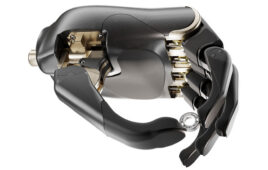
An image of Metacarpal's GEM prosthetic hand.
Prosthetics developer Metacarpal seizes on reliability
A patient stacks wooden blocks using a DEKA advanced prosthetic arm and hand.
Next-gen prosthetics tech developer Blue Arbor hits more milestones
Katzschmann-Filippi_robotic-arm_Soft Robotics Lab_ETH Zurich
Biohybrid solutions could enhance medical robotics, implants
HP showcases breakthrough orthotics and prosthetics case studies
“mdo
EXPAND YOUR KNOWLEDGE AND STAY CONNECTED
Get the latest medical device business news, application and technology trends.

DeviceTalks Weekly

See More >

MDO Digital Edition

Digital Edition

Subscribe to Medical Design & Outsourcing. Bookmark, share and interact with the leading medical design engineering magazine today.

MEDTECH 100 INDEX

Medtech 100 logo
Market Summary > Current Price
The MedTech 100 is a financial index calculated using the BIG100 companies covered in Medical Design and Outsourcing.

New MedTech Resource

Medical Tubing

MassDevice

Mass Device

The Medical Device Business Journal. MassDevice is the leading medical device news business journal telling the stories of the devices that save lives.

Visit Website
MDO ad
Medical Design and Outsourcing
  • MassDevice
  • DeviceTalks
  • MedTech100 Index
  • Medical Tubing + Extrusion
  • Medical Design Sourcing
  • Drug Delivery Business News
  • Drug Discovery & Development
  • Pharmaceutical Processing World
  • R&D World
  • About Us/Contact
  • Advertise With Us
  • Subscribe to Print Magazine
  • Subscribe to our E-Newsletter
  • Listen to our Weekly Podcasts
  • Join our DeviceTalks Tuesdays Discussion

Copyright © 2026 Arrowfly, LLC. All Rights Reserved. The material on this site may not be reproduced, distributed, transmitted, cached or otherwise used, except with the prior written permission of Arrowfly LLC. Site Map | Privacy Policy | RSS

Search Medical Design & Outsourcing

  • Home
  • Medical Device Business
    • Mergers & Acquisitions
    • Financial
    • Regulatory
  • Applications
    • Cardiovascular
    • Devices
    • Imaging
    • Implantables
    • Medical Equipment
    • Orthopedic
    • Surgical
  • Technologies
    • Supplies and Components Index
    • Contract Manufacturing
    • Components
    • Electronics
    • Extrusions
    • Materials
    • Motion Control
    • Prototyping
    • Pumps
    • Tubing
  • MedTech Resources
    • Medtech Events in 2026
    • The 2026 Medtech Big 100
    • Medical Device Handbook
    • MedTech 100 Index
    • Subscribe to Print Magazine
    • DeviceTalks
    • Digital Editions
    • eBooks
    • Educational Assets
    • Manufacturer Search
    • Podcasts
    • Webinars / Digital Events
    • Whitepapers
    • Voices
    • Views
    • Video
  • 2026 Leadership
    • 2025 Winners
    • 2024 Winners
    • 2023 Winners
    • 2022 Winners
    • 2021 Winners
  • Women in Medtech
  • Advertise
  • Subscribe