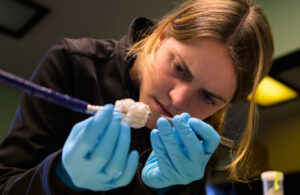
Evelyn Haynes, head of delivery systems and accessories at Capstan Medical, works on the device developer’s catheter-delivered heart valve implant. [Photo courtesy of Capstan Medical]
The startup announced a $110 million Series C funding round with support from investors including Intuitive Ventures, and plans for some high-level hires as it pushes toward its first-in-human procedure.
DeviceTalks Boston: Join Capstan Medical CEO Maggie Nixon and other medtech leaders at our 2025 show
Ahead of that announcement, Capstan Medical CEO Maggie Nixon offered a technical update in an interview with Medical Design & Outsourcing to bring us up to speed on what she and her team have been up to since we last spoke in spring 2024. (The following has been lightly edited for clarity and length.)
MDO: What more can you share about your mitral valve, the robot, and the tricuspid valve? Last time we spoke you were in verification and validation (V&V) on mitral, right?
Nixon: “We’re doing final production of our first-in-human. We’re on the back end of that V&V wave. We’ve got our our robotic architecture set up, our catheter range of motion, and all of that is really been enabling on accessing the locations in the heart that we need to get to optimize the position of our implant. What’s exciting is we’ve been really starting to make it a little easier to use for the clinicians. This is where we’re starting to look at preoperative CT images and map pathways and leverage that technology to navigate into position, make it easier for clinicians to navigate through those pathways. So we’ve got some new coordinated motion control activity that we’ve been able to implement on the control side. And rather than just having pure button presses to move the individual joints, we’ve got coordinated algorithms around that right now. With that, we’re going to be learning so much as we get multiple clinicians with their hands on the devices. We had our clinical advisory board in the last three months pressure testing everything that we’ve implemented, and that’s already fueling what the next-gen device is going to look like. So this first-in-human configuration, we’re locked in on, but this is when all of these different control modes are going to start feeding what our actual user interface needs to look like for this next-gen that will go into the pre-pivotal and pivotal activities? This is where we move away from an Xbox controller into our custom controller based on how you know this user feedback is being leveraged into these control modes. We’ve got that foundational architecture. We know how our device can articulate from point A to point B, and now we get to do some of the smart under-the-hood features to make it user friendly.”
MDO: What’s your biggest challenge there?

Capstan Medical CEO Maggie Nixon [Photo courtesy of Capstan Medical]
MDO: Have you got any technical updates on the tricuspid project?
Nixon: “The excellent thing about tricuspid is there’s so much focus on the tricuspid valve in the structural heart space right now. You’ve seen the TriClip and the Evoque products come into market, and with that, you get all that additional insight. So we’ve made some adjustments into the size of our implant that we’re starting with. We’ve made some adjustments to the geometry and how it collapses down, and we’re moving into the pre-clinical work, the chronic animal implants; we’ve integrated it into our catheter and are moving through our acute animal studies with the device. This will continue all the way through the first half of next year and then move into formal V&V to start those first-in-human cases.”
MDO: The change to the size — are you making the heart valve smaller?
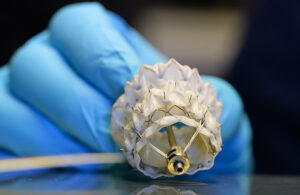
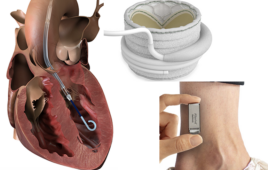
Capstan Medical is developing a robotics platform and catheter-delivered heart implants for mitral and tricuspid valve replacements. [Photo courtesy of Capstan Medical]
MDO: And that size increase doesn’t change the size of your delivery catheter, right?
Nixon: “No, it’s the size of the frame. It still collapses down to the same size.”
MDO: What about the change in geometry, can you explain that more?
Nixon: “The left side of the heart with the mitral valve and the right side of the heart with the tricuspid valve are really different. First and foremost, the pressures are really different. In the tricuspid valve, the pressures are a lot lower so you don’t need the same rigidity and retention structure around it. That gives you some flexibility to navigate a few different geometries on that front. And so we’re still trying to stay compatible with a variety of anatomies, but we’re doing that by keeping our implant nice and compliant so it can conform to the existing anatomy. You can do that a little bit easier on the right side of the heart, just because of those lower pressures. You don’t have the retention kind of demands that you do on the left side of the heart.”
MDO: And you’re getting that compliance from the nitinol frame?
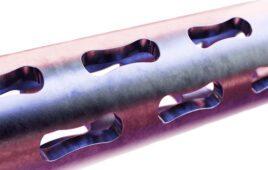
Nixon: “Yep, we use self-expanding nitinol for both of our implants.”
Free webinar: Nitinol knowledge with former Edwards Lifesciences Engineering SVP Ming Wu
MDO: Are you developing a single robot for both of the heart valve implants?

This photo shows the articulated end of Capstan Medical’s delivery catheter and the compressed mitral valve implant. [Photo courtesy of Capstan Medical]