Medical Design and Outsourcing

  • Home
  • Medical Device Business
    • Mergers & Acquisitions
    • Financial
    • Regulatory
  • Applications
    • Cardiovascular
    • Devices
    • Imaging
    • Implantables
    • Medical Equipment
    • Orthopedic
    • Surgical
  • Technologies
    • Supplies and Components Index
    • Contract Manufacturing
    • Components
    • Electronics
    • Extrusions
    • Materials
    • Motion Control
    • Prototyping
    • Pumps
    • Tubing
  • MedTech Resources
    • Medtech Events in 2026
    • The 2026 Medtech Big 100
    • Medical Device Handbook
    • MedTech 100 Index
    • Subscribe to Print Magazine
    • DeviceTalks
    • Digital Editions
    • eBooks
    • Educational Assets
    • Manufacturer Search
    • Podcasts
    • Webinars / Digital Events
    • Whitepapers
    • Voices
    • Views
    • Video
  • 2026 Leadership
    • 2025 Winners
    • 2024 Winners
    • 2023 Winners
    • 2022 Winners
    • 2021 Winners
  • Women in Medtech
  • Advertise
  • Subscribe

Centrifuge replacement is toy-inspired—and costs less than 25 cents

January 11, 2017 By Danielle Kirsh

paperfuge

[Photo courtesy Stanford University]

A centrifuge can cost hundreds of dollars, weigh several pounds and consume lots of electricity. What if there was a toy-inspired device that drastically reduced the price, energy consumption, and weight and was completely powered by human force? The whirligig-inspired Paperfuge does just that, weighing 2 g and costing less than a quarter to produce.

Stanford bioengineers have developed a human-powered centrifuge that can reach rotational speeds of 125,000 rpms and isolate malaria parasites in a matter of minutes.

The way the Paperfuge works is simple. The user inserts a capillary of blood into a pocket in the center of the paper disc. They grab the looped ends of the attached twine and start rhythmically pulling. The twine will coil and uncoil while the disc starts rotating in an oscillating fashion at high speeds. It’s the similar motion that comes when you release a yo-yo and bring it back to you without returning it to your hand.

Using 20 cents worth of paper, twine and plastic, the Paperfuge can exert centrifugal forces of 30,000 Gs with its 125,000 rpms.

“To the best of my knowledge, it’s the fastest spinning object driven by human power,” said Manu Prakash, an assistant professor of bioengineering at Stanford and senior author on the study.

A centrifuge is a machine that spins objects in a rotating container and applies centrifugal force to the objects to separate liquids with different densities or liquids from solids. It can make pathogens easier to identify by separating blood components.

When it comes to blood samples in centrifuges, heavy red cells collects at the bottom of samples, and watery plasma floats to the top. Parasites that cause blood diseases are what’s left in the middle.

The idea of the Paperfuge was originally intended to help people who live without electricity but still have important healthcare needs.

“There are more than a billion people around the world who have no infrastructure, no roads, no electricity. I realized that if we wanted to solve a critical problem like malaria diagnosis, we needed to design a human-powered centrifuge that costs less than a cup of coffee,” said Prakash.

Saad Bhamla, a postdoctoral research fellow in Prakash’s lab and first author on the study, was inspired by spinning toys to create the Paperfuge. Bhamla and Prakash wanted to harvest human energy into spinning forces.

“One night I was playing with a button and string, and out of curiosity, I set up a high-speed camera to see how fast a button whirligig would spin. I couldn’t believe my eyes,” said Bhamla.

Bhamla had three undergraduate Massachusetts Institute of Technology (MIT) engineering students build a mathematical model of how whirligigs worked. The team built several different simulations based on different factors, like disc size, string elasticity and pulling force. The engineers created a prototype with rotational speeds of 125,000 rpm.

They worked on the device’s safety and started testing the separation of malaria parasites from red blood cells. They found that the parasites were able to be separated after 15 minutes and by spinning them in a capillary coated with acridine orange dye, malaria parasites were identifiable under a microscope.

“From a technical spec point of view, we can match centrifuges that cost from $1,000 to $5,000,” said Prakash.

This is not the first time Prakash has used paper for medical applications.

For just under a dollar, Prakash developed a fully functional microscope that health providers can use to diagnose blood-borne diseases. Deemed the Foldscope, there are currently 50,000 paper microscopes around the world.

Prakash also developed a $5 programmable chemistry kit for kids based on a toy music box. The device pumps fluids through tiny channels, or control valves, and droplet generators.

Prakash hopes that these cheap tools will be able to help people in the remote places of the world. He suspects people will be able to carry an entire laboratory set in a bag.

“Frugal science is about democratizing scientific tools to get them out to people around the world,” said Prakash.


About The Author

Danielle Kirsh

Danielle Kirsh is an award-winning journalist and senior editor for Medical Design & Outsourcing, MassDevice, and Medical Tubing + Extrusion, and the founder of Women in Medtech and lead editor for Big 100. She received her bachelor's degree in broadcast journalism and mass communication from Norfolk State University and is pursuing her master's in global strategic communications at the University of Florida. You can connect with her on Twitter and LinkedIn, or email her at [email protected].

Related Articles Read More >

An illustration showing Corcym's Memo 4D Curve's laser-cut nitinol core.
Laser-cut nitinol and a layered design let these cardiac implants flex
A photo of J&J MedTech SVP and Global Head of Digital Shan Jegatheeswaran.
Where Johnson & Johnson sees opportunity in surgical intelligence
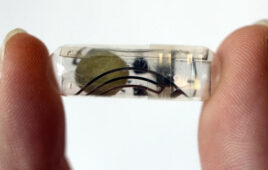
The 1.84 volt paper battery (brown circle structure) was tested in pigs with a bioabsorbable radio-frequency identification (RFID) device.
MIT researchers develop bioresorbable batteries for ingestible medical devices
An illustration of HITMAN operating in glioblastoma cells.
MIT researchers develop injectable nanodevices that remotely kill brain tumor cells
“mdo
EXPAND YOUR KNOWLEDGE AND STAY CONNECTED
Get the latest medical device business news, application and technology trends.

DeviceTalks Weekly

See More >

MDO Digital Edition

Digital Edition

Subscribe to Medical Design & Outsourcing. Bookmark, share and interact with the leading medical design engineering magazine today.

MEDTECH 100 INDEX

Medtech 100 logo
Market Summary > Current Price
The MedTech 100 is a financial index calculated using the BIG100 companies covered in Medical Design and Outsourcing.

New MedTech Resource

Medical Tubing

MassDevice

Mass Device

The Medical Device Business Journal. MassDevice is the leading medical device news business journal telling the stories of the devices that save lives.

Visit Website
MDO ad
Medical Design and Outsourcing
  • MassDevice
  • DeviceTalks
  • MedTech100 Index
  • Medical Tubing + Extrusion
  • Medical Design Sourcing
  • Drug Delivery Business News
  • Drug Discovery & Development
  • Pharmaceutical Processing World
  • R&D World
  • About Us/Contact
  • Advertise With Us
  • Subscribe to Print Magazine
  • Subscribe to our E-Newsletter
  • Listen to our Weekly Podcasts
  • Join our DeviceTalks Tuesdays Discussion

Copyright © 2026 Arrowfly, LLC. All Rights Reserved. The material on this site may not be reproduced, distributed, transmitted, cached or otherwise used, except with the prior written permission of Arrowfly LLC. Site Map | Privacy Policy | RSS

Search Medical Design & Outsourcing

  • Home
  • Medical Device Business
    • Mergers & Acquisitions
    • Financial
    • Regulatory
  • Applications
    • Cardiovascular
    • Devices
    • Imaging
    • Implantables
    • Medical Equipment
    • Orthopedic
    • Surgical
  • Technologies
    • Supplies and Components Index
    • Contract Manufacturing
    • Components
    • Electronics
    • Extrusions
    • Materials
    • Motion Control
    • Prototyping
    • Pumps
    • Tubing
  • MedTech Resources
    • Medtech Events in 2026
    • The 2026 Medtech Big 100
    • Medical Device Handbook
    • MedTech 100 Index
    • Subscribe to Print Magazine
    • DeviceTalks
    • Digital Editions
    • eBooks
    • Educational Assets
    • Manufacturer Search
    • Podcasts
    • Webinars / Digital Events
    • Whitepapers
    • Voices
    • Views
    • Video
  • 2026 Leadership
    • 2025 Winners
    • 2024 Winners
    • 2023 Winners
    • 2022 Winners
    • 2021 Winners
  • Women in Medtech
  • Advertise
  • Subscribe