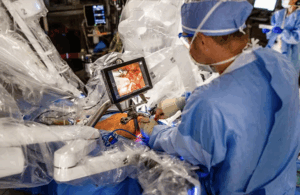
Cleveland Clinic surgerons have successfully completed robotic aortic valve replacements that are each made through a tiny incision in a person’s neck. [Image courtesy of Cleveland Clinic]
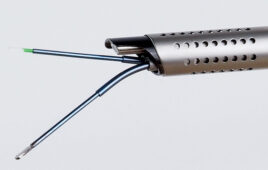
Dr. Marijan Koprivanac at the Cleveland Clinic’s Heart, Vascular & Thoracic Institute performed the first-of-its-kind surgery on a patient in April. He used a Perceval Plus sutureless aortic heart valve from London-based Corcym and the CoreVista Robot Enabling Platform from Glasgow, U.K.–based CardioPrecision, according to a Corcym news release out today.
Corcym says Koprivanac utilized an Intuitive da Vinci Xi robotic surgery system. (The use was off-label. Presently, there is only one cardiac procedure that is FDA cleared on da Vinci X and Xi: coronary artery bypass graft (CABG) with adjunctive mediastinotomy.)
The Cleveland Clinic in June reported four successful robotic aortic valve replacements using the new procedure: AVATAR (Advanced Videoscopic Aortic valve surgery by Transcervical Approach using Robot assistance).
All four patients were able to resume an active life one week later without any restrictions and a low amount of pain during recovery.
“We are optimistic that this strategy could be a breakthrough for offering the benefits of surgical AVR without the lengthier and more painful recovery associated with current options,” Koprivanac said in a news release.
The new AVATAR procedures come as Intuitive — the dominant company in soft tissue surgical robotics — has been returning to its roots with a renewed focus on cardiac surgery amid increased interest from surgeons. This year, Baylor St. Luke’s Medical Center surgeons used an Intuitive da Vinci Xi system to successfully perform what they say is the first robotic heart transplant procedure in the U.S.
Corcym CEO Christian Mazzi tells Medical Design & Outsourcing that AVATAR opens up a whole new approach for minimally invasive cardiac surgery, with the technologies able to deliver incisions as small as 1.5 cm. The Corcym valve helped enable the procedure because it was collapsible and sutureless, saving procedure time.
“The advantage of it is that it adds to a continuous evolution of reducing the incisions and making the invasiveness even less, and ultimately, the recovery of the patient faster, with less pain,” Mazzi said. “What’s particularly new is the fact that it adds robotics into the mix in a pretty symbiotic way.”
How the new robotic aortic valve replacement works
Koprivanac has seen surgical aortic valve replacement evolve rapidly in recent years: “Although SAVR via sternotomy is still regarded as the gold standard for surgical candidates in need of an isolated valve procedure, currently it should be performed infrequently, if ever, because of the availability of excellent less-invasive options, including mini-sternotomy, right anterior thoracotomy, and transaxillary and robotic SAVR.”
He first took an interest in what would become AVATAR after learning to perform transcervical thymectomies while in cardiothoracic surgical training. Access is through a small incision in the neck, without the need for a thoracotomy or sternotomy incision.
“The transcervical approach is well-suited to AVR, as it offers an excellent view of the aorta and aortic valve from above,” Koprivanac said.
At an anatomy lab at Cleveland Clinic Lerner Research Institute, Koprivanac developed his novel technique on human cadavers, using a mammary retractor and then a specialized transcervical retractor. He soon brought in some of his surgical colleagues and team. They demonstrated feasibility on roughly 20 cadavers. After that, they started offering the procedure to Cleveland Clinic patients.
Overall the procedure uses four incisions:
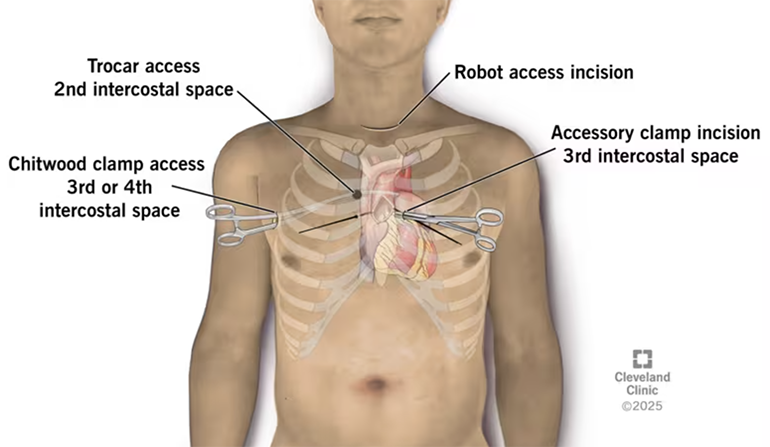
[AVATAR illustration courtesy of Cleveland Clinic]

[AVATAR illustration courtesy of Cleveland Clinic]
The Cleveland Clinic says it used a Corcym valve in one procedure and an Edwards Lifesciences Inspiris Resilia in the other three.
“This is a great advancement in minimally invasive surgical treatment for aortic stenosis,” said Dr. Samir Kapadia, chair of Cardiovascular Medicine at Cleveland Clinic. “This surgery may be preferred by patients if it delivers similar safety and efficacy as other, more invasive surgeries.”
What’s next for robotic aortic valve procedures
Koprivanac said the new robotic aortic valve replacement procedure is getting easier as surgeons learn from each new patient. “With experience, we are refining techniques — such as optimal port placement and level of valve introduction — and becoming more efficient. As we have proved the safety of the procedure, reducing cross-clamp times is the main goal now.”
Corcym’s Mazzi said he was heading to the University of Chicago soon to see an AVATAR performed there with a next-gen da Vinci 5 system. He said the key now is to create a repeatable reproducible approach for robotic aortic valve replacement through the neck.
“I know that the Cleveland Clinic is actively working with that. We’re supporting that process, both with the Cleveland Clinic and other places. But that’s the essence, particularly in the context of robotics, [to] have the ability to take a procedure and split it out into the discrete steps and train on those steps.”
Mazzi said collaborations — with health providers, surgical robotics and endoscope companies, and more — are key to innovation at Corcym. He noted that Corcym worked closely with CardioPrecision on cadaver work related to AVATAR at the University of Chicago. “Part of the journey that we’re on is working with other companies, where we bring our technologies together in the operating room for the benefit of the surgeon and the patient in order to do new technologies.”
Mazzi described more about the future of surgical valve replacements during a DeviceTalks Weekly podcast episode that aired in June: