Medical Design and Outsourcing

  • Home
  • Medical Device Business
    • Mergers & Acquisitions
    • Financial
    • Regulatory
  • Applications
    • Cardiovascular
    • Devices
    • Imaging
    • Implantables
    • Medical Equipment
    • Orthopedic
    • Surgical
  • Technologies
    • Supplies and Components Index
    • Contract Manufacturing
    • Components
    • Electronics
    • Extrusions
    • Materials
    • Motion Control
    • Prototyping
    • Pumps
    • Tubing
  • MedTech Resources
    • Medtech Events in 2026
    • The 2026 Medtech Big 100
    • Medical Device Handbook
    • MedTech 100 Index
    • Subscribe to Print Magazine
    • DeviceTalks
    • Digital Editions
    • eBooks
    • Educational Assets
    • Manufacturer Search
    • Podcasts
    • Webinars / Digital Events
    • Whitepapers
    • Voices
    • Views
    • Video
  • 2026 Leadership
    • 2025 Winners
    • 2024 Winners
    • 2023 Winners
    • 2022 Winners
    • 2021 Winners
  • Women in Medtech
  • Advertise
  • Subscribe

Designing wearables without battery constraints

March 8, 2016 By Heather Thompson

IHDEA board and button cell.1679Battelle’s research leader, Steve Risser shows a picture of a Snickers bar and a 47-g battery and asks the provocative question: which has more energy. Those of you schooled in energy and thermodynamics will immediately understand the answer. The candy holds 291 Wh versus the battery, which holds 11 Wh.

Of course, the challenge, says Risser, is that the battery is sitting at the top of the hill, ready to go, while the candy requires much more work to convert to a useful form. “But if we can figure out how to take advantage of the other energy sources available to us, the potential is enormous. Because the candy bar is easier to carry, more available, and more powerful,” he says.

What if that type of battery technology could be applied to wearable technology. Could designers imagine wearables on the market without picturing a hard rigid and bulky rectangular box? By focusing on developments in sensors, electronics and power, designers could free to create devices that offer unique integrated functionality and form factors.

Risser says the first step to such design freedom is to rethink the battery “Batteries have improved significantly over the past two decades; with an approximate 3-times increase in energy density.” But, he says, there is still a long way to go.

In reality, batteries in medical technology follow advances in other markets. “The consumer industry is driving small format batteries. “ And, he says, the various formats have tradeoffs. “Rechargables are great, but you pay a penalty for not having to replace the battery.”

The chemistries vary widely, he says. For example, the lithium family alone can differ by 50% in performance based on the chemistry. Risser notes that more than $100 million has been invested in the past few years in bringing alternate chemistries to the market. The majority of those discoveries will go toward large format battery technology, and won’t be available for medical wearables. However, there are some technologies that could be used in wearables.

Lithium sulfur
Li-s is a lightweight rechargeable battery. It is known for its low cost and high energy density.

“Li sulfur has been under development for 20 years. Only now are we seeing possibilities,” Risser notes. However, he says the self-discharge is not great. In addition, “variation in discharge voltage complicates the design. The cycle life is still 100 cycles.”

Metal Air
Metal-air battery is an electrochemical cell that has an anode made of pure metal and an external cathode of ambient air, typically with an aqueous electrolyte.

“Metal Air is even more complicated,” says Risser. Discharge can change the mass and size of the battery, and we don’t normally design for this type of change. In addition, designers need to think about airflow, and how it will feed the battery. “There is a lot that still needs to be worked out.”

Flexible Printed
Risser says the most immediate opportunity is in alternate physical forms, such as nonplanar, flexible, printed, embedded, or combinations with energy harvesting. Such physical forms, says Risser, can integrate a battery into curved shapes.

A few companies can make flexible batteries, says Risser. And the battery can be embedded into the packaging. “What if, for example, you got the battery out of an electric car and integrated it into the side panels and roofing? You could then make the interior space available for users you save in weight and you are no longer limiting the shape of packaging,” he says.

This design freedom, says Risser, is really only 5-7 years down the road. The key to the getting the technology to reach its potential, however, is in energy harvesting. And this is not an easy task. “We have to think about how we can grab energy from the environment.” Imagine a glucose fuel cell, he says. Such technology could revolutionize implants.

“We are at the cusp,” says Risser. “We are no longer making devices to fit the battery, rather we can start thinking about how the power will fit the design.”

Related Articles Read More >

Reconstructed 3D fluorescence image of the stained biohybrid mesh-tissue integration. The red, green, and blue colors correspond to the mesh, F-actin, and nuclei, respectively.
Researchers mesh electronics with human cells to develop living battery
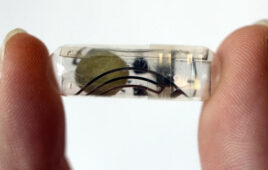
The 1.84 volt paper battery (brown circle structure) was tested in pigs with a bioabsorbable radio-frequency identification (RFID) device.
MIT researchers develop bioresorbable batteries for ingestible medical devices
Ensurge relocates San Jose operations to advance microbattery development
ITEN advances solid-state batteries for Class III implants
“mdo
EXPAND YOUR KNOWLEDGE AND STAY CONNECTED
Get the latest medical device business news, application and technology trends.

DeviceTalks Weekly

See More >

MDO Digital Edition

Digital Edition

Subscribe to Medical Design & Outsourcing. Bookmark, share and interact with the leading medical design engineering magazine today.

MEDTECH 100 INDEX

Medtech 100 logo
Market Summary > Current Price
The MedTech 100 is a financial index calculated using the BIG100 companies covered in Medical Design and Outsourcing.

New MedTech Resource

Medical Tubing

MassDevice

Mass Device

The Medical Device Business Journal. MassDevice is the leading medical device news business journal telling the stories of the devices that save lives.

Visit Website
MDO ad
Medical Design and Outsourcing
  • MassDevice
  • DeviceTalks
  • MedTech100 Index
  • Medical Tubing + Extrusion
  • Medical Design Sourcing
  • Drug Delivery Business News
  • Drug Discovery & Development
  • Pharmaceutical Processing World
  • R&D World
  • About Us/Contact
  • Advertise With Us
  • Subscribe to Print Magazine
  • Subscribe to our E-Newsletter
  • Listen to our Weekly Podcasts
  • Join our DeviceTalks Tuesdays Discussion

Copyright © 2026 Arrowfly, LLC. All Rights Reserved. The material on this site may not be reproduced, distributed, transmitted, cached or otherwise used, except with the prior written permission of Arrowfly LLC. Site Map | Privacy Policy | RSS

Search Medical Design & Outsourcing

  • Home
  • Medical Device Business
    • Mergers & Acquisitions
    • Financial
    • Regulatory
  • Applications
    • Cardiovascular
    • Devices
    • Imaging
    • Implantables
    • Medical Equipment
    • Orthopedic
    • Surgical
  • Technologies
    • Supplies and Components Index
    • Contract Manufacturing
    • Components
    • Electronics
    • Extrusions
    • Materials
    • Motion Control
    • Prototyping
    • Pumps
    • Tubing
  • MedTech Resources
    • Medtech Events in 2026
    • The 2026 Medtech Big 100
    • Medical Device Handbook
    • MedTech 100 Index
    • Subscribe to Print Magazine
    • DeviceTalks
    • Digital Editions
    • eBooks
    • Educational Assets
    • Manufacturer Search
    • Podcasts
    • Webinars / Digital Events
    • Whitepapers
    • Voices
    • Views
    • Video
  • 2026 Leadership
    • 2025 Winners
    • 2024 Winners
    • 2023 Winners
    • 2022 Winners
    • 2021 Winners
  • Women in Medtech
  • Advertise
  • Subscribe