By Sunil Inamdar, VP of Design Services and Engineering, Solesis
Medical device delivery systems must navigate complex anatomy while supporting controlled, minimally invasive procedures. Low-pressure balloons help meet these demands by providing compliant, adaptive structures that support catheter positioning, temporary vessel occlusion and device deployment.
Unlike high-pressure balloons designed for controlled dilation, low-pressure balloons expand and conform to surrounding anatomy. Developing these components requires careful consideration of material behavior, balloon geometry and manufacturing methods to achieve the performance required for each application.
Understanding Balloon Compliance
Compliance describes how much a balloon expands as pressure increases. Low-pressure balloons are highly compliant, allowing them to stretch beyond their initial dimensions and recover close to their original size after deflation. This flexibility makes them useful when a device requires gentle, adaptive contact with surrounding tissue.
However, greater compliance does not mean greater pressure tolerance. Designers must balance expansion behavior with durability, inflation and deflation requirements, and the balloon’s intended interaction with anatomy. Defining these requirements early helps guide material selection and component development.
Supporting Vascular Devices and Delivery Systems
Low-pressure balloons serve several functions in vascular procedures. They can help stabilize a catheter within a vessel, temporarily interrupt blood flow or support occlusion testing. They also assist with positioning during certain ablation procedures and with selected neurovascular applications, including balloon-assisted coiling.
Each application creates different design requirements. A balloon intended for temporary occlusion may require different geometry and expansion characteristics than one used to support catheter fixation or device positioning. Challenging vascular pathways also make flexibility, a compact delivery profile and consistent inflation and deflation behavior important considerations.
Matching the balloon’s design to its intended function helps manufacturers establish appropriate performance criteria before selecting materials and manufacturing processes.
Selecting Materials for Performance
Material selection influences balloon compliance, durability, wall thickness and manufacturability. Although latex has historically been used for compliant medical balloons, allergy concerns have encouraged the use of alternative materials.
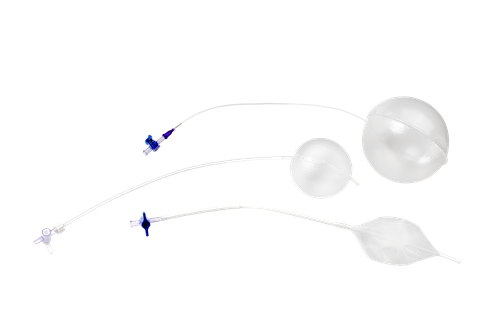
Polyurethane offers a useful balance of elasticity, durability and processing versatility. It can be thermoformed or dip-molded to create custom shapes and configurations, including balloons with a large body relative to their neck diameter.
Silicone is another option for dip-molded low-pressure balloons because of its elasticity and strength. Thermoplastic elastomers may also be considered when an application requires flexible expansion behavior.
The right material depends on the complete set of device requirements, including the intended geometry, tissue interaction, inflation behavior and manufacturing approach. Evaluating these factors together helps avoid design choices that are difficult to reproduce during production.
Choosing a Manufacturing Method
Thermoforming and dip molding offer two approaches to producing custom low-pressure balloons. The choice depends on the material, balloon configuration and required performance.
Thermoforming supports three-dimensional balloon geometries in a range of sizes and wall thicknesses. Thermoformed polyurethane balloons can be compact and foldable, supporting insertion through a delivery system. The process also accommodates different neck-to-body ratios, providing flexibility for application-specific designs.
Dip molding creates seamless, hollow structures by applying liquid polymer to a mandrel, followed by curing and removal. Controlling material distribution and layer construction helps manufacturers achieve the desired wall characteristics and consistent component performance.
Dip molding accommodates several material options, including polyurethane and silicone. Its seamless construction can be valuable when the application requires a continuous balloon surface.
Both methods require alignment between material properties, processing conditions and design requirements. Early evaluation helps determine which approach can deliver the intended geometry and support repeatable manufacturing.
Advancing Development With Solesis
Developing a low-pressure balloon requires more than selecting a compliant polymer. Material science, component design and process development must work together to support the balloon’s intended function within the complete device.
Solesis helps medical device manufacturers develop custom polymer, textile and hybrid solutions – starting from material selection and early development through scale-up and commercialization – aligning component requirements and materials with appropriate manufacturing processes for successful vascular devices and delivery system integrations.
Learn more about how Solesis supports low-pressure balloon development for next-generation vascular devices.
Read and Learn MoreSponsored content by Solesis