Medical Design and Outsourcing

  • Home
  • Medical Device Business
    • Mergers & Acquisitions
    • Financial
    • Regulatory
  • Applications
    • Cardiovascular
    • Devices
    • Imaging
    • Implantables
    • Medical Equipment
    • Orthopedic
    • Surgical
  • Technologies
    • Supplies and Components Index
    • Contract Manufacturing
    • Components
    • Electronics
    • Extrusions
    • Materials
    • Motion Control
    • Prototyping
    • Pumps
    • Tubing
  • MedTech Resources
    • Medtech Events in 2026
    • The 2026 Medtech Big 100
    • Medical Device Handbook
    • MedTech 100 Index
    • Subscribe to Print Magazine
    • DeviceTalks
    • Digital Editions
    • eBooks
    • Educational Assets
    • Manufacturer Search
    • Podcasts
    • Webinars / Digital Events
    • Whitepapers
    • Voices
    • Views
    • Video
  • 2026 Leadership
    • 2025 Winners
    • 2024 Winners
    • 2023 Winners
    • 2022 Winners
    • 2021 Winners
  • Women in Medtech
  • Advertise
  • Subscribe

Doctors Don’t Really Care About Fitness Tracker Data

November 27, 2015 By Sam Brusco

Smart watches and activity trackers market themselves as convenient and stylish ways to monitor your health. They’re certainly popular—Apple, Fitbit, and Pebble are expected to ship over 76 million devices by the end of 2015. Of course, many can’t analyze the data themselves, so they’re bringing it to their doctors to have a look at.

But as it turns out, doctors aren’t finding this data helpful at all. They’re both questioning the data’s value, as well as the validity of the enormous amount of data.

“I’m an oncologist, and I have these patients who are proto ‘quantified self’ kinds of people,” reported Sage Bionetworks oncologist Andrew Trister in an MIT Technology Review article. “They come in with these very large Excel spreadsheets, with all this information—I have no idea what to do with that.”

According to Trister, from a clinical standpoint, it’s quite difficult to point out trends that may exist in the patient-generated data. Researchers are finding that a remarkably few amount of the consumer-oriented wearable devices stack up to the reliability a medical-grade wearable device might have.

It also doesn’t help matters that consumer-oriented wearables—like Fitbit and the Apple Watch—aren’t clinically validated by the FDA to function with the same reliability standards that a medical device would have. They’re rather marketed under the much less extensive “wellness-focused” guidelines.

Rather than fitness trackers, which provide a data spread of general activity, medical wearables should focus on collecting data from specific types of activity. One in particular that holds a lot of promise, according to Trister, is the Embrace wristband from Empatica, which uses an electrodermal activity sensor to measure skin’s electrical conductance, in order to track seizure activity in epileptics.

That’s not to say using fitness trackers is a completely worthless endeavor, however. They do help people to be aware of their level of activity—and lack thereof—in order to make conscious health decisions. Doctors aren’t quite ready to deal with the sheer amount of information at the moment, nor do they believe the quality of sensors is strong enough for their data to be clinically relevant.

Hopefully clinicians will become aware of these trackers as their technology improves, because these wearables could prove useful for helping patients manage chronic diseases.


Related Articles Read More >

The most innovative medical devices of 2026
Reconstructed 3D fluorescence image of the stained biohybrid mesh-tissue integration. The red, green, and blue colors correspond to the mesh, F-actin, and nuclei, respectively.
Researchers mesh electronics with human cells to develop living battery
A photo of the Paradromics Connexus brain-computer interface on a fingertip.
How Paradromics designed its Connexus brain-computer interface system
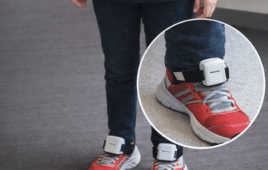
A photo of the wearable gait sensors used in the study.
Yale-led study finds wearable sensors match motion capture for gait tracking in knee osteoarthritis
“mdo
EXPAND YOUR KNOWLEDGE AND STAY CONNECTED
Get the latest medical device business news, application and technology trends.

DeviceTalks Weekly

See More >

MDO Digital Edition

Digital Edition

Subscribe to Medical Design & Outsourcing. Bookmark, share and interact with the leading medical design engineering magazine today.

MEDTECH 100 INDEX

Medtech 100 logo
Market Summary > Current Price
The MedTech 100 is a financial index calculated using the BIG100 companies covered in Medical Design and Outsourcing.

New MedTech Resource

Medical Tubing

MassDevice

Mass Device

The Medical Device Business Journal. MassDevice is the leading medical device news business journal telling the stories of the devices that save lives.

Visit Website
MDO ad
Medical Design and Outsourcing
  • MassDevice
  • DeviceTalks
  • MedTech100 Index
  • Medical Tubing + Extrusion
  • Medical Design Sourcing
  • Drug Delivery Business News
  • Drug Discovery & Development
  • Pharmaceutical Processing World
  • R&D World
  • About Us/Contact
  • Advertise With Us
  • Subscribe to Print Magazine
  • Subscribe to our E-Newsletter
  • Listen to our Weekly Podcasts
  • Join our DeviceTalks Tuesdays Discussion

Copyright © 2026 Arrowfly, LLC. All Rights Reserved. The material on this site may not be reproduced, distributed, transmitted, cached or otherwise used, except with the prior written permission of Arrowfly LLC. Site Map | Privacy Policy | RSS

Search Medical Design & Outsourcing

  • Home
  • Medical Device Business
    • Mergers & Acquisitions
    • Financial
    • Regulatory
  • Applications
    • Cardiovascular
    • Devices
    • Imaging
    • Implantables
    • Medical Equipment
    • Orthopedic
    • Surgical
  • Technologies
    • Supplies and Components Index
    • Contract Manufacturing
    • Components
    • Electronics
    • Extrusions
    • Materials
    • Motion Control
    • Prototyping
    • Pumps
    • Tubing
  • MedTech Resources
    • Medtech Events in 2026
    • The 2026 Medtech Big 100
    • Medical Device Handbook
    • MedTech 100 Index
    • Subscribe to Print Magazine
    • DeviceTalks
    • Digital Editions
    • eBooks
    • Educational Assets
    • Manufacturer Search
    • Podcasts
    • Webinars / Digital Events
    • Whitepapers
    • Voices
    • Views
    • Video
  • 2026 Leadership
    • 2025 Winners
    • 2024 Winners
    • 2023 Winners
    • 2022 Winners
    • 2021 Winners
  • Women in Medtech
  • Advertise
  • Subscribe