Medical Design and Outsourcing

  • Home
  • Medical Device Business
    • Mergers & Acquisitions
    • Financial
    • Regulatory
  • Applications
    • Cardiovascular
    • Devices
    • Imaging
    • Implantables
    • Medical Equipment
    • Orthopedic
    • Surgical
  • Technologies
    • Supplies and Components Index
    • Contract Manufacturing
    • Components
    • Electronics
    • Extrusions
    • Materials
    • Motion Control
    • Prototyping
    • Pumps
    • Tubing
  • MedTech Resources
    • Medtech Events in 2026
    • The 2025 Medtech Big 100
    • Medical Device Handbook
    • MedTech 100 Index
    • Subscribe to Print Magazine
    • DeviceTalks
    • Digital Editions
    • eBooks
    • Educational Assets
    • Manufacturer Search
    • Podcasts
    • Webinars / Digital Events
    • Whitepapers
    • Voices
    • Views
    • Video
  • 2026 Leadership
    • 2025 Winners
    • 2024 Winners
    • 2023 Winners
    • 2022 Winners
    • 2021 Winners
  • Women in Medtech
  • Advertise
  • Subscribe

Electronic Device Implanted in Brain Could Stop Seizures

August 31, 2018 By University of Cambridge

Researchers have successfully demonstrated how an electronic device implanted directly into the brain can detect, stop and even prevent epileptic seizures.

The researchers, from the University of Cambridge, the École Nationale Supérieure des Mines and INSERM in France, implanted the device into the brains of mice, and when the first signals of a seizure were detected, delivered a native brain chemical which stopped the seizure from progressing. The results, reported in the journal Science Advances, could also be applied to other conditions including brain tumours and Parkinson’s disease.

The work represents another advance in the development of soft, flexible electronics that interface well with human tissue. “These thin, organic films do minimal damage in the brain, and their electrical properties are well-suited for these types of applications,” said Professor George Malliaras, the Prince Philip Professor of Technology in Cambridge’s Department of Engineering, who led the research.

While there are many different types of seizures, in most patients with epilepsy, neurons in the brain start firing and signal to neighbouring neurons to fire as well, in a snowball effect that can affect consciousness or motor control. Epilepsy is most commonly treated with anti-epileptic drugs, but these drugs often have serious side effects and they do not prevent seizures in three out of 10 patients.

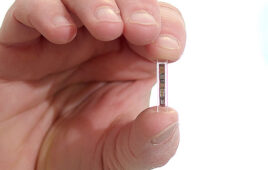
In the current work, the researchers used a neurotransmitter which acts as the ‘brake’ at the source of the seizure, essentially signalling to the neurons to stop firing and end the seizure. The drug is delivered to the affected region of the brain by a neural probe incorporating a tiny ion pump and electrodes to monitor neural activity.

When the neural signal of a seizure is detected by the electrodes, the ion pump is activated, creating an electric field that moves the drug across an ion exchange membrane and out of the device, a process known as electrophoresis. The amount of drug can be controlled by tuning the strength of the electric field.

“In addition to be being able to control exactly when and how much drug is delivered, what is special about this approach is that the drugs come out of the device without any solvent,” said lead author Dr. Christopher Proctor, a postdoctoral researcher in the Department of Engineering. “This prevents damage to the surrounding tissue and allows the drugs to interact with the cells immediately outside the device.”

The researchers found that seizures could be prevented with relatively small doses of drug representing less than 1% of the total amount of drug loaded into the device. This means the device should be able to operate for extended periods without needing to be refilled. They also found evidence that the delivered drug, which was in fact a neurotransmitter that is native to the body, was taken up by natural processes in the brain within minutes which, the researchers say, should help reduce side effects from the treatment.

Although early results are promising, the potential treatment would not be available for humans for several years. The researchers next plan to study the longer-term effects of the device in mice.

Malliaras is establishing a new facility at Cambridge which will be able to prototype these specialised devices, which could be used for a range of conditions. Although the device was tested in an animal model of epilepsy, the same technology could potentially be used for other neurological conditions, including the treatment of brain tumours and Parkinson’s disease.

Related Articles Read More >

A photo of the Paradromics Connexus brain-computer interface on a fingertip.
How Paradromics designed its Connexus brain-computer interface system
An illustration of HITMAN operating in glioblastoma cells.
MIT researchers develop injectable nanodevices that remotely kill brain tumor cells
An illustration of CSF flow through the brain.
MIT researchers find pink noise can encourage CSF flow during sleep
A photo of Kitea Health's Kitea Sensor with fingers for scale.
Intracranial sensor maker says automated testing slashed firmware development time
“mdo
EXPAND YOUR KNOWLEDGE AND STAY CONNECTED
Get the latest medical device business news, application and technology trends.

DeviceTalks Weekly

See More >

MDO Digital Edition

Digital Edition

Subscribe to Medical Design & Outsourcing. Bookmark, share and interact with the leading medical design engineering magazine today.

MEDTECH 100 INDEX

Medtech 100 logo
Market Summary > Current Price
The MedTech 100 is a financial index calculated using the BIG100 companies covered in Medical Design and Outsourcing.

New MedTech Resource

Medical Tubing

MassDevice

Mass Device

The Medical Device Business Journal. MassDevice is the leading medical device news business journal telling the stories of the devices that save lives.

Visit Website
MDO ad
Medical Design and Outsourcing
  • MassDevice
  • DeviceTalks
  • MedTech100 Index
  • Medical Tubing + Extrusion
  • Medical Design Sourcing
  • Drug Delivery Business News
  • Drug Discovery & Development
  • Pharmaceutical Processing World
  • R&D World
  • About Us/Contact
  • Advertise With Us
  • Subscribe to Print Magazine
  • Subscribe to our E-Newsletter
  • Listen to our Weekly Podcasts
  • Join our DeviceTalks Tuesdays Discussion

Copyright © 2026 Arrowfly, LLC. All Rights Reserved. The material on this site may not be reproduced, distributed, transmitted, cached or otherwise used, except with the prior written permission of Arrowfly LLC. Site Map | Privacy Policy | RSS

Search Medical Design & Outsourcing

  • Home
  • Medical Device Business
    • Mergers & Acquisitions
    • Financial
    • Regulatory
  • Applications
    • Cardiovascular
    • Devices
    • Imaging
    • Implantables
    • Medical Equipment
    • Orthopedic
    • Surgical
  • Technologies
    • Supplies and Components Index
    • Contract Manufacturing
    • Components
    • Electronics
    • Extrusions
    • Materials
    • Motion Control
    • Prototyping
    • Pumps
    • Tubing
  • MedTech Resources
    • Medtech Events in 2026
    • The 2025 Medtech Big 100
    • Medical Device Handbook
    • MedTech 100 Index
    • Subscribe to Print Magazine
    • DeviceTalks
    • Digital Editions
    • eBooks
    • Educational Assets
    • Manufacturer Search
    • Podcasts
    • Webinars / Digital Events
    • Whitepapers
    • Voices
    • Views
    • Video
  • 2026 Leadership
    • 2025 Winners
    • 2024 Winners
    • 2023 Winners
    • 2022 Winners
    • 2021 Winners
  • Women in Medtech
  • Advertise
  • Subscribe