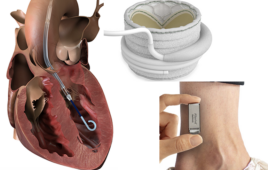
Endiatx co-founder and CEO Torrey Smith with PillBot [Photo by Hardy Wilson for MDO]
An unconventional CEO and his team take aim at endoscopies with faster, cheaper stomach imaging — and that’s just the start. Welcome to the era of tiny robots inside the body.
As he prepared to swallow his robot for the first time, Torrey Smith’s doctors warned that the battery was his greatest threat.
If the capsule came apart and the battery burned the tissue lining his stomach, it would only be the beginning of a very bad experience.
“I was just hoping that we would get any kind of a positive signal that we were on the right track,” Smith, co-founder and CEO of Endiatx, said of the June 2020 test. “At that time, our radio bandwidth was so limited. We were pushing 48 pixels square of grayscale, not even color, at just a few frames per second. The worst video quality you could imagine — but it was real.”
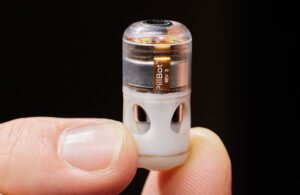
The Endiatx PillBot [Photo by Hardy Wilson for MDO]
“It almost looked kind of like the surface of the moon with that grayscale,” he said. “But then we saw a dangling piece of tissue sloughing off from inside my stomach in real-time, and I literally shouted. Even with the extreme limitations of that revision, we were on to something.”
Starting small
Less than two years after that first trial on the living room couch, Smith and his co-founders have swallowed more than 20 PillBots and tested the technology in a Mayo Clinic cadaver lab. They’re now courting investors to raise $3 million in seed funding for the Redwood City, California-based startup as they look forward to clinical trials, FDA approval and commercialization.
It’s not the first disposable pill camera. Medtronic’s PillCam platform already captures images of a patient’s esophagus, stomach, small bowel and colon as it goes with the flow through the GI tract. Nor is it the first single-use robotic pill. For example, Rani Therapeutics’ RaniPill is designed to survive the stomach and deploy in the intestine. The pH change in the intestine unfurls the RaniPill to inject biologic drugs for conditions ranging from diabetes to Crohn’s disease.

This cutaway diagram of the Endiatx PillBot shows its unique propulsion system. [Image courtesy of Endiatx]
Another controllable, swallowable imaging device has been developed by AnX Robotica, which uses magnetic systems to precisely position its pill-sized camera during sedation-free examinations. That magnetic equipment means the patient must still visit the doctor, though it’s less invasive than a traditional endoscopic gastroduodenoscopy (more commonly called an upper endoscopy) to search for cancers, infection, bleeding and other problems.

Dr. Vivek Kumbhari, the chair of gastroenterology and hepatology at Mayo Clinic–Florida, joined the Endiatx board in February 2021. [Photo courtesy of Dr. Kumbhari]
“Imaging in medicine is moving to non-invasive,” he said, citing positron emission tomography (PET) scans, new types of computerized tomography (CT) scans and volume rendering. “Endoscopy is primed to follow.”
Kumbhari, who performs about 1,300 endoscopies per year, recalled a lecture on the future of gastroenterology 15 years ago during his residency, specifically a hypothetical swallowable robot that could repair a stomach bleed.
Coincidentally, Endiatx’s Pill Surgeon might be the next big iteration for this small device, currently assembled with about $35 worth of off-the-shelf components, Smith said.
“My goal is to make it at least 10 times easier to just let a doctor have a look around inside you. A cheap, mass-market screening tool is what we think is the beginning for this adventure,” he said. “Then we start putting on the robot arms and the little snippers and tools and needles.”
Simple tissue biopsies would likely come first, though there’s also demand from doctors for ways to mark tissue so they can locate it later for reexamination. Other ideas range from bleed cauterizing to microbiome sampling in the GI tract and voyages through bile ducts to search for early signs of pancreatic cancer.
Endiatx plans to seek FDA clearance for PillBot as a Class II medical device on a 510(k) predicate-based pathway based on prior approvals of AnX Robotica’s magnetic NaviCam and Medtronic’s at-home PillCam. The goal is to pursue indications that can be achieved without too many improvements to the device, such as diagnosis of stomach lesions, ulcers and bleeds in a bid to enter the market as soon as 2023.
“Our regulatory consultants are saying this looks like one of the easiest 510(k)s they’ve ever explored,” Smith said. “It just squirts water out the back. It’s not really that scary.”
‘Hardcore telemedicine’

Endiatx co-founder and CEO Torrey Smith imagines the future could hold smaller, surgical versions of PillBot. [Image courtesy of Endiatx]
“It doesn’t look like they’ve raised much capital, and the non-buttoned-up CEO could be part of the reason,” said Paul Grand, CEO and founder of the MedTech Innovator startup accelerator. “I personally like people who aren’t your usual polished execs. These are the out-of-the-box kinds of things we like to see.”
Smith said he’s been laughed at dozens of times during pitches, but he doesn’t take it personally.
“The idea is to start somewhere tangible, drive it down step by step, learn as you go,” Smith said. “It’s okay if you get your butt kicked in different ways at every step. By the time we started swallowing this on our couch, we started getting a new kind of interest.”

Endiatx prototypes leading to the smallest version, the 28mm-long PillBot [Photo by Hardy Wilson for MDO]
“We have to drive this all the way down to the molecular level. Can I do that? … I’m probably not the one who’s going to be doing molecular machines,” said Smith, a mechanical engineer who previously designed atherectomy catheters. “What we’re really building is the concept of normalcy of what we call hardcore telemedicine. We want a reliable platform where you can swallow a pill in your living room, but a doctor anywhere on the planet — or off-planet — controls it remotely.”
He hopes his self-described “maverick spirit” will be balanced and complemented by Kumbhari. Others adding clout to the Endiatx team include co-founder, Chair and Chief Technology Officer Alex Luebke (previously at Google X/Loon in advanced tech development), co-founder and Chief Technology Officer Emeritus Dan Moyer, and co-founder and Principal R&D Engineer James “Heavy Metal” Erd, a metalworking wizard who was building spherical fuel tanks for the Google Lunar X Prize challenge when he first met Smith.
To build trust with doctors, future patients and potential investors, Endiatx posts videos from its R&D efforts online in an unusually transparent approach. But winning over investors might just come down to commercial opportunity.

Endiatx co-founder and CEO Torrey Smith in his Oakland, California, workshop [Photo by Hardy Wilson for MDO]
Smith emphasizes that Endiatx intends to compete with in-person endoscopies, not passive pill cams, to win market share, improve care and allow doctors to treat more patients.
“If PillBot, the cheap mass-market screening tool, can be effective and safe and make upper endoscopies a lot easier, Endiatx is a billion-dollar company at the minimum,” Smith said. “We want to IPO this thing. … We’re in this for the long haul.”
Until then, the team continues a wild ride that has already taken them on a zero-gravity flight aboard a Cessna 310 as they worked on PillBot’s swimming skills. Buoyancy is key, and in the way you might imagine the Endiatx team to circumvent flotation issues, they brought the device in a water tank aboard the twin-engine aircraft and had the pilot execute a maneuver to simulate weightlessness.
Dr. Kumbhari wasn’t on that flight, and he’s not among those who have swallowed a PillBot.
“Apart from the added excitement when you’re trying to raise money or when you’re presenting, there’s not a whole ton of value doing it now,” he said. “Once optics are improved — which is a simple thing to do, and Alex will work on that when the time’s right — and the form factor and buoyancy are optimized, then that’s the time to start swallowing. Then I think it’ll be a whole lot of fun.”