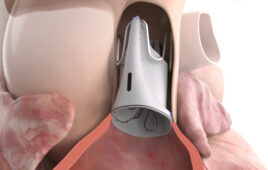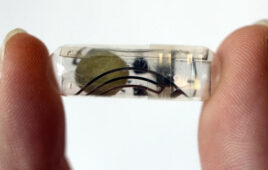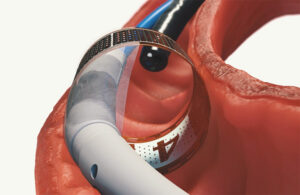
The Endogenex ReCET system’s catheter has an expandable electronic circuit for delivering pulsed-field energy to the duodenum’s wall. [Illustration courtesy of Endogenex]
That’s where Minneapolis-based Endogenex’s investigational ReCET (Re-Cellularization via Electroporation Therapy) system delivers nonthermal pulsed electric field (PEF) energy to mucosal and submucosal tissue to initiate cell regeneration.
Overcoming that obstinate organ was an early obstacle for the startup, Endogenex CEO Stacey Pugh said in a Medical Design & Outsourcing interview.
“One of the biggest challenges we saw in our feasibility trials was you don’t make the duodenum happy — it’s an organ that’s designed to kick you out — and you don’t make it happy when you’re delivering high-voltage electrical pulses over and over again through it,” she said.
DeviceTalks Minnesota: Registration is now open for our May 4 show

The Endogenex ReCET system’s catheter delivers nonthermal pulsed electric field energy to duodenal tissue, initiating the body’s natural process of cell regeneration. [Illustration courtesy of Endogenex]
“The goal is to create as much optimum wall opposition to that circuit and in adherence to that circuit while you’re delivering these nanosecond pulse,” Pugh said. “It takes us about a minute worth of total energy activation broken into two segments when we’re delivering these pulses, and we really want to hold that tight, consistent and still.”

The Endogenex ReCET system’s pulsed-field energy delivery circuit can expand to fit the varying size of the patient’s duodenum. [Illustration courtesy of Endogenex]
Visibility was more of a challenge on distal end than the proximal end. The team’s solution was to add triangular polyurethane wings that roll out with the circuit and keep the duodenal tissue — the villus and modal structures — from getting caught in the process.
“Those wings, when they’re out, keep tissue away and it makes the act of opening and closing and moving so much more simple,” Pugh said.

This illustration of the Endogenex ReCET system’s catheter shows the polyurethane wings on each side of the expandable electronic circuit. [Illustration courtesy of Endogenex]

Endogenex CEO Stacey Pugh [Photo courtesy of Endogenex]
“These results from the integrated REGENT-1 analysis provide the first peer-reviewed evidence demonstrating that non-thermal pulsed electric field-based duodenal therapy can produce clinically meaningful and durable improvements in glycemic control, body weight, and markers of insulin resistance through 48 weeks with a single endoscopic procedure,” said Dr. David O’Neal, the corresponding author of the results published in Diabetes, Obesity and Metabolism.
Read more from our interview with Pugh about the Endogenex ReCET system here and watch for more at Medical Design & Outsourcing soon, including her advice for device design and medtech careers. Sign up for our free MDO newsletter so you don’t miss it!