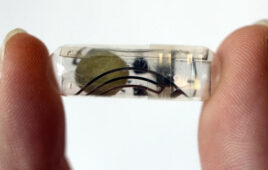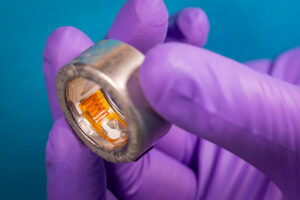
One half of the ring houses the sensor array (the orange stripes pictured here), sweat extraction component and fluidic channel. The other half of the ring houses the battery and printed circuit board. [Photo courtesy of UC San Diego]
Researchers at the University of California San Diego created a wearable smart ring that uses finger sweat to monitor six biochemical markers: glucose, ketones, vitamin C, uric acid, lactate and alcohol.
The engineers published their results in Nature Communications and shared details in a news release.
The ring uses an osmotic hydrogel to create a pressure gradient that pulls sweat into the ring. Then an electrochemical sensor array within the ring analyzes the collected sample.
A rechargeable zinc-silver oxide battery supplies power for up to 12 hours of operation. A 3D-printed polymer makes up the outer shell of the wearable.
“Commercial rings only provide biophysical information, but they lack molecular information about biochemical markers that offers deeper insights about an individual’s health status,” said postdoctoral researcher Tamoghna Saha, co-first author of the study.
MDO Min-Vasive Medtech: Watch our interviews with R&D experts from innovative device developers working on next-gen minimally invasive technology, including audience Q&A to end each session
The researchers said trials with patients with type 1 diabetes as well as nondiabetic patients found that results from the ring closely matched those of commercial continuous glucose monitors and ketone blood meters.
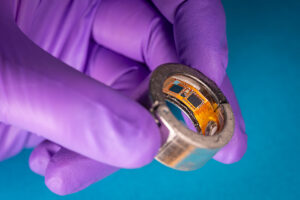
This half of the ring contains the flexible battery and printed circuit board. [Photo courtesy of UC San Diego]
The ring can provide personalized trends based on collected biomarker data. With serial measurements, the technology can establish subject-specific calibration factors, converting current responses into concentration values. According to the paper, the personalized calibration remains stable for approximately two months.
The work was supported by the UC San Diego Center of Wearable Sensors and the National Science Foundation – UC San Diego Materials Research Science and Engineering Center.