This article is part of Qosina’s “The Engineer’s Guide” recurring series covering practical component selection guidance for medical device design engineers.
By Stephanie Alwais, Qosina

Stephanie Alwais is an applications engineer at Qosina, a global supplier of OEM single-use components for the medical and pharmaceutical industries. [Photo courtesy of Qosina]
Barbed connectors are among the simplest components in a fluid path, but the connections they create are not. Engineers reach for a nominal size, order the part and move on. The failure, when it comes, tends to arrive late and in production.
Previously from Qosina: The Engineer’s Guide to Luer connector selection
The basics: three components, one connection
A barbed connection’s three components are the barb, the tubing and the device that retains them. Engineers tend to specify the first, inherit the second and leave the third for last. That order is backwards. The three together make one engagement, and how it performs depends on the tubing and the retention device as much as the barb.
The consequences in a fluid delivery device are specific. An engagement that weeps in an IV administration set is a dosing error. One that separates downstream in an infusion pump during an occlusion alarm is a fluid path breach at the bedside. One that restricts the bore more than planned turns a labeled flow rate into a claim that cannot be supported.

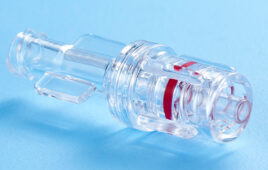
A connector is described by the nominal inner diameter of the tubing it is intended to accept. [Photo courtesy of Qosina]
Barb geometry and grip profiles: what the nominal size does not tell you
Barbed connectors come in a range of configurations, and fluid path layout usually dictates the choice. Straight connectors join two lengths of tubing in line. Elbows redirect flow, typically at 90 degrees, where routing space is limited. T and Y connectors split one line into two or combine two into one, with the Y’s shallower branch angle producing less flow disturbance than a T. Cross connectors join four lines at a single junction. Reducing versions of each accommodate a change in tubing size across the engagement. It’s worth noting early: every direction change adds flow resistance, and a sharp elbow adds more than a swept one.
Whatever the configuration, the connector is described by the nominal inner diameter of the tubing it is intended to accept. That description is a starting point, not a performance guarantee. Unlike Luer connectors, there is no consensus standard governing barb dimensions relative to tubing ID. Two fittings labeled for 1/4” tubing can have meaningfully different stem diameters, grip profiles and retention characteristics.
The features worth comparing across candidate parts:
- Interference, or percentage oversize, is how much larger the barb stem is than the nominal tubing ID. More interference means more sealing force and more pull-off resistance, along with higher assembly force and more sustained stress in the tubing wall. A stem at 10% to 25% oversize behaves very differently from one at 50% to 100%, and the right target is driven by tubing durometer rather than by the barb.
- Stem profile determines how load is distributed. A tapered stem eases assembly and spreads load along its length. A straight oversized stem grips more uniformly. A stem sized equal to nominal tubing ID depends almost entirely on a retention device to hold the engagement.
- Edge geometry must be sharp enough to grip and seal, and round enough not to score the tubing. An aggressive edge against soft tubing under vibration is a slow cut in progress. A shallow rounded barb against stiff tubing releases under modest axial load.
- Parting line is the detail most often missed. When a mold opens and closes, it leaves a seam where the halves meet. On a barb stem, that seam is a leak path running the length of the sealing surface. Specify barbs molded without a parting line on the sealing surface and inspect for it at incoming.
- Anti-rotation ribs resist twisting of the tubing on the barb, which matters when the assembly will be handled, coiled or routed after the engagement is made.
Single barb or multi-barb: where less is better
You might think additional barbs always improve a connection. They don’t and understanding why changes how the choice gets made.
The first barb the tubing passes over does most of the sealing. Barbs behind it contribute progressively less sealing and progressively more mechanical retention. A multi-barb stem is therefore a pull-off and blow-off feature rather than a redundant seal.
This makes multi-barb the right selection for pressurized lines, for engagements that will be handled in use and for stiffer tubing needing multiple grip points. The cost is insertion force stacks. The tubing must stretch over every barb in the series, so a three-barb stem can require several times the assembly force of a single barb in the same nominal size. This pushes the assembly toward fixtures and raises the odds of an incompletely seated engagement, which is a leak that passes visual inspection. Multi-barb stems also require more engagement length than space-limited assemblies always allow.
Single barbs suit gravity-fed and low-pressure lines, connections made by hand at the point of care and any engagement intended to be solvent bonded or overmolded, where one clean sealing land gives more uniform adhesive coverage than a barb stack.
A practical detail to consider during design on a multi-barb stem is seating the retention device over a barb crest rather than in a valley between barbs. A clamp seated in a valley compresses tubing with nothing rigid underneath it.

Barbed connectors come in a range of configurations, and fluid path layout usually dictates the choice. [Photo courtesy of Qosina]
Material selection: matching resin to fluid and sterilization
Barbed fittings for fluid delivery are most commonly molded in polypropylene, nylon or polyvinylidene fluoride (PVDF). All three are rigid relative to the tubing, so the tubing essentially does all the deforming at engagement. The differences are chemical resistance, sterilization behavior, dimensional stability and cost.
- Polypropylene (PP) is the default choice. It is inexpensive, widely available in medical grades with USP Class VI data, chemically resistant to most aqueous drugs and solutions, autoclavable and compatible with ethylene oxide. Its weakness is radiation. Unstabilized PP undergoes chain scission under gamma and can embrittle months after irradiation. Where gamma or e-beam is the sterilization method, specify a radiation-stabilized grade and confirm mechanical performance after aging rather than immediately post-process.
- Nylon (polyamide) is stiffer and stronger than PP, suiting higher pressure connections and fittings that combine a barb with a threaded or Luer feature. The complication is that nylon is hygroscopic. It absorbs ambient moisture, its dimensions grow and its stiffness drops. For an engagement that depends on a controlled interference fit, that is not a trivial consideration.
- Polyvinylidene fluoride (PVDF) resists aggressive solvents and oxidizers, tolerates high temperatures and holds up under gamma and repeated steam cycles. It also carries a low extractables profile. The tradeoffs are cost, which runs substantially higher than PP, and a rigidity that narrows the assembly window.
Material compatibility runs both ways. Plasticizers in flexible PVC tubing can migrate into or interact with connector resins over shelf life, which means the extractables and leachables assessment should cover the engagement rather than the two components separately.
What comes next?
Choosing the connector is only half of the decision. A barb does not seal against a specification. It seals against a specific tube, held by a specific retention method, and both change what geometry and resin can deliver.
Part 2 of The Engineer’s Guide to barbed connector selection will discuss matching tubing to the barb, choosing between clamping and bonding, protecting flow rate through the bore and verifying that the connection qualified on the bench is the one that ships.
Stephanie Alwais is an applications engineer at Qosina, a global supplier of OEM single-use components for the medical and pharmaceutical industries.
Read more MDO Contributions and learn how to submit your own.
The opinions expressed in this blog post are the author’s only and do not necessarily reflect those of Medical Design & Outsourcing or its employees.