Leaders from Medtronic, Insulet and more taking action in the face of policy and economic challenges offer tools for others to do the same.

“Our superpower is our authenticity,” said Medtronic VP Ravyn Miller (left, pictured with Insulet SVP Carolyn Sleeth) at the June 2025 DeviceTalks Minnesota Women in MedTech Breakfast. [Photo by Jeff Pinette for Medical Design & Outsourcing]
Supply chain disruptions continue to impact the availability and cost of critical components and devices, creating uncertainty in production and delivery timelines. Compounding those issues are worldwide healthcare labor shortages, which slow the adoption and ultimately the implementation of new technologies.
Shifting U.S. policies are impacting reimbursement and market access as regulatory uncertainty intensifies with structural changes at the U.S. Department of Health & Human Services and its agencies. Diversity, equity, and inclusion (DEI) rollbacks are compromising efforts to achieve more representative workforce and clinical trial populations.
“We have tariffs, the biggest changes to the world trading system since 1947,” former Philips VP and GM Heather Hudnut-Page said during our Women in MedTech Breakfast at DeviceTalks Minnesota in June. “If those tariffs all hit, it could increase the cost of care by more than 15%.”
How are leaders expected to lead in these uncertain times? That was the question facing Hudnut-Page and four panelists: Insulet SVP of Global Commercial Capabilities & U.S. GM Carolyn Sleeth, Medtronic CRM Marketing Communications VP Ravyn Miller, Patient Square Capital Operating Executive Ellie Humphrey, and The Bailey Group CEO Ann Houser.
Economic uncertainty

The Bailey Group CEO Ann Houser [Photo courtesy of The Bailey Group]
Remote medtech jobs: These medical device employers have remote job openings
The panelists offered advice to larger organizations.
“The uncertainty today, whether it be tariffs or what’s going to happen with Medicaid, is just making that mismatch between those who need investment and those who can provide investment even worse,” Humphrey said. “You’re seeing kind of a paralysis, to a certain extent. If you’re at a big company, that means you’re going to have to be really creative on deal structures to find some of those unique opportunities that, in the past, you could just pay with your stock.”
“Don’t panic,” Miller said. “As these new things are getting interrupted, give yourself enough time to understand and contextualize what’s actually happening. As you do that, you see the thing starts to settle down.”
From reaction to pro-action, the panelists suggest that these unprecedented economic challenges can also create opportunities.
“We just hosted one of our largest conventions in the world. China did not come out of fear. Canada did not come out of principle,” Miller said. “… So what did we do instead? We made a decision that if our customers don’t feel comfortable coming to us, we will go and visit our customers. This is an opportunity for us to lean in and hear our customers differently perhaps than what we have before. How are they understanding the market? How can we find mutual benefit and then move forward towards execution together? And thus far, it’s proven to be very beneficial.”
Policy and funding shifts

Former Philips VP and GM Heather Hudnut-Page [Photo courtesy of Philips]
R&D alert: Research and development spending stalls in the 2025 Medtech Big 100 ranking
These recent developments, plus EU MDR requirements and potential policy shifts, have introduced new complexities for medtech companies as changes to healthcare coverage, like Medicaid, have compromised patient access to care.
“We have to be very, very patient-oriented because diabetes is actually quite a consumer business,” said Sleeth. “I’ve got to think about how else I might get my diabetes medical products covered. And thinking through that entire patient journey and saying, ‘Where are the moments that we could help that maybe we weren’t thinking about before?’ Because it’s the entire experience, not just the product we’re selling.”
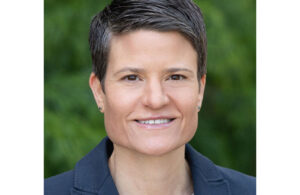
Patient Square Capital Operating Executive Ellie Humphrey [Photo courtesy of Patient Square Capital]
“What you’re going to be facing in a small company is the really ruthless decisions about your ability to raise capital to fund your innovation,” Humphrey said. “You’re going to have to be ruthless about prioritization. … If you don’t, you’re going to have significant capital constraints and potentially liquidity crises. … The last thing you want … is to be in a crisis that makes you vulnerable to somebody coming in and effectively taking your company out from underneath you at a cheap price.”
Adding to Humphrey’s point, Miller said, “There’s now the opportunity to talk about radical prioritization. What are the must-dos in the company in order to still maximize our impact across the world? And what are some things that we need to trade off? … It gives us a chance to check back in with our strategy to say, ‘Is this sustainable, or is this where we need to make some tweaks? Do we need to continue to do things offshore? Is there an opportunity to bring local manufacturing? Is there a way for us to design our way out of this because we were looking at new components anyway?’”
The panelists also had advice for those at the end of their funding journey.
“If you’re at a mid-sized company and you’re looking for an exit or a sale, you’re going to have to be patient,” Humphrey said. “You’re going to have to be seeing those complicated deal structures and understanding you’re probably going to have to take on more risk than you might have had to in the past.”
Diversity, equity and inclusion
“The top quartile for gender diversity on executive teams are 25% more likely to have above average profitability,” Hudnut-Page said. “Ethnically diverse companies are 36% more likely to outperform their competitors. We also know that the FDA is removing the diversity requirement in many of their clinical trials, which we need to get approval.”
Equity is increasingly politicized, and with federal cutbacks, making access to information and health challenging, the panelists shared how their organizations are responding.
“At The Bailey Group, we are big fans of DEI, and we’re still doing it because it resonates with our beliefs and values. I think organizations should try to be as true to their values as possible,” said Houser. “And oftentimes, I think they may find that their values have an underpinning in DEI.”

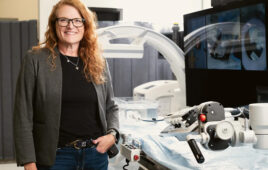
Insulet SVP of Global Commercial Capabilities & U.S. GM Carolyn Sleeth at DeviceTalks Minnesota 2025 [Photo by Jeff Pinette for Medical Design & Outsourcing]
“And if we don’t have people … thinking differently with a different set of experiences, mindset, and bringing that forward, you’re not going to get the most innovative solutions,” she continued. “We continue to prioritize inclusion and diversity to make sure we’ve got that.”
Miller cited a study reported in the American Scientific Journal that found diverse teams don’t make the same assumptions as homogeneous teams.
“And because of that, we have not shifted, we have not changed,” she said. “We are still going to move forward with that because it impacts patients’ lives.”
Talent is the most important factor for a company’s success, Humphrey said.
“Scour every corner of every part of the world to find the best talent,” she said. “The data is so clear about the value of diversity and how much better diverse companies perform. And I think the key is to remember that progress isn’t linear, and we’ve made so much progress on this dimension over the past 20 years, and to not let us be deterred. We need to stay focused on why we’re doing this, which is to get the best talent, produce the best results. Whether it’s at Patient Square, whether it’s with any of our over a dozen portfolio companies, nobody is backing off. You’ve got to recognize that you can’t be bullied into doing something that isn’t the best thing for you and your customers and your patients.”
Leading fearlessly
We will always face uncertainty, and a fearless leader doesn’t wait for volatility to pass. They know disruption is the norm, but they lead anyway. These fearless leaders shared how they communicate operational changes and decisions internally.
“Communicate honestly, communicate openly, and communicate often,” said Houser. “Give people space to process what’s going on and to stay on top of the changes.”
Miller offered up what she calls the Five Cs.
“The first is to contextualize. Contextualize the situations that we’re facing so people are very clear about what this is and what this isn’t,” she said. “The second is criticality. Who are the critical people who need to hear the critical message … and what is the critical action that they need to take? Three and four go together: candor, concise. People like candor. They trust you. They rely on you. It builds credibility. But keep it concise. And finally, communicate whatever channel that is.”
“Those five Cs have served us well,” she continued. “It has served us with retention. It has served us with people doing the right thing at the right time for the right outcome.”
Humphrey offered two more Cs: courage and conviction.
“It’s up to all of us to decide how we’re going to behave in an environment of change and uncertainty and how we’re going to show up to our teams and our companies, how we’re going to show up in our communities,” she said.
The panelists end the conversation by sharing hard-won advice on how best to lead teams for better outcomes.
“I’m a huge fan of positive intelligence and positive psychology, the premise being that the more positive we can be, the more we see opportunity, the more we have good results,” said Houser. “… [Ask yourself] what actions do you want to take so you can be that best version of yourself 10 years from now.”
Said Humphrey, “We run a company with efficiency and integrity and don’t compromise on compliance or cut corners. Staying focused on the original purpose and how we’ve created value for decades in this industry, those are the things that are going to continue to create value in the future.”
Sleeth said she’s constantly telling her team, “You’re my eyes and ears. I rely on you. I want to listen to you and make sure you feel heard and valued. We’re going to get a lot better information, and we can move forward with confidence and conviction.”
But for the person leading the team, Sleeth said, “Manage yourself. That self-care really helps you to be able to step forward.”
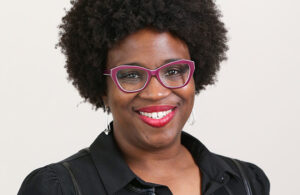
Medtronic CRM Marketing Communications VP Ravyn Miller [Photo courtesy of Vanderbilt University]
“Our superpower is our authenticity,” she added. “We don’t need to be anybody else. Nobody else is trying to be us. And as we do that, we will see the best of our work, which then proves to be the best for our patients.”
“Stay true to the moral compass of your company and stay true to yourself through authenticity,” Miller continued. “Those two things will guide you through any challenge and actually elevate all opportunities.”
We’re bringing the next Women in MedTech Breakfast to the West Coast on Oct. 16! Join us at DeviceTalks West in Santa Clara, California for networking and a fireside chat with Intuitive Global Cardiac Surgery VP Darla Hutton. Following the chat, we will break out into discussion groups led by senior leaders from companies like Medtronic, Abbott, Boston Scientific, and Baxter to continue the conversation. Register at West.DeviceTalks.com. Here’s a 25% off discount code: MDO25OFF