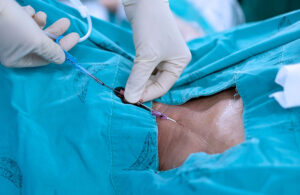
A clinician places a central venous catheter in a patient’s neck. Fibrin sheath can begin forming around catheters like these within hours of insertion. [Photo courtesy of FFS]
The Fight Fibrin Sheath (FFS) campaign says the complication has been treated as an unavoidable side effect rather than a solvable problem. The campaign aims to fund and conduct research into preventing fibrin sheath, raise awareness of the condition and its impacts and push device manufacturers to “step up innovation efforts.”
The group’s founding partners include the Vascular Access Society and medical device coatings developer BioInteractions, with support from the European Kidney Patients Federation and the Dialysis Catheter Collaborative.
“Fibrin sheath is a massive issue that no one is talking about, hence our desire to start a campaign to tackle it once and for all,” said campaign spokesperson Nick Inston, a consultant vascular access surgeon at Queen Elizabeth Hospital Birmingham. “Fibrin sheath develops in 80–100% of CVCs within the first week of insertion. This directly affects the 50–75% of dialysis patients who begin treatment on a catheter, the majority of whom still need one for their primary vascular access six or more months later.”
In a survey of 111 clinicians in 37 countries, 52% said fibrin sheath or thrombosis was the main complication limiting catheter lifespan. FFS said only 38% expressed confidence that current devices can prevent it, the lowest score of any complication tested.
FFS says it’s backing a range of solutions, including lock solutions, coatings, catheter tip and design geometry, and policy and procedures.
“The harsh truth is that CVCs have been vilified despite their continued importance,” Inston said. “It’s hugely frustrating and patients should be angry. We say it’s time for the community, including industry to start looking at catheters again. The current situation is unacceptable and why this campaign exists.”