Medical Design and Outsourcing

  • Home
  • Medical Device Business
    • Mergers & Acquisitions
    • Financial
    • Regulatory
  • Applications
    • Cardiovascular
    • Devices
    • Imaging
    • Implantables
    • Medical Equipment
    • Orthopedic
    • Surgical
  • Technologies
    • Supplies and Components Index
    • Contract Manufacturing
    • Components
    • Electronics
    • Extrusions
    • Materials
    • Motion Control
    • Prototyping
    • Pumps
    • Tubing
  • MedTech Resources
    • Medtech Events in 2026
    • The 2026 Medtech Big 100
    • Medical Device Handbook
    • MedTech 100 Index
    • Subscribe to Print Magazine
    • DeviceTalks
    • Digital Editions
    • eBooks
    • Educational Assets
    • Manufacturer Search
    • Podcasts
    • Webinars / Digital Events
    • Whitepapers
    • Voices
    • Views
    • Video
  • 2026 Leadership
    • 2025 Winners
    • 2024 Winners
    • 2023 Winners
    • 2022 Winners
    • 2021 Winners
  • Women in Medtech
  • Advertise
  • Subscribe

Flexible Ferroelectrics Bring Two Material Worlds Together

January 17, 2017 By Phys.org

A scanning electron microscopy image of flexible haloimidazole crystals, which were found to show both ferroelectric and piezoelectric properties. (Credit: Seungbum Hong/Argonne National Laboratory)

Until recently, “flexible ferroelectrics” could have been thought of as the same type of oxymoronic phrase. However, thanks to a new discovery by the U.S. Department of Energy’s (DOE) Argonne National Laboratory in collaboration with researchers at Northwestern University, scientists have pioneered a new class of materials with advanced functionalities that moves the idea from the realm of irony into reality.

Ferroelectrics are a useful type of material that is found in capacitors that are used in sensors, as well as computer memory and RFID cards. Their special properties originate from the fact that they contain charged regions polarized in a specific orientation, which can be controlled with an external electric field. But they’ve also had a big drawback as engineers try to use them in new inventions.

“Ferroelectric materials are known for being quite brittle, and so it has always been a big challenge to make them mechanically flexible,” says Argonne nanoscientist Seungbum Hong, who helped to lead the research. “Because ferroelectricity and this kind of flexibility are relatively rare properties to see on their own, to have both ferroelectricity and flexibility in this new material is basically unprecedented.”

Previous generations of ferroelectric materials were primarily ceramic, Hong says, which made them fairly brittle. In the new material, the crystal planes at the atomic level tend to slip past one another, adding to the material’s ductility.

One advantage of flexible ferroelectrics comes from the fact that all ferroelectric materials are also piezoelectric, which means they can convert an applied mechanical force into an electrical signal, or vice versa; for example, when you flick a lighter to generate a spark. Having more flexible ferroelectrics could enable a greater response from a smaller input.

With flexible ferroelectrics, scientists and engineers may have the opportunity to adapt these materials for a host of new and improved uses, including precision actuators for atomic force microscopy, ultrasonic imaging sensors and emitters for medical applications and even sensors for some automotive applications.

For data storage, the impact may be even greater. “There’s a very large information density potential with ferroelectric storage,” Hong says. “This could make a big difference as we think about future generations of the data cloud.”

An article based on the research, “Flexible ferroelectric organic crystals,” was published online in Nature Communications in October. One of the lead Northwestern authors of the study, Sir Fraser Stoddart, received the 2016 Nobel Prize in Chemistry for his work on molecular machines.


Related Articles Read More >

The most innovative medical devices of 2026
Reconstructed 3D fluorescence image of the stained biohybrid mesh-tissue integration. The red, green, and blue colors correspond to the mesh, F-actin, and nuclei, respectively.
Researchers mesh electronics with human cells to develop living battery
A photo of the Paradromics Connexus brain-computer interface on a fingertip.
How Paradromics designed its Connexus brain-computer interface system
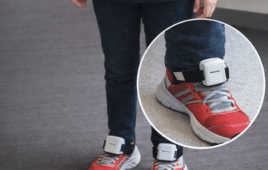
A photo of the wearable gait sensors used in the study.
Yale-led study finds wearable sensors match motion capture for gait tracking in knee osteoarthritis
“mdo
EXPAND YOUR KNOWLEDGE AND STAY CONNECTED
Get the latest medical device business news, application and technology trends.

DeviceTalks Weekly

See More >

MDO Digital Edition

Digital Edition

Subscribe to Medical Design & Outsourcing. Bookmark, share and interact with the leading medical design engineering magazine today.

MEDTECH 100 INDEX

Medtech 100 logo
Market Summary > Current Price
The MedTech 100 is a financial index calculated using the BIG100 companies covered in Medical Design and Outsourcing.

New MedTech Resource

Medical Tubing

MassDevice

Mass Device

The Medical Device Business Journal. MassDevice is the leading medical device news business journal telling the stories of the devices that save lives.

Visit Website
MDO ad
Medical Design and Outsourcing
  • MassDevice
  • DeviceTalks
  • MedTech100 Index
  • Medical Tubing + Extrusion
  • Medical Design Sourcing
  • Drug Delivery Business News
  • Drug Discovery & Development
  • Pharmaceutical Processing World
  • R&D World
  • About Us/Contact
  • Advertise With Us
  • Subscribe to Print Magazine
  • Subscribe to our E-Newsletter
  • Listen to our Weekly Podcasts
  • Join our DeviceTalks Tuesdays Discussion

Copyright © 2026 Arrowfly, LLC. All Rights Reserved. The material on this site may not be reproduced, distributed, transmitted, cached or otherwise used, except with the prior written permission of Arrowfly LLC. Site Map | Privacy Policy | RSS

Search Medical Design & Outsourcing

  • Home
  • Medical Device Business
    • Mergers & Acquisitions
    • Financial
    • Regulatory
  • Applications
    • Cardiovascular
    • Devices
    • Imaging
    • Implantables
    • Medical Equipment
    • Orthopedic
    • Surgical
  • Technologies
    • Supplies and Components Index
    • Contract Manufacturing
    • Components
    • Electronics
    • Extrusions
    • Materials
    • Motion Control
    • Prototyping
    • Pumps
    • Tubing
  • MedTech Resources
    • Medtech Events in 2026
    • The 2026 Medtech Big 100
    • Medical Device Handbook
    • MedTech 100 Index
    • Subscribe to Print Magazine
    • DeviceTalks
    • Digital Editions
    • eBooks
    • Educational Assets
    • Manufacturer Search
    • Podcasts
    • Webinars / Digital Events
    • Whitepapers
    • Voices
    • Views
    • Video
  • 2026 Leadership
    • 2025 Winners
    • 2024 Winners
    • 2023 Winners
    • 2022 Winners
    • 2021 Winners
  • Women in Medtech
  • Advertise
  • Subscribe