Medical Design and Outsourcing

  • Home
  • Medical Device Business
    • Mergers & Acquisitions
    • Financial
    • Regulatory
  • Applications
    • Cardiovascular
    • Devices
    • Imaging
    • Implantables
    • Medical Equipment
    • Orthopedic
    • Surgical
  • Technologies
    • Supplies and Components Index
    • Contract Manufacturing
    • Components
    • Electronics
    • Extrusions
    • Materials
    • Motion Control
    • Prototyping
    • Pumps
    • Tubing
  • MedTech Resources
    • Medtech Events in 2026
    • The 2025 Medtech Big 100
    • Medical Device Handbook
    • MedTech 100 Index
    • Subscribe to Print Magazine
    • DeviceTalks
    • Digital Editions
    • eBooks
    • Educational Assets
    • Manufacturer Search
    • Podcasts
    • Webinars / Digital Events
    • Whitepapers
    • Voices
    • Views
    • Video
  • 2026 Leadership
    • 2025 Winners
    • 2024 Winners
    • 2023 Winners
    • 2022 Winners
    • 2021 Winners
  • Women in Medtech
  • Advertise
  • Subscribe

Harvard researchers are closer to human heart fabrication

July 19, 2022 By Chris Newmarker

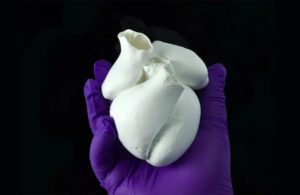
Harvard SEAS image of biohybrid model of a four-chambered heart engineered with focused rotary jet spinning or FRJS

A biohybrid model of a four-chambered heart engineered with focused rotary jet spinning (FRJS) technology [Image courtesy of Harvard SEAS]

Harvard University researchers used focused rotary jet spinning (FRJS) technology to fabricate polymer fibers that mimic the helical structure of heart muscles.

They created ventricle structures with the method and then seeded them with rat cardiomyocyte or human stem cell-derived cardiomyocyte cells, according to a news release from the Wyss Institute for Biologically Inspired Engineering at Harvard University. Roughly a week later, they had several thin layers of beating tissue covering the scaffold. The cells in the beating tissue followed the same helical alignment as the fibers underneath.

The bioengineers, who were from the Wyss Institue and the Harvard John A. Paulson School of Engineering and Applied Sciences (SEAS), were then able to run experiments that compared the performance of ventricles made from helically aligned fibers with those made from circumferentially aligned fibers. They found the helically aligned tissue outperformed the circumferentially aligned tissue on every front. The result provided evidence backing a decades-old hypothesis — biomathematician Edward Sallin’s idea from 1969 that the heart’s helical alignment is critical to achieving large ejection fractions.

“In this case, we went back to address a never tested observation about the helical structure of the laminar architecture of the heart. Fortunately, Professor Sallin published a theoretical prediction more than a half century ago, and we were able to build a new manufacturing platform that enabled us to test his hypothesis and address this centuries-old question,” said Kit Parker, professor of bioengineering and applied physics at SEAS, an associate faculty member at the Wyss Institute and senior author of the research paper appearing in Science.

Developed at SEAS by Parker’s Disease Biophysics Group, focused rotary jet spinning (FRJS) can provide high-throughput fabrication of specifically aligned fibers. Diameters can range from several micrometers to hundreds of nanometers.

“The human heart actually has multiple layers of helically aligned muscles with different angles of alignment. With FRJS, we can recreate those complex structures in a really precise way, forming single and even four chambered ventricle structures,” said Huibin Chang, a SEAS postdoctoral fellow and co-first author of the paper.

Here’s how the Wyss Institue news release describes FRJS:

“The first step of FRJS works like a cotton candy machine — a liquid polymer solution is loaded into a reservoir and pushed out through a tiny opening by centrifugal force as the device spins. As the solution leaves the reservoir, the solvent evaporates, and the polymers solidify to form fibers. Then, a focused airstream controls the orientation of the fiber as they are deposited on a collector. The team found that by angling and rotating the collector, the fibers in the stream would align and twist around the collector as it spun, mimicking the helical structure of heart muscles. The alignment of the fibers can be tuned by changing the angle of the collector.”

It would take more than a century to 3D print every bit of collagen in the human heart at a single micron diameter resolution; it takes a single day with FRJS, according to the Harvard researchers.

The Harvard Office of Technology Development is exploring commercialization opportunities around the intellectual property related to the project.

Said Parker: “This work is a major step forward for organ biofabrication and brings us closer to our ultimate goal of building a human heart for transplant.”


About The Author

Avatar photo
Chris Newmarker

Chris Newmarker is the executive editor of WTWH Media life science's news websites and publications including MassDevice, Medical Design & Outsourcing and more. A professional journalist of 18 years, he is a veteran of UBM (now Informa) and The Associated Press whose career has taken him from Ohio to Virginia, New Jersey and, most recently, Minnesota. He’s covered a wide variety of subjects, but his focus over the past decade has been business and technology. He holds bachelor’s degrees in journalism and political science from Ohio State University. Connect with him on LinkedIn or email at [email protected].

Comments

  1. William says

    July 20, 2022 at 6:11 am

    Certainly a large step indeed toward producing a usable replacement heart. But certainly a lot of steps remain.
    Verifying the conclusions of half a century ago is interesting as the question is why did it take so long.
    So what will the next steps be??
    Please keep us informed about this.

Related Articles Read More >

An illustration showing Corcym's Memo 4D Curve's laser-cut nitinol core.
Laser-cut nitinol and a layered design let these cardiac implants flex
A close of of Medical 21's Maverics graft.
A surgeon’s prayer helped St. Jude Medical founder Manny Villafaña size his latest device
A photo of Forj Medical's Costa Rica manufacturing facility.
Forj Medical opens Costa Rica manufacturing site
Syensqo material supports modular sternal spacer for cardiothoracic care
“mdo
EXPAND YOUR KNOWLEDGE AND STAY CONNECTED
Get the latest medical device business news, application and technology trends.

DeviceTalks Weekly

See More >

MDO Digital Edition

Digital Edition

Subscribe to Medical Design & Outsourcing. Bookmark, share and interact with the leading medical design engineering magazine today.

MEDTECH 100 INDEX

Medtech 100 logo
Market Summary > Current Price
The MedTech 100 is a financial index calculated using the BIG100 companies covered in Medical Design and Outsourcing.

New MedTech Resource

Medical Tubing

MassDevice

Mass Device

The Medical Device Business Journal. MassDevice is the leading medical device news business journal telling the stories of the devices that save lives.

Visit Website
MDO ad
Medical Design and Outsourcing
  • MassDevice
  • DeviceTalks
  • MedTech100 Index
  • Medical Tubing + Extrusion
  • Medical Design Sourcing
  • Drug Delivery Business News
  • Drug Discovery & Development
  • Pharmaceutical Processing World
  • R&D World
  • About Us/Contact
  • Advertise With Us
  • Subscribe to Print Magazine
  • Subscribe to our E-Newsletter
  • Listen to our Weekly Podcasts
  • Join our DeviceTalks Tuesdays Discussion

Copyright © 2026 Arrowfly, LLC. All Rights Reserved. The material on this site may not be reproduced, distributed, transmitted, cached or otherwise used, except with the prior written permission of Arrowfly LLC. Site Map | Privacy Policy | RSS

Search Medical Design & Outsourcing

  • Home
  • Medical Device Business
    • Mergers & Acquisitions
    • Financial
    • Regulatory
  • Applications
    • Cardiovascular
    • Devices
    • Imaging
    • Implantables
    • Medical Equipment
    • Orthopedic
    • Surgical
  • Technologies
    • Supplies and Components Index
    • Contract Manufacturing
    • Components
    • Electronics
    • Extrusions
    • Materials
    • Motion Control
    • Prototyping
    • Pumps
    • Tubing
  • MedTech Resources
    • Medtech Events in 2026
    • The 2025 Medtech Big 100
    • Medical Device Handbook
    • MedTech 100 Index
    • Subscribe to Print Magazine
    • DeviceTalks
    • Digital Editions
    • eBooks
    • Educational Assets
    • Manufacturer Search
    • Podcasts
    • Webinars / Digital Events
    • Whitepapers
    • Voices
    • Views
    • Video
  • 2026 Leadership
    • 2025 Winners
    • 2024 Winners
    • 2023 Winners
    • 2022 Winners
    • 2021 Winners
  • Women in Medtech
  • Advertise
  • Subscribe