Cardiac Dimensions Chief Medical officer Dr. William Abraham [Photo courtesy of The Ohio State University]
V-Wave’s U.S. pivotal trial, RELIEVE-HF (short for Reducing Lung CongestIon Symptoms Using the V-Wave Shunt in Advanced Heart Failure), demonstrated the Ventura interatrial shunt’s safety but fell short of its efficacy endpoint across the entire patient population.
Related: Why V-Wave’s heart failure tech is worth $1.7B to J&J
The study included heart failure with reduced ejection fraction (HFrEF) patients as well as patients with heart failure with preserved ejection fraction (HFpEF). The results showed benefits for that first group but not the second, and the trial’s design meant it wasn’t the end of the road for V-Wave’s technology.
“It was a very well designed and really well executed study,” he said in a Medical Design & Outsourcing interview.
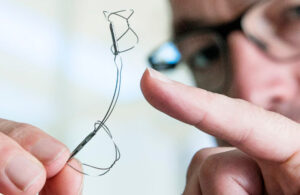
The Cardiac Dimensions Carillon Mitral Contour System is made of nitinol for its superelasticity and shape memory properties. [Photo courtesy of Cardiac Dimensions]
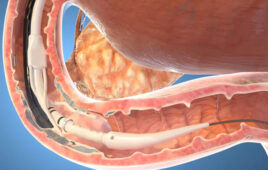
In this second part, we discuss lessons from V-Wave’s pivotal trial and what’s ahead for Cardiac Dimensions as it enrolls functional mitral regurgitation (FMR) patients in the Empower study of its implantable, nitinol-enabled Carillon Mitral Contour System, which already has a CE mark in Europe.
The following has been lightly edited for clarity and space.
MDO: What did you learn from the V-Wave pivotal trial that could help other device developers?

The V-Wave Ventura interatrial shunt being anchored inside a patient’s heart before the guidewire is retracted. [Image courtesy of V-Wave]
How is that different from subgroups?
Abraham: “We specify lots of subgroups. Oftentimes subgroup specification in clinical trials is based on what we did in the last trial or what we think is appropriate to do. We stratify by sex, men and women, we stratify by age, older and younger, and so on and so forth. We don’t expect differences among those subgroups. But when we stratify randomization, we do that because we think it’s possible that the two strata may not be poolable. We may not see the same results, and we want to have the ability to independently analyze the two strata in a way that is perhaps statistically a bit more valid than just the typical subgroup analysis.”
What’s the trade off from that approach? Time and cost to get the enrollment numbers?
Abraham: “To some extent. You don’t have to individually power to either strata. A lot depends on how it all turns out at the end. There’s no crystal ball. We test the interaction between the strata using something called an interaction test. You’ve heard of the interaction p-value. Based on statistical principle, if the interaction p-value is insignificant, it means that the two strata are poolable and you analyze the results in the entire group. If the interaction p-value is positive, it indicates the two strata are not poolable. They behave very differently in the study. Then, statistical principles say you go on and you analyze the separate strata. You can’t stratify randomization on too many factors. We try to do it on the basis of one or at most two clinical factors. But it at least gives you an opportunity to come up with a hypothesis that we don’t think this therapy is going to depend on whether or not you’re a man or a woman, but we do think this therapy might depend on whether or not you have HFrEF or HFpEF. So let’s stratify on that basis, and based on these statistical principles, do the right test at the end of the day to see who really responds to this therapy.”
What’s your biggest challenge in the Carillon system’s pivotal trial and what’s the plan to overcome it?

Cardiac Dimensions designed the nitinol-enabled Carillon Mitral Contour System implant to treat mitral regurgitation by cinching the valve annulus from the coronary sinus. [Illustration courtesy of Cardiac Dimensions]
What kind of tactics can device developers use to get the right people in their trial?
Abraham: “One of the most effective tactics we’ve used over the years is promoting the heart team approach and the co-equals at sites between implanting physician and managing physician to designate co-PIs (principal investigators). Usually institutions have to designate a single PI of record for IRB and contracting purposes, but there’s no reason why a study sponsor can’t designate a lead implanter and a lead heart failure specialist as co-PIs, or an implanter and heart failure specialist at the site. You get engagement from both specialties that are vitally important in executing the trial. It’s developing that partnership with the managing physicians and the implanting physicians to make sure there’s a smooth flow of patients from one to the other.”
Nitinol innovation: Download our free special report featuring nitinol expertise and tips from medical device OEMs