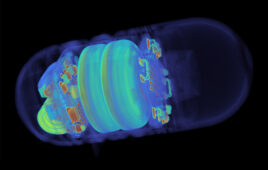
[Brain EEG rendering from peterschreiber.media on Adobe Stock]
Researchers say it could enable doctors to soon reduce epilepsy misdiagnoses by up to 70%. This tool uncovers hidden epilepsy signatures in seemingly normal EEG (electroencephalogram) tests. According to a post on Johns Hopkins’ website, the tool could significantly reduce false positives seen in around 30% of cases globally. This would spare patients form medication side effects, driving restrictions and other quality of life changes related to misdiagnosis.
The researchers published their findings in Annals of Neurology.
“Even when EEGs appear completely normal, our tool provides insights that make them actionable,” said Sridevi V. Sarma, a Johns Hopkins biomedical engineering professor who led the work. “We can get to the right diagnosis three times faster because patients often need multiple EEGs before abnormalities are detected, even if they have epilepsy. Accurate early diagnosis means a quicker path to effective treatment.”
According to Johns Hopkins, clinicians partly rely on EEGs to diagnose epilepsy and decide if patients need anti-seizure medications. However, EEGs can prove challenging to interpret due to noisy signals and because seizures rarely occur during the recording. To improve this, Sarma’s team looked at what happens in the brains of patients when they aren’t experiencing seizures.
The tool, called EpiScalp, uses algorithms trained on dynamic network models. It maps brainwave patterns and identifies hidden signs of epilepsy from a single routine EEG. The study looked at 198 patients across five major medical centers. Of these patients, 91 had epilepsy while the rest had non-epileptic conditions mimicking epiliepsy.
Reanalyzing the initial EEGs using EpiScalp, the tool ruled out 96% of the false positives. It cut potential misdiagnoses among these cases from 54% to 17%.
“This is where our tool makes a difference because it can help us uncover markers of epilepsy in EEGs that appear uninformative, reducing the risk of patients being misdiagnosed and treated for a condition they don’t have,” said Khalil Husari, co-senior author and assistant professor of neurology at Johns Hopkins. “These patients experienced side effects of the anti-seizure medication without any benefit because they didn’t have epilepsy. Without the correct diagnosis, we can’t find out what’s actually causing their symptoms.”
The team is now conducting a larger prospective study to further validate its findings across three epilepsy centers. Additionally, the researchers filed a patent for the EpiScalp technology in 2023.