Select the right electrical termination methods for smooth and reliable high-voltage power supply (HVPS) operation.
By Dermot Flynn, Advanced Energy

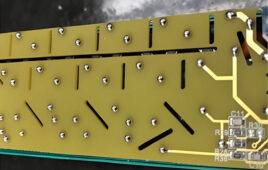
This illustration shows proper ball soldering techniques using J-hooks and studs. [Image courtesy of Advanced Energy]
To ensure HVPS devices operate smoothly and reliably, it is important to pay close attention to the electrical termination and mounting methods on the printed circuit board (PCB) or in the system.
In this two-part series, we will examine best practice for the installation and integration of high-voltage power supplies to ensure reliable, trouble-free and safe operation, starting with termination methods in this first article and mounting methods in the second article.
Nitinol Innovation Special Report: Download MDO’s free special report featuring interviews with OEM experts developing high-voltage systems for pulsed-field ablation
Electrical termination methods for HVPS
High-voltage power supplies can be electrically terminated via a PCB. This is a common and straightforward method. There are two primary approaches to PCB termination: direct and ball soldering.
The power supply can be soldered directly to the PCB, leveraging the industry standard 0.100-inch / 0.200-inch header spacing. This method offers simplicity in manual mounting but may present challenges in service and automated assemblies. Soldering directly to a PCB can provide a solid and reliable electrical connection, but it also demands meticulous attention to detail to ensure that the solder joints are robust and free from defects that could compromise the connection over time.
While nearly all input/output (I/O) connections of a power supply can be soldered directly to a PCB using typical industry-wide soldering techniques, extreme care must be taken when soldering conductors together, which will carry high voltage. When such connections are needed, ball soldering is commonly used in the high voltage industry.
For ball soldering, all connections subjected to high voltage must be terminated with a smooth, semi-spherical ball of solder with no sharp edges or points. This greatly reduces or eliminates the electric field (e-field) around the joint, avoiding localized ionization and allowing for high reliability and long product life.
Failure to do so will result in high e-field levels around the connection, which will create ionization that in turn leads to the production of ozone. Even if the solder joint is completely encapsulated within insulative potting material, the high e-field will eventually break down the potting compound and may damage the PCB substrate, resulting in tracking, flashover, and eventual catastrophic failure of the joint and the power supply itself.
Sockets as an alternative to soldering
Sockets provide a more flexible solution, particularly for field-repairable systems. They allow for easier troubleshooting and component-level repairs.
In-line machined sockets, such as single-row or dual-row variants, are preferred for their ease of handling and placement during assembly. Press-in sockets, although requiring non-standard PCB holes, offer robustness by reducing the number of different socket types needed for various HVPS models. Sockets facilitate the replacement of the power supply or PCB without the need for soldering, making maintenance and servicing more efficient. However, if any sockets carry high voltage, ball-soldering is a must.
When mounting the HVPS onto a PCB, it is crucial to ensure robust mechanical support to prevent pin damage from mechanical stress. Often it is essential to incorporate thermal management practices to avoid overheating issues. Sockets can help by reducing thermal strain during soldering processes and providing a secure connection that mitigates the risk of mechanical stress.
Wiring harness termination
Wiring harness termination offers more flexibility to position a HVPS within an enclosure, which is beneficial for thermal management and space utilization. This can be achieved by soldering the wire harness directly to the HVPS. This approach requires a reliable soldering technique, such as the J-hook method.
It is important to strain-relief the harness to protect the HVPS pins from lateral forces that could cause damage or fatigue. Direct soldering can offer a very secure connection. However, it must be done with precision to avoid cold solder joints or excessive mechanical strain on the pins.
Another reliable approach is to select an HVPS that has pluggable connectors instead of pin connections. Pluggable connectors can be lockable and keyed, preventing inadvertent incorrect connection. This enhances troubleshooting and eases assembly. Pluggable connectors help maintain a sturdy connection even in challenging environments. They are preferable for applications where the HVPS might need replacement or frequent servicing because they make disassembly and reassembly simpler and more reliable.

Dermot Flynn [Photo courtesy of Advanced Energy]
Dermot Flynn, head of product line management for medical products system power at Advanced Energy, has more than 20 years of experience in the power supply industry. He holds a BAI in electronic and electrical engineering and a BA in mathematics from Trinity College, Dublin, as well as a higher diploma in management and marketing from University College, Cork, and a higher diploma in education from Trinity College, Dublin.
Read more MDO Contributions and learn how to submit your own
The opinions expressed in this blog post are the author’s only and do not necessarily reflect those of Medical Design & Outsourcing or its employees.