CathWorks CEO Ramin Mousavi says his startup “came very close to not existing” before reworking its noninvasive CAD tech.

CathWorks CEO Ramin Mousavi [Image courtesy of CathWorks]
The idea sounded “crazy” to the founders of CathWorks in 2013, but the possibility ignited the startup’s bold mission to transform how heart disease is diagnosed and treated.
Like many startups, CathWorks initially struggled. During the COVID-19 pandemic, the company nearly failed, CathWorks CEO Ramin Mousavi said during an appearance on our DeviceTalks Weekly podcast.
It survived for 13 years by leaning on strategic partnerships. In February 2026, Medtronic announced plans to acquire the company for up to $585 million in a deal that closed near the end of April.
CathWorks fast-tracked its path to acquisition by relying on its strategic partnerships during product development. Medtronic saw potential in CathWorks’ technology in 2018, becoming a minority investor with non-dilutive funding before it was commercialized.
“[It was] the best of both worlds,” Mousavi said. “The money invested in CathWorks empowered us to put our heads down and innovate, and generate clinical evidence.”
Medtronic now sees the potential for CathWorks to positively disrupt the traditional wire-based FFR segment, according to Medtronic SVP and Coronary & Renal Denervation President Jason Weidman, a key voice in CathWorks’ product development.
“This acquisition allows Medtronic to transform the cath lab with a technology that provides real-time data, informs individualized treatment approaches and drives new standards of care,” Weidman said in an announcement of the deal.
Advice for medical device startups: The 2026 MDO Medtech Startups Special Report
Birth of a startup
Coronary artery disease (CAD) is a leading cause of death in the United States. When a patient shows suspected CAD symptoms, they may undergo two diagnostic procedures: an angiogram and a fractional flow reserve (FFR) test.
During an angiogram, contrast dye is injected through a catheter in the femoral artery, illuminating blood flow and helping visualize blockages and narrow arteries on X-ray images. If stenosis is severe or inconclusive, a more invasive procedure to assess FFR would determine the type of intervention needed.
MDO Min-Vasive Medtech: Download our free 72-page special report featuring interviews with minimally invasive device development experts and engineers at major OEMs and groundbreaking startups
FFR measures the severity of stenosis and potential for ischemia, using sensors on a guidewire to measure blood flow on either side of the blockage. Sometimes, physicians increase blood flow with medication for the most accurate measurements. Wire-based FFR is underutilized because of its invasive nature despite being essential for improving patient outcomes.
CathWorks sought to create an alternative, noninvasive system.
“The unmet need was, ‘Can you find an innovative technology solution that can fit within the current workflow, that can be a better alternative?’ [We needed] one that was well vetted and clinically evaluated for invasive coronary physiology [assessment].” Mousavi said.
CathWork’s first launch and failure
CathWorks’ FFRangio system works as an intraoperative device that uses artificial intelligence (AI) and advanced computational technology to provide a comprehensive physiological assessment of the entire coronary tree based on routine coronary angiograms (X-rays) within minutes. But the system wasn’t a quick success.
FFRangio’s first rendition showed high diagnostic accuracy when compared to traditional wire-based FFR when it earned FDA approval in 2018, but it didn’t include any of the advanced technology that creates the coronary assessment in today’s version.

The CathWorks FFRangio system uses AI and advanced computational technology to provide a comprehensive physiological assessment of the entire coronary tree. [Image courtesy of CathWorks]
“No way [physicians] were going to spend 22 minutes in the lab letting someone do a Picasso,” Mousavi said. “Like most startups, [we] failed very badly at that launch. … We had to go back to the drawing board.”
Mousavi consulted with Weidman and Medtronic VP Chris Eso with a big question: “How are we going to solve this?”
CathWorks’ technology failed to satisfy customers, and it needed a solution to accelerate its diagnostic process, but even if Mousavi and his team found a quick fix, the COVID-19 pandemic would hinder any chance at a successful product launch.
“The company came very close to not existing,” Mousavi said.
Eso and Weidman were willing to take a risk with the technology that failed, Mousavi said. They gave CathWorks feedback based on their industry experience and sought insights directly from customers.
CathWorks’ partners recommended automating the diagnostic process — specifically, the manual model creation element — using AI and advanced computational science. With that, Mousavi’s engineers embarked on FFRangio’s revision.
Continued development and how it works
Mousavi’s team first began automating the manual 3-D coronary model process by constructing artificial neural networks with X-ray images as data sets.
FFRangio takes three X-ray images and uses a series of neural networks to organize and identify the main vessels and side branches in the artery. Then, it uses a proprietary algorithm validated by a resistance model to build the 3-D coronary tree model.
After automating the 3-D model process, CathWorks treated the heart as an “electric circuit,” Mousavi said.
“We take all the [heart’s] nodes and calculate how much resistance is in each of the nodes,” Mousavi explained. “Then, we convert that into a visualization of the blockage. … It’s pretty genius, actually.”
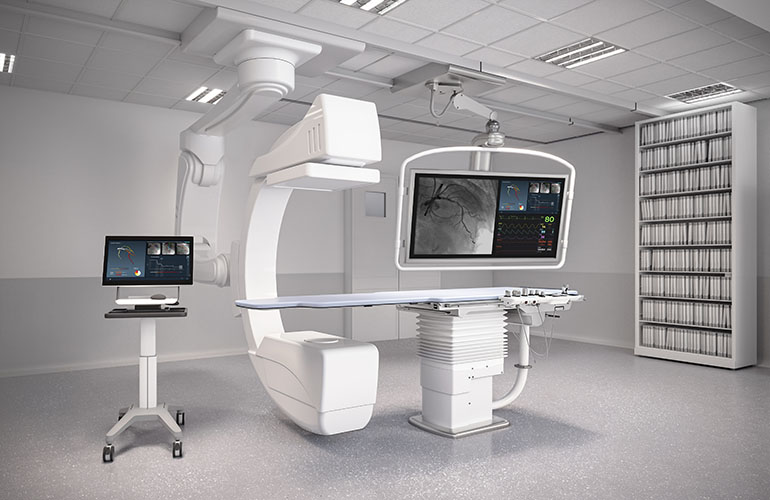
FFRangio offers a noninvasive alternative to the traditional wire-based FFR segment and fits within the current hospital workflow. [Image courtesy of CathWorks]
The revamped system is around 95% automated with some user confirmation, but a comprehensive diagnostic process that once took 22 minutes now takes only two minutes.
Launch 2.0 and a renewed partnership
CathWorks and its partners tested FFRangio’s upgraded system in a limited release aimed at gaining customer feedback, and Mousavi said they saw the same thing: “The improvement that we were all hoping for.”
CathWorks began receiving offers for acquisition following its success, but Mousavi waited to enter another strategic partnership with Medtronic in 2022. He said the company was still in its early commercial days despite its vast improvement, and he didn’t want the technology to fail after acquisition.

Jason Weidman, SVP and president of Medtronic’s Coronary & Renal Denervation business, was a key voice in CathWorks’ product development. [Image courtesy of Medtronic]
The structure of CathWorks’ 2022 partnership with Medtronic would give Mousavi and his team time to bring the technology to a place where it had an increased opportunity of becoming the next standard of care, Mousavi said. They needed more clinical evidence and access to Medtronic’s global network in a co-promotion deal while CathWorks engineers continued to advance its software.
CathWorks has conducted five validation studies with global clinical data and FFRangio has earned regulatory approval in the U.S., Europe and Japan, since beginning its partnership with Medtronic. CathWorks will present the results of its largest randomized controlled clinical trial, which enrolled over 1,900 patients across 59 global investigational sites, at the American College of Cardiology meeting later this year.
“We’ve done a lot of things that you couldn’t do if you just handed [the technology] to someone else,” Mousavi said. “That’s why we chose Medtronic.”
DeviceTalks Editorial Director Tom Salemi contributed to this report.
This article was originally published on Feb. 17, 2026 and was updated on April 20, 2026 when the deal closed.