Breaking down why medical-grade silicone is at the heart of CGMs and other healthcare innovations.
By Jay Rutherford, Lubrizol
Part one of this series focuses on medical-grade silicone’s use in life-critical devices, including how it balances moisture and its importance in wound care and implants. Part two focuses on how to navigate material choices and leverage innovations like pigments and multilayer designs for complex devices.
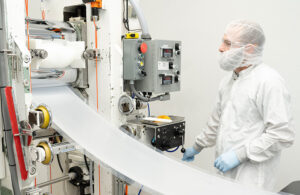
In a tightly controlled cleanroom environment, a technician oversees the calendering process, a precision method used to produce medical-grade, high-performance silicone sheets with exact thickness and surface consistency. [Photo courtesy of Lubrizol]
Biocompatible and breathable, medical-grade silicone is ideal for sealing, bonding and creating barriers of elastomeric components. Indeed, it can be a versatile, effective tool in a medical designer’s tool kit. But medical-grade silicone must meet the strictest purity standards to be trusted for life-critical devices.
Let’s explore some of the standards that high-quality silicone should meet, how its properties can provide advantages in some critical applications, and how medical device engineers can apply the material to meet today’s demands.
Getting to know silicone

These fine-tipped forceps are gently lifting an ultra-thin medical-grade silicone film — possibly as slim as 0.0005 in. — demonstrating the delicate handling required for this thin and flexible material in both manufacturing and surgical settings. [Photo courtesy of Lubrizol]
From these raw materials, a huge variety of medical devices can be produced, many of which make use of silicone film and sheeting. Medical-grade sheeting from Lubrizol is manufactured per ISO 13485 (QMS requirements) in ISO Class 7 cleanrooms. The resulting material can be cut and shaped to fit just about any need. Precision cutting is handled by die cutting and laser cutting. There are also multilayer options having (typically) two or three silicone layers that add another dimension of versatility.

This technician is using a handheld gauge to verify thickness of a pigmented medical-grade silicone sheet. [Photo courtesy of Lubrizol]
Silicone also has unique functional properties that make it a go-to material for improving patient outcomes, especially in challenging applications.

Carefully controlled manufacturing practices are required to form unvulcanized silicone into sheeting without contamination or flaw. Machines do heavy lifting, but the final stage of calendering is all about the human touch, with technicians teaming up to make sure each sheet is perfect before it moves on. [Photo courtesy of Lubrizol]
Silicone is frequently used as a primary wound dressing placed in direct contact with wounds. The perforated silicone film dressing stays in place for extended periods of time, so secondary wound dressings — used to absorb wound exudate — can be changed without disturbing the delicate healing skin. (Mepitel One manufactured by Mölnlycke Health Care, and Cuticell Contact manufactured by Essity are two examples of this type of product.) Plus, the transparency of the film means you can inspect the wound without removing the dressing, a huge benefit for undisturbed healing and cutting down on the number of changes.
How silicone is overcoming design challenges in critical applications

A medical-grade silicone sheet winds through the processing line. [Photo courtesy of Lubrizol]
A common use of reinforced sheeting is at suture locations. Without reinforcement, sutures will cut through silicone, causing it to tear. Proper reinforcement makes suture sites stronger than the sutures themselves. Tissue expanders used in breast reconstruction or skin repair, for example, use suture tabs made from reinforced sheeting to ensure they remain in place.
Devices that are implanted in the brain, such as cerebral shunts and electrodes, can also rely on reinforced sheeting to handle physical stresses while being safe for nearby tissues. The silicone encapsulation prevents tissue from growing into the mesh and minimizes trauma to the surrounding tissue if the device moves or must be removed.
The bottom line is that silicone is a trusted material for OEMs because it’s tough when needed but soft enough for delicate uses.
And its versatility gets even better when you bring vulcanized and unvulcanized silicone together. In part two, we explore how this duo works in harmony to create innovative, practical solutions for device assembly. We’ll also dive deeper into how customizations like pigments, radiopaque additives and medical-grade inks are helping meet other safety and functionality needs for devices that rely on high-quality silicones.

Jay Rutherford [Photo courtesy of Lubrizol]
How to submit a contribution to MDO
The opinions expressed in this blog post are the author’s only and do not necessarily reflect those of Medical Design & Outsourcing or its employees.