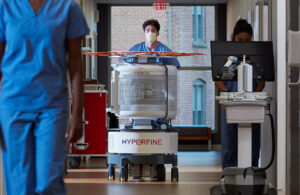
At 33 in. wide, the 1,400-lb Hyperfine Swoop MRI scanner is compact enough to be wheeled through hospital hallways. [Photo courtesy of Hyperfine]
“We can perform brain MRIs pretty much anywhere because we have a very unique, portable brain MRI,” Hyperfine President and CEO Maria Sainz said in an interview. “Where we’re headed is really to help with brain health … to provide screening and scans to patients at large as part of physicals on an annual basis, based on pre-existing conditions, genetics, any other risk factor. We will be able to perform a brain MRI just like we do an EKG or pulse oximetry to check your pulse as part of your physical exam.”
Hyperfine won its first FDA clearances for the technology in 2020 and improved image quality with subsequent software updates. The device developer is now rolling out the ninth generation of software.
How Hyperfine designed the Swoop portable brain MRI
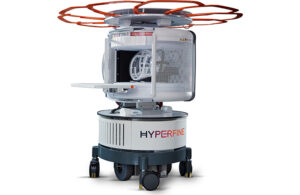
Hyperfine’s portable Swoop MRI scanner [Photo courtesy of Hyperfine]
“Even at that low field, we’re able to generate clinically valuable and diagnostic quality brain images, and we do that through the help of a lot of AI and software development and sequence development,” Sainz said.
And unlike larger, permanently fixed MRI scanners, Swoop doesn’t need helium (a finite, dwindling resource) to cool its magnet.
The Swoop system’s form factor has remain mostly unchanged from the early days, Sainz said. At 33 in. wide and operated with an iPad, the 1,400-lb device is compact enough to be wheeled into standard elevators, through standard hallways and right up to the bedside of a critical care patient who’s not fit to be moved for a traditional MRI — or a child who’s afraid to be scanned without a parent next to them.
Hyperfine has applied its AI algorithms to the four sequences that matter for brain scanning: T1, T2, fluid-attenuated inversion recovery (FLAIR) and diffusion-weighted imaging (DWI).
“The accumulation of our own images, understanding what was noise, what was artifact, what was pathology, what was anatomy is what has enabled us to continue to improve with the help of software development and deep learning,” Sainz said.
Hyperfine’s next challenges

Hyperfine President and CEO Maria Sainz [Photo courtesy of Hyperfine]
The biggest challenge is common to MRI developers: motion, which can cause artifacts that reduce an image’s diagnostic value. Hyperfine’s engineers also have to worry about the potential for artifacts caused by interference from other equipment wherever the system is wheeled. But faster image acquisition through smarter software can help solve both of those problems, Sainz said.
“The biggest challenge we face and we need to solve for with software, with image quality and with AI, is motion. … By reducing the time it takes to get the images — the scan time — the ability for the patient to move is less, and the ability to undergo interferences is also less,” she said.
Hyperfine is also involved in studies that could demonstrate whether faster access to imaging through Swoop can detect trouble sooner, improve patient outcomes and lower overall costs.
“They are not big clinical trials,” Sainz said. “They are more adoption studies that are aimed to prove how this compares, first on detection abilities. So do we see stroke just as well as a high-field magnet, do we see [rheumatoid arthritis] complications for Alzheimer’s patients just as well, but if we do, can we discharge the patients faster? Can we lower the cost of care because we have access to the images quicker? That is where I am focused in terms of those workflow benefits that we need to prove and show to generate the adoption of our technology.”
‘We can help you wherever you need us’

The Hyperfine Swoops is being used for pediatric conditions that require multiple scans where radiation-free MRI would be safer than CT scans. [Photo courtesy of Hyperfine]
“We need to take the brain a lot more seriously than we’ve been taking it, and be more proactive with screening and early detection,” Sainz said. “… Technology needs to serve care where it’s going, in a decentralized way, closer to home. I think there’s a day where hopefully our scanners can be in the drugstore around the corner, so that just like you go get your blood pressure checked, you could go and get your brain scanned [and the results] conveyed to a clinician that would be appropriately trained and qualified to read it so that the diagnosis is accurate.”
“Whether you’re an infant born with a defect or an elderly patient starting to lose your memory, we can help — and we can help you wherever you need us,” she said. “That makes this such a unique mission and such an exciting mission.”