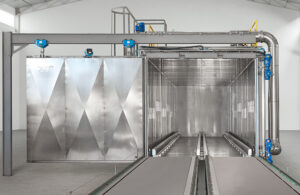
This empty, open ethylene oxide sterilization chamber has double pallet tracks for automated processing. [Photo courtesy of Jabil]
Device manufacturers should build greater agility and security of supply into their sterilization strategies from the outset.
By Ben DeVos, Jabil Healthcare
Identify where existing processes introduce unnecessary time, cost or risk in a production cycle, and you will have a blueprint for improving it.
This systems-level perspective has shaped Jabil’s manufacturing for more than six decades and is elemental to how we build, scale and optimize the production of sophisticated healthcare products for our customers.
Over time, this discipline has revealed that the greatest opportunities for improvement are often found not within an individual process, but at the points where processes overlap or connect. Looking across the medical device manufacturing programs we support, quite often the greatest source of schedule variability isn’t assembly, packaging, or supplier performance. It is sterilization, and more specifically, access to it.
That observation prompted Jabil to make a series of strategic investments in sterilization services to help customers move finished products through this critical stage with greater predictability and speed, ensuring patients and providers have reliable access to the medical devices they depend on.
Why access to sterilization matters
Viewed as a discrete manufacturing step, sterilization occurs near the end of the production process. In practice, however, its effects are felt broadly upstream and downstream, influencing production planning, capacity decisions and ongoing inventory strategies. Delays or capacity constraints occurring during a product’s sterilization handoff can quickly lead to stockouts, missed launch windows and unfulfilled customer demand.
Despite this, most devices are sterilized outside the manufacturer’s direct operating environment through specialized third-party providers.
In the conventional outsourced sterilization model, a finished product leaves the manufacturing site, moves through transportation and staging, enters a sterilization queue, undergoes processing, awaits release documentation and then enters distribution.
From a manufacturing systems perspective, the challenge this model presents is not capability or the number of process steps, but the organizational handoffs between them. Each transfer introduces another boundary where scheduling, communication, documentation and decisionmaking become more distributed.
For a company whose manufacturing approach centers on optimizing processes and production systems, the question was what would it look like to make sterilization a more integrated extension of the manufacturing process?
Multiple modalities for the most flexibility
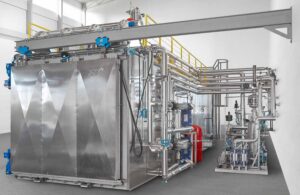
Ethylene oxide sterilization requires air circulation equipment like you see pictured here. [Photo courtesy of Jabil]
EO’s value is difficult to replace. The gas penetrates complex geometries and sealed packaging at low temperature and is compatible with the plastics, adhesives and electronics common to mixed-material devices that tolerate no other method.
The principal constraint is regulatory. Since 2018, emissions scrutiny, facility closures and evolving environmental requirements have reshaped the long-term capacity outlook. More recently, federal actions since the 2024 rule — including two-year compliance exemptions for certain EO sterilization facilities and the EPA’s proposed reconsideration of key requirements — have helped stabilize the near-term supply. Whether that stability proves durable remains an open question.
Jabil’s EO capability is co-located with manufacturing and packaging in the Dominican Republic. The facility was built with emissions abatement and continuous monitoring to the strictest available standard from the outset rather than positioned for a later retrofit, a deliberate hedge against the regulatory uncertainty that continues to surround EO. Its single-chamber process consolidates preconditioning, sterilization and aeration into one workflow instead of moving product between separate rooms, reducing total cycle time from more than 50 hours to roughly 22.
Paired with validated parametric release, which clears product on documented process data rather than a multiday, biological-indicator hold, much of the dwell time conventionally associated with EO comes out of the schedule. Packaging, sterilization, documentation, finished pack and logistics run within the one site and quality system.
The facility opens at the end of 2026, with significant customer commitments already in place, an indication of growing demand for integrated sterilization capacity that gives manufacturers greater visibility and operational control.
Gamma irradiation has operated at Jabil’s Albuquerque, New Mexico, campus since 2019 utilizing two tote-over-pass irradiators. Like Jabil’s EO operation in the Dominican Republic, the Albuquerque facility’s gamma capability is integrated within a broader manufacturing environment rather than operating as a standalone sterilization service. That proximity allows production planning, quality oversight and release activities to remain closely coordinated.
Gamma penetrates deeply across a wide range of product densities, leaves no residues and supports rapid product release through established dosimetry. Its dependence on cobalt-60, however, introduces a supply chain consideration, as a limited number of global producers and rising demand continue to influence availability and cost.
X-ray is Jabil’s most recent investment in sterilization capabilities. As an additional irradiation pathway, it provides a strategic answer to where gamma has limits. X-ray sterilization works by converting an electron beam (e-beam) into high-energy photons that penetrate as deeply as gamma but require no radioisotope on site, and processes dense, palletized loads efficiently, unlike e-beam sterilization, which requires products to pass through a thin, single-layer curtain.
Jabil’s X-ray facility is under development in Byhalia, Mississippi, in the Memphis logistics corridor. One feature sets it apart from what OEMs typically expect of a contract manufacturer. Jabil intends to accept qualifying product it did not build, so where X-ray fits the device, an OEM can send finished goods to the site regardless of where they were manufactured.
Because these three modalities now sit within one network, the flexibility they create can be built into a medical device program before manufacturing begins. Jabil’s engineers can work with OEMs early in the design process to validate a product for multiple sterilization modalities where the device allows it. Not every program will support that approach, but when it does, optionality becomes a deliberate element of the manufacturing strategy, preserving flexibility that might otherwise be lost later in the product lifecycle.
Questions every OEM should ask about sterilization
Every medical device program has unique technical requirements. There is no single sterilization strategy that fits every product or every manufacturer. But there are several questions that are becoming increasingly important to ask much earlier in development.
Can the product be validated for more than one sterilization modality? Preserving flexibility during development may provide valuable options long after commercialization.
Where does elapsed time actually accumulate? The sterilization cycle itself is only part of the overall clock. Transportation, staging, release documentation and handoffs often determine total lead time. Every transition introduces another opportunity for delays, communication gaps or documentation challenges.
How much visibility do you have once product leaves manufacturing? Schedule disruptions are inevitable, so you’ll want to know where product is in the process, how quickly issues can be resolved and who is accountable for the next decision.
The answers to these questions provide a useful measure of whether an organization’s sterilization strategy is keeping pace with a changing manufacturing environment. Modality technologies, regulatory expectations and medical device complexity will continue to evolve.
The manufacturers best positioned for long-term success will likely be those that build greater agility and security of supply into their device sterilization strategies from the outset. That means treating sterilization as an integrated part of manufacturing, with the same expectations for visibility, accountability, and operational performance as every other critical manufacturing process.

Jabil Healthcare Senior Director of Global Business Units Ben DeVos [Photo courtesy of Jabil]
Read more MDO Contributions and learn how to submit your own.
The opinions expressed in this article are the author’s only and do not necessarily reflect those of Medical Design & Outsourcing or its employees.