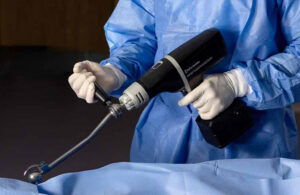
Johnson & Johnson MedTech’s DePuy Synthes launched the Kincise Surgical Automated System in 2020 and the Kincise 2 in 2025. [Photo courtesy of Johnson & Johnson MedTech]
When Johnson & Johnson MedTech’s DePuy Synthes launched its Kincise Surgical Automated System for total hip arthroplasty (THA) in 2020, it used surface electromyography (sEMG) to measure muscle performance during use of the new tool versus a manual surgical mallet.
Kincise “is essentially an automated powered mallet,” DePuy Synthes President of Global Digital, Robotics Surgery and Customer Solutions Janardhan (JR) Ramachandran said in a Medical Design & Outsourcing interview. (In our interview, he also discussed the development of new Velys software for faster hip replacements and offered robotics and AI advice for device developers.)
“In hip surgery, as you’re preparing the stem and the cup you have to broach the canal of the long bone of the hip so you can insert the stem,” he said. “It is a very physically demanding step. The surgeon is literally impacting the bone with a broach and a mallet. They would strike anywhere between 250 and 300 times for each procedure with a significant force.”
Rotator cuff injuries are one of the biggest issues for hip surgeons, so the R&D team saw an opportunity to make those procedures easier and possibly even extend their careers.

DePuy Synthes President of Global Digital, Robotics Surgery and Customer Solutions Janardhan (JR) Ramachandran [Photo courtesy of J&J MedTech]
To compare fatigue for users of the Kincise system versus manual mallets, DePuy Synthes recruited six medically trained subjects to measure performance across eight muscle compartments in their arms and back during a simulated femoral broaching sequence.
“We fit them with sensors that looked at the firing of key muscles, how much effort was being expended, and Kincise lowers that significantly,” Ramachandran said. “It’s a quality of life improvement for surgeons.”
In that study, four of the participants showed a statistically significant reduction in fatigue, DePuy Synthes said, particularly in their arm mucles (the bicep brachii and brachioradialis).
One of the participants showed no difference “due to low level of muscle activity captured during both impaction modalities,” the company said, while the sixth participant actually had higher fatigue using Kincise “due to the forceful use while operating the system.”
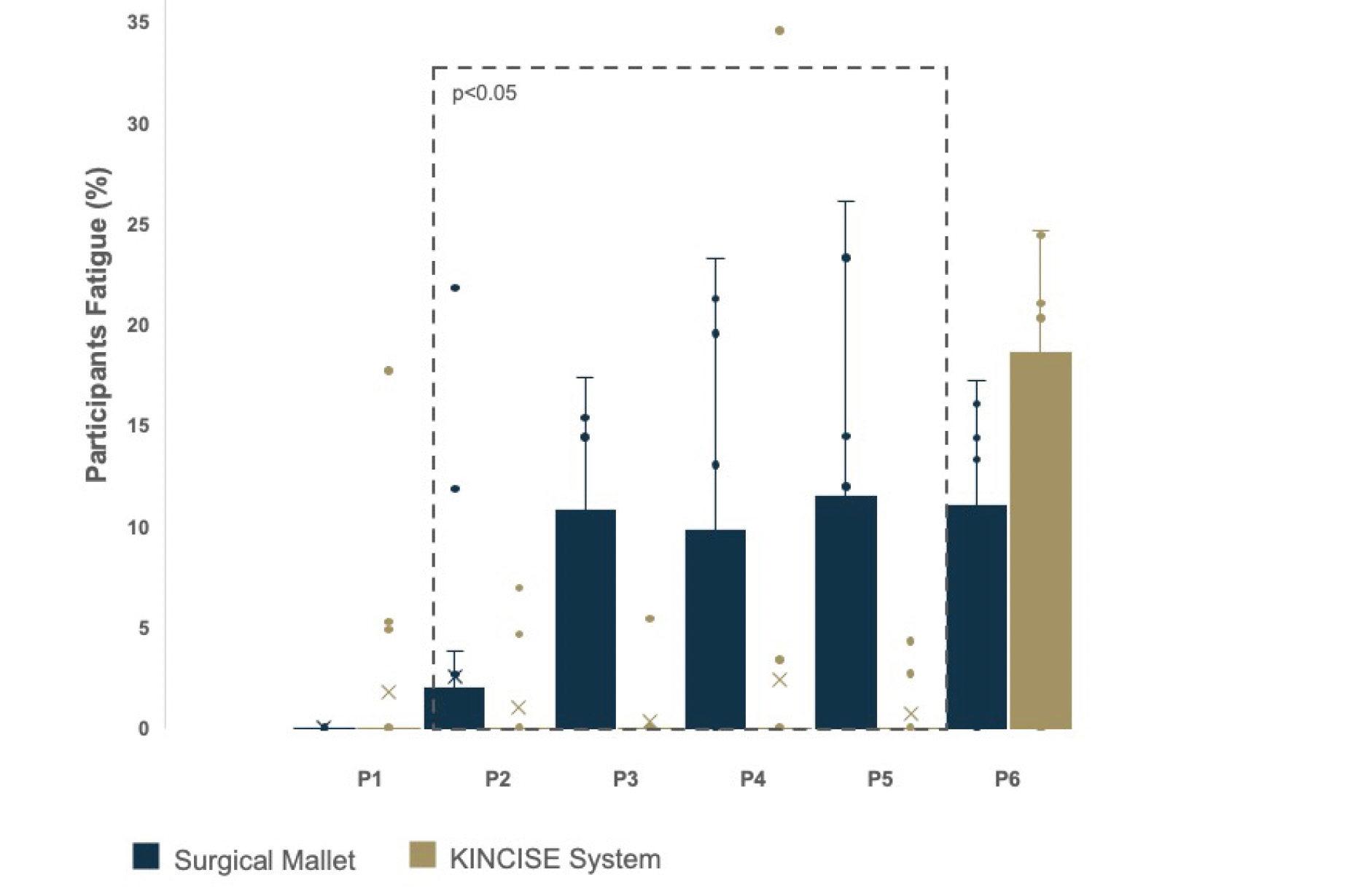
The Kincise fatigue study showed a significant difference in four of the six participants. [Image courtesy of Johnson & Johnson MedTech]
Related: Silence in the OR was a J&J MedTech innovation opportunity




