Johnson & Johnson MedTech Global Head of Robotics & Digital R&D Neda Cvijetic [Photo courtesy of J&J]
In the second part of our interview with Cvijetic from the July 2026 Society of Robotic Surgery (SRS) annual meeting, she also offered her perspective on the future of surgical robotics, including automation and digital twins. (In the first part of our interview, she discussed Ottava’s folding arms, soothing sounds and haptics capability.)
The following has been lightly edited for space and clarity.
MDO: We’re always looking for methods to help identify and understand unmet needs. Did your R&D team use any unusual or particularly useful methods over the years?
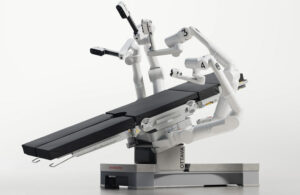
Johnson & Johnson MedTech’s Ottava is the world’s first table-integrated soft-tissue robotics system. [Photo courtesy of Johnson & Johnson]
Related: Sensors on surgeons helped J&J sell a new tool
You’ve said the next big thing you’re working on is detailed imaging to enable task automation. Where is this technology headed?
Cvijetic: “In terms of automation, that fully motorized, spatially aware architecture creates the opportunity for a cadence of releases of software in that dimension. That innovation pipeline and the features we bring to the market will be designed to empower the human clinical expert in the OR. Full stop. Everything we do will be done for that purpose, and how we prioritize that feature cadence and what we bring to the market first will be informed very directly by the feedback from our customers.”
Are digital twins part of the future of surgical robotics?

An overhead view of Johnson & Johnson MedTech’s Ottava in a mock OR [Photo courtesy of Johnson & Johnson]
“As more and more physics models come into these tool chains, you can think about fluidics, deformation physics, all being modeled. And at that point, so many of clinically relevant aspects, whether that’s outside of the patient and in the OR or even surgical scenes inside of the patient, we have the capability to realistically model them. Once we have that capability, it opens up a universe of possibilities: preoperative planning software for clinical teams, surgical simulators that could begin to look like something like a high-fidelity flight simulator for pilots. My vision is that we started with Monarch for urology, but we have the capability to leverage technologies like that across our entire surgical robotics portfolio.”
Previously: J&J MedTech arms its Monarch robot for futuristic lung cancer therapies
If you’re sitting down with a medtech engineer, what could you share from the Ottava journey to help them innovate?
Cvijetic: “On the technological front, for surgical robotics or robotics of any kind, the software and digital capabilities are as important as the hardware. And if you look historically, that hasn’t always been the case for robotics. It has traditionally been a hardware-driven engineering discipline. Now it is both. It is both in equal measure. Think about those interplays between the two, because the ability to bring both with equal differentiation is what will create the greatest innovations going forward.
“And then in terms of engineer-to-engineer culture, any time you’re working on something category-defining, it’s incredibly important to have that bold spirit and to realize it may not be a fully linear path, but it is an incredibly worthwhile path. A key indicator of success there is increasing momentum, and that increasing momentum is definitely something that we continue to feel and have and what I felt during my time here.”
First Look: J&J unveils its Ottava surgical robotics system