
Medical Design and Outsourcing

  • Home
  • Medical Device Business
    • Mergers & Acquisitions
    • Financial
    • Regulatory
  • Applications
    • Cardiovascular
    • Devices
    • Imaging
    • Implantables
    • Medical Equipment
    • Orthopedic
    • Surgical
  • Technologies
    • Supplies and Components Index
    • Contract Manufacturing
    • Components
    • Electronics
    • Extrusions
    • Materials
    • Motion Control
    • Prototyping
    • Pumps
    • Tubing
  • MedTech Resources
    • Medtech Events in 2026
    • The 2026 Medtech Big 100
    • Medical Device Handbook
    • MedTech 100 Index
    • Subscribe to Print Magazine
    • DeviceTalks
    • Digital Editions
    • eBooks
    • Educational Assets
    • Manufacturer Search
    • Podcasts
    • Webinars / Digital Events
    • Whitepapers
    • Voices
    • Views
    • Video
  • 2026 Leadership
    • 2025 Winners
    • 2024 Winners
    • 2023 Winners
    • 2022 Winners
    • 2021 Winners
  • Women in Medtech
  • Advertisers
    • Advertise
    • PR Submissions
    • Eblast Submissions
  • Subscribe

Johns Hopkins researchers develop miniature magnetic drug delivery robots to target infections at the site

Endocarditis is their starting point, but the team sees opportunities in cancer therapy and other challenging areas.

October 15, 2026 By Skyler Rivera

A photo of Johns Hopkins researcher's mini robots in a phantom heart benchtop test.

Johns Hopkins researchers tested their mini drug-delivery robots in a phantom heart. [Photo courtesy of Johns Hopkins University]

Researchers at Johns Hopkins University created wireless magnetic miniature robots that travel through the body to deliver drugs to the heart and treat endocarditis in a minimally invasive procedure.

“Infective endocarditis remains difficult to treat due to limited drug accumulation at infection sites via systemic delivery and reliance on invasive, high-risk surgery,” the researchers said in their article published in Advanced Materials Technologies. “To address this, we present a wireless, modular millirobotic system actuated by external magnetic fields for targeted cardiac drug delivery.”

The mini-robots are the size of a pencil tip and as long as a grain of rice. They’re designed to replace open-heart surgery that’s often required when antibiotics fail. Even with intravenous antibiotics, endocarditis is difficult to treat since the medication is often too diluted by the time it reaches the heart.

“With just a little pinprick, you insert a micro robot and do a procedure without infection or blood loss. And you don’t need to have a surgeon operating it to get the drugs robustly, safely, and efficiently to the right place,”Axel Krieger, the paper’s senior author, told JHU.

The JHU researchers see their robots as a less invasive and more precise method to treat hard-to-reach diseases. Endocarditis is their starting point, but they see opportunities in other challenging areas including cancer therapy.

“There’s a lot of areas beyond heart infections where this kind of targeted drug therapy and these kinds of steerable robots could play a major role,” Krieger said. “It’s really the frontier of surgical robotics.”

How the robots work

The system is comprised of two robots that work together. A barbed needle module robot latches onto the heart at the site of infection after navigating the body with guidance from an external electromagnetic coil system and AI-assisted vision guidance for autonomous navigation. This robot serves as a docking station for its counterpart, the drug module robot.

“Magnetic guidance is exciting because you don’t have to power the robot itself. It doesn’t carry batteries and motors,” Krieger said. “The drugs can be delivered safely, with technology like the gradients and fields in an MRI. But instead of using it for imaging, it drives the millirobots.”

Using the same guidance technology, the drug module magnetically docks to the first robot and slowly releases medication directly to the infection. It’s capable of delivering 22 microliter liquid doses over 180 minutes, the researchers said.

“Usually if you do IV drug treatment, you need four to six weeks of therapy. But with these robots the entire procedure might take 10 minutes, maybe an hour if you want to do a couple rounds,” the study’s first author, Anuruddha Bhattacharjee, told JHU. “If everything works well, you go from four to six weeks of treatment to one day or less.”
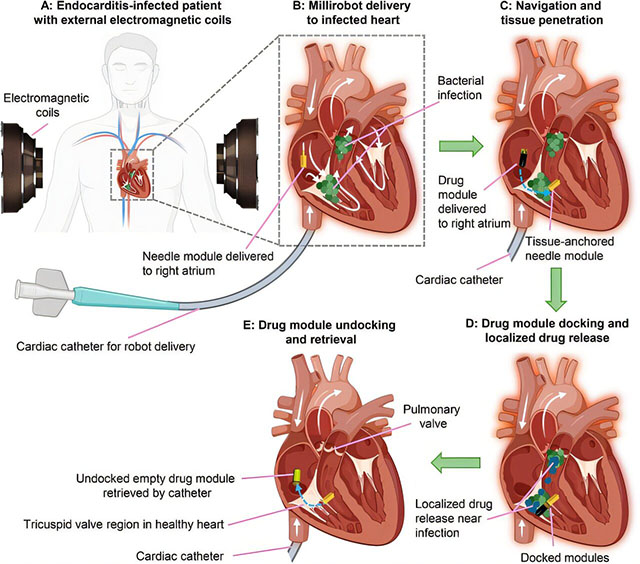
A diagram of how the JHU researcher's mini robots work as a drug-delivery system.

The JHU researchers see their robots as a less invasive and more precise method to treat hard-to-reach diseases. [Image courtesy of Advanced Materials Technologies]

Two tiny robots rather than one larger one enable the technology to access small spaces in the body. It also allows for repetition, as the needle robot can remain docked while the drug module is replaced for repeat doses as needed.

The team validated the system with phantom heart models and pulsatile blood flow to mimic a human heart, and tested the robot’s docking and undocking with porcine heart tissue. Results of their benchtop testing showed the robot’s potential for precise and repeatable performance in minimally invasive cardiac therapies.

Outside of cardiac therapies, the researchers believe their technology could be used in delivering targeted therapies to fight cancer where it’s spreading. For now, they plan to test the system in more realistic phantom hearts with muscle contraction and beating movement.

Read more MDO coverage of minimally invasive medtech here.

About The Author

Skyler Rivera

Skyler Rivera is an associate editor at Arrowfly, covering medical device industry news and technology at MassDevice and Medical Design & Outsourcing. She began her career covering sports at The Athletic and MLB before transitioning to medical writing at Edwards Lifesciences. Based in Southern California, she holds a master's degree in science writing from Johns Hopkins University and a bachelor’s in broadcast journalism from Syracuse University. Connect with her on LinkedIn or email at [email protected].

Related Articles Read More >

The Virtuoso System endoscope tip with manipulators,
Tiny, superelastic nitinol arms make this breakthrough surgical robot possible
A photo of J&J MedTech SVP and Global Head of Digital Shan Jegatheeswaran.
Where Johnson & Johnson sees opportunity in surgical intelligence
A photo of Maxon CEO Eugen Elmiger.
Maxon names new leaders in CEO, deputy CEO and COO roles
An image of the September 2026 Medical Design & Outsourcing magazine featuring the Medtech Big 100 ranking of the world's largest medical device companies.
September 2026 issue: The MDO Medtech Big 100 breaks $500 billion
“mdo
EXPAND YOUR KNOWLEDGE AND STAY CONNECTED
Get the latest medical device business news, application and technology trends.

DeviceTalks Weekly

See More >

MDO Digital Edition

Digital Edition

Subscribe to Medical Design & Outsourcing. Bookmark, share and interact with the leading medical design engineering magazine today.

MEDTECH 100 INDEX

Medtech 100 logo
Market Summary > Current Price
The MedTech 100 is a financial index calculated using the BIG100 companies covered in Medical Design and Outsourcing.

New MedTech Resource

Medical Tubing

MassDevice

Mass Device

The Medical Device Business Journal. MassDevice is the leading medical device news business journal telling the stories of the devices that save lives.

Visit Website
MDO ad
Medical Design and Outsourcing
  • MassDevice
  • DeviceTalks
  • MedTech100 Index
  • Medical Tubing + Extrusion
  • Medical Design Sourcing
  • Drug Delivery Business News
  • Drug Discovery & Development
  • Pharmaceutical Processing World
  • R&D World
  • About Us/Contact
  • Advertise With Us
  • Subscribe to Print Magazine
  • Subscribe to our E-Newsletter
  • Listen to our Weekly Podcasts
  • Join our DeviceTalks Tuesdays Discussion

Copyright © 2026 Arrowfly, LLC. All Rights Reserved. The material on this site may not be reproduced, distributed, transmitted, cached or otherwise used, except with the prior written permission of Arrowfly LLC. Site Map | Privacy Policy | RSS

Search Medical Design & Outsourcing

  • Home
  • Medical Device Business
    • Mergers & Acquisitions
    • Financial
    • Regulatory
  • Applications
    • Cardiovascular
    • Devices
    • Imaging
    • Implantables
    • Medical Equipment
    • Orthopedic
    • Surgical
  • Technologies
    • Supplies and Components Index
    • Contract Manufacturing
    • Components
    • Electronics
    • Extrusions
    • Materials
    • Motion Control
    • Prototyping
    • Pumps
    • Tubing
  • MedTech Resources
    • Medtech Events in 2026
    • The 2026 Medtech Big 100
    • Medical Device Handbook
    • MedTech 100 Index
    • Subscribe to Print Magazine
    • DeviceTalks
    • Digital Editions
    • eBooks
    • Educational Assets
    • Manufacturer Search
    • Podcasts
    • Webinars / Digital Events
    • Whitepapers
    • Voices
    • Views
    • Video
  • 2026 Leadership
    • 2025 Winners
    • 2024 Winners
    • 2023 Winners
    • 2022 Winners
    • 2021 Winners
  • Women in Medtech
  • Advertisers
    • Advertise
    • PR Submissions
    • Eblast Submissions
  • Subscribe