Medical Design and Outsourcing

  • Home
  • Medical Device Business
    • Mergers & Acquisitions
    • Financial
    • Regulatory
  • Applications
    • Cardiovascular
    • Devices
    • Imaging
    • Implantables
    • Medical Equipment
    • Orthopedic
    • Surgical
  • Technologies
    • Supplies and Components Index
    • Contract Manufacturing
    • Components
    • Electronics
    • Extrusions
    • Materials
    • Motion Control
    • Prototyping
    • Pumps
    • Tubing
  • MedTech Resources
    • Medtech Events in 2026
    • The 2025 Medtech Big 100
    • Medical Device Handbook
    • MedTech 100 Index
    • Subscribe to Print Magazine
    • DeviceTalks
    • Digital Editions
    • eBooks
    • Educational Assets
    • Manufacturer Search
    • Podcasts
    • Webinars / Digital Events
    • Whitepapers
    • Voices
    • Views
    • Video
  • 2026 Leadership
    • 2025 Winners
    • 2024 Winners
    • 2023 Winners
    • 2022 Winners
    • 2021 Winners
  • Women in Medtech
  • Advertise
  • Subscribe

Jupiter Endovascular may have solved a critical catheter challenge

November 18, 2024 By Jim Hammerand

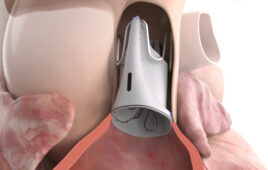
An image showing Jupiter Endovascular's Vertex pulmonary embolism system.

Jupiter Endovascular’s Vertex pulmonary embolism system [Image courtesy of Jupiter Endovascular]

Balancing catheter flexibility and stiffness has long vexed device designers and engineers trying to access the human anatomy’s innermost reaches.

The solution might be a promising new technology originally developed for endoscopy at Neptune Medical, founded by Alex Tilson in 2014.

His first hire was Garrett Gomes, who’s now VP of product development at Jupiter Endovascular, which spun out of Neptune to advance the technology in the form of the Vertex pulmonary embolectomy system.

Jupiter Endovascular received FDA investigational device exemption for the large-bore aspiration system in August 2024 and reported the first human cases in September, followed by the first U.S. case in October.

To remove a pulmonary embolism with a minimally invasive catheter approach (rather than an open pulmonary thromboendarterectomy), a physician starts in the femoral vein and navigates through twists and turns up through the right atrium, then the right ventricle and into the pulmonary artery. That’s a journey through two heart valves and chambers in a delicate organ that’s already stressed by the blocked outflow, which causes high blood pressure and enlarges the heart.

“Pushing current large-bore, stiff catheters through that heart distorts the anatomy, and it’s very difficult to control, so we saw that as just very ripe for this technology, for our solution,” Gomes said.

MDO Min-Vasive Medtech series: Join us for a live interview with Gomes and a Q&A session with our webcast audience

Gomes discussed the complicated transcatheter pulmonary embolectomy workflow his team hopes to simplify with Vertex.

“Right now, there’s multiple guidewire exchanges to get these stiff catheters in,” he said. “You have to start with a soft wire and a guide catheter, swap [the soft wire] out for a stiff wire, take out the guide catheter, put the [interventional device] in, and then try to do some work, and then you might lose position. Then you have to go to a different location, you have to do that whole swap again. And every time you’re doing this, you know you’re putting stress on the heart. We have designed [the Vertex system] to have fewer guide wire swaps, to have fewer device swaps, and to just be a very reliable system.”

How Jupiter Endovascular’s Vertex system works

An image showing Jupiter Endovascular's Vertex pulmonary embolism catheters.

Jupiter Endovascular’s Vertex pulmonary embolism system includes the the 26F Vertex catheter (pictured) and the 20F Meridian aspiration catheter. [Image courtesy of Jupiter Endovascular]

While Gomes said it’s too early to discuss the “secret sauce” behind the technology in depth, he offered some details about how the Vertex system works.

“There are two states to the catheter,” Gomes said. “It’s in a relaxed state initially, it’s very flexible and designed to track directly over a guidewire. Once it’s in position or whatever the physician wants, they can activate it. Activating it to transition it from the relaxed state to the fixed state is done with a simple locking insufflator and saline.”

The device uses the same type of insufflator used for angioplasty balloons, which means there’s no capital equipment, no energy being delivered to the system, and no complicated handles or user interface.

When activated, the pressure is “fully contained within the walls of the catheter,” he said, with only negligible expansion of the device.

“It doesn’t change shape, elongate, shorten,” he said. “It locks in place, and then when you’d like to move the catheter, you just unlock it, depressurize it, and move the catheter, and then go again. You can go back and forth [between states] many, many times.”

An image showing the clot-sucking end of Jupiter Endovascular's Vertex pulmonary embolism catheter.

This close-up shows the distal end of Jupiter Endovascular’s Vertex catheter. [Image courtesy of Jupiter Endovascular]

The system doesn’t use unique materials or advanced manufacturing techniques in a new way, Gomes said. The catheter is made of low-durometer elastomers and stainless steel wire, employing traditional catheter manufacturing techniques for wire- and braid-reinforced tubes.

“The way that we put it together, the exact material selection is special,” he said. “But that’s all I can share at this time. … Our advances are we made this simple to activate, simple to operate, and part of that is not using things that require high energy or exotic materials. This needs to be a catheter that can scale with volume, especially as we’re thinking about other applications beyond PE. That might be smaller diameter, that might be higher volume and more price sensitive, so we’ve gone in with a technology that is highly scalable.”

What’s next for Jupiter Endovascular’s technology?

A portrait of Garrett Gomes, VP of product development at Jupiter Endovascular.

Jupiter Endovascular VP of Product Development Garrett Gomes [Photo courtesy of Jupiter Endovascular]

Gomes declined to discuss other potential applications beyond pulmonary embolism — for now.

“Being an innovation-driven startup, we always have irons in the fire, something that has led to where we’re at now. … It’s always difficult to balance today and three years from now, especially as a startup, but we force ourselves to do that. We have lots of different projects in the works, and we aren’t disclosing those right now. It’s just trying to figure out the right fit. We found the perfect fit in PE for the reasons I stated. And now we’re trying to find where else is this most needed. We don’t want to just force this into any procedure. And as it was with PE, it’s not just about this catheter. It’s about the procedure itself. So if this catheter might be good for that procedure, we need to work on the full solution for that.”

But there’s more to come, Gomes said.

“With this new technology, we’ve had a lot of theories about what can be done. And now we’re seeing what actually can be done and we’re finding things that we didn’t even think of. That’s extremely exciting. It’s going to be incredible to see what limits we can push and what utility we can provide, not just to PE but to other procedures. Once we have this level of access and control, the doors open in terms of what can you do, what sorts of therapies were previously inconceivable because the amount of work that you had to do, the amount of loads that you needed to put on the system, amount of [devices] that you need to deliver to a location. It just couldn’t fit, you know, it couldn’t, couldn’t get there. And so our vision goes well beyond PE, well beyond delivering a stent better.”

“The phrase ‘revolutionize endovascular medicine,’ everyone wants to do that, everyone says that,” he continued. “But in this case, we’re delivering a completely new toolset, completely new capabilities to physicians, that have already unlocked their creativity and what they want to do. We’ve got a long future ahead of us.”


About The Author

Jim Hammerand

Jim Hammerand is the managing editor of Arrowfly's Medical Design & Outsourcing, where he leads coverage of medtech innovation, design, engineering and manufacturing. He also reports breaking news at Arrowfly's MassDevice and contributes to our DeviceTalks podcasts and live events. Hammerand has more than two decades of journalism experience spanning newspapers, magazines, websites, live events, radio and TV news. For nearly a decade, Hammerand reported and edited business news for American City Business Journals as a reporter and digital editor at the Minneapolis/St. Paul Business Journal and then as managing editor of the Puget Sound Business Journal in Seattle. He holds degrees in journalism and management from the University of Minnesota and has won journalism awards from the Society of Professional Journalists, American Society of Business Publication Editors, and Trade, Association, Business Publications International. Connect with him on LinkedIn or by email at [email protected].

Related Articles Read More >

A close of of Medical 21's Maverics graft.
A surgeon’s prayer helped St. Jude Medical founder Manny Villafaña size his latest device
A photo of Edwards Lifesciences' Autus size-adjustable heart valve.
A heart valve that grows with children shows what pediatric devices can become
The Medtech Innovation Board logo
Leading medical device experts and MDO launch Medtech Innovation Board
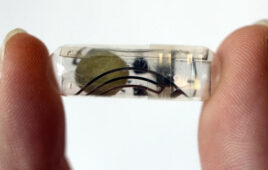
The 1.84 volt paper battery (brown circle structure) was tested in pigs with a bioabsorbable radio-frequency identification (RFID) device.
MIT researchers develop bioresorbable batteries for ingestible medical devices
“mdo
EXPAND YOUR KNOWLEDGE AND STAY CONNECTED
Get the latest medical device business news, application and technology trends.

DeviceTalks Weekly

See More >

MDO Digital Edition

Digital Edition

Subscribe to Medical Design & Outsourcing. Bookmark, share and interact with the leading medical design engineering magazine today.

MEDTECH 100 INDEX

Medtech 100 logo
Market Summary > Current Price
The MedTech 100 is a financial index calculated using the BIG100 companies covered in Medical Design and Outsourcing.

New MedTech Resource

Medical Tubing

MassDevice

Mass Device

The Medical Device Business Journal. MassDevice is the leading medical device news business journal telling the stories of the devices that save lives.

Visit Website
MDO ad
Medical Design and Outsourcing
  • MassDevice
  • DeviceTalks
  • MedTech100 Index
  • Medical Tubing + Extrusion
  • Medical Design Sourcing
  • Drug Delivery Business News
  • Drug Discovery & Development
  • Pharmaceutical Processing World
  • R&D World
  • About Us/Contact
  • Advertise With Us
  • Subscribe to Print Magazine
  • Subscribe to our E-Newsletter
  • Listen to our Weekly Podcasts
  • Join our DeviceTalks Tuesdays Discussion

Copyright © 2026 Arrowfly, LLC. All Rights Reserved. The material on this site may not be reproduced, distributed, transmitted, cached or otherwise used, except with the prior written permission of Arrowfly LLC. Site Map | Privacy Policy | RSS

Search Medical Design & Outsourcing

  • Home
  • Medical Device Business
    • Mergers & Acquisitions
    • Financial
    • Regulatory
  • Applications
    • Cardiovascular
    • Devices
    • Imaging
    • Implantables
    • Medical Equipment
    • Orthopedic
    • Surgical
  • Technologies
    • Supplies and Components Index
    • Contract Manufacturing
    • Components
    • Electronics
    • Extrusions
    • Materials
    • Motion Control
    • Prototyping
    • Pumps
    • Tubing
  • MedTech Resources
    • Medtech Events in 2026
    • The 2025 Medtech Big 100
    • Medical Device Handbook
    • MedTech 100 Index
    • Subscribe to Print Magazine
    • DeviceTalks
    • Digital Editions
    • eBooks
    • Educational Assets
    • Manufacturer Search
    • Podcasts
    • Webinars / Digital Events
    • Whitepapers
    • Voices
    • Views
    • Video
  • 2026 Leadership
    • 2025 Winners
    • 2024 Winners
    • 2023 Winners
    • 2022 Winners
    • 2021 Winners
  • Women in Medtech
  • Advertise
  • Subscribe