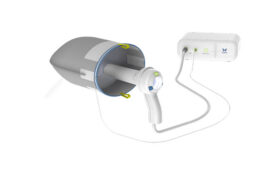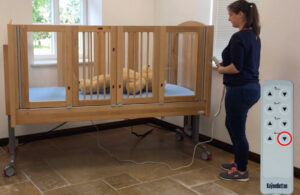
KayserBetten is replacing hand controls for its adjustable KayserBett Ida pediatric care beds to add an auto-lock function that could help avoid injuries. [Image from a KayserBetten instructional video]
At Medical Design & Outsourcing, we flag medical device recalls to warn of supply chain shortages help our audience of medtech engineers, designers and other technical professionals remain vigilant about product safety. It’s an opportunity to avoid repeating the mistakes of others and learning those lessons the hard way.
Many of these recalls come to our attention after device malfunctions or design flaws cause serious injuries or death for patients and even health care providers. These adverse events are reported in the Manufacturer and User Facility Device Experience (MAUDE) database, usually with the kind of formal, sanitized language that makes it harder to keep in mind that these are stories about patients and physicians having some of the worst days of their lives. Sometimes it’s the last day of their life.
After seeing a recent recall and looking up event filings in MAUDE, I found one particular report that’s going to stick with me.
In 2023, a 7-year-old boy who had an adjustable KayserBett pediatric care bed was being cared for by his grandmother in Germany. According to the report filed by the bed’s manufacturer, KayserBetten, she “opened the bed doors and left the room without first lowering the sleeping platform to its lowest position and locking the hand control with a key.”
“The boy climbed out of the bed, crawled under the sleeping platform, and operated the hand control himself,” the report continued, attributing his fatal strangulation to user error after technical malfunction had been ruled out.
“A risk that was not foreseen at the time materialized solely as a result of several cumulative user errors,” KayserBetten said.
But the manufacturer and regulators agreed the hazard should be considered a reasonably foreseeable misuse under ISO 14971, and KayserBetten said in the report that it worked with its drive manufacturer to develop “a modified hand control with an auto-lock function as a precautionary measure to eliminate this misuse risk in the future.”
In another tragic situation, a 4-year-old in England died in 2021 after his head got stuck in a KayserBetten bed. In 2024, a jury decided the death was due to an accidental “user action.” It’s not clear whether the 2023 death was raised in that inquest.
Later that year, KayserBetten issued an urgent field safety notice in Europe warning of the problem and the plan to start upgrading hand controls in 2025.
Then in April 2026, KayserBetten warned U.S. customers of the hazard and the hand control replacement campaign, according to the FDA. The agency has classified it as a Class I recall, the most serious type, due to the risk of serious injury or death.
More than a decade ago, KayserBetten warned of another problem with some of its beds. The motor units for height adjustability were mounted inside the bed frame.
“If the patient’s head is lying directly next to the motor unit for height adjustability, hair that is falling through a gap into the motor unit might get gripped by the turning spindle and get spooled,” the company explained in a 2014 warning to users. “Thus, the patient might get into a dangerous situation with a potential serious health risk.”
When I saw news of the recall for the hand control update earlier this month, I emailed KayserBetten and its U.S. distributor asking for more information and whether they had any advice that might help other device developers improve the safety of their own products. An auto-reply said they were experiencing “a very high volume of inquiries,” but I will update this post if I get more to share.
Until then, let this be a reminder that patients and physicians won’t always follow or understand the instructions and safety warnings. It’s on medical device professionals to put in the extra effort to make these products as safe as possible, especially pediatric devices meant for our most vulnerable patients.