Medical Design and Outsourcing

  • Home
  • Medical Device Business
    • Mergers & Acquisitions
    • Financial
    • Regulatory
  • Applications
    • Cardiovascular
    • Devices
    • Imaging
    • Implantables
    • Medical Equipment
    • Orthopedic
    • Surgical
  • Technologies
    • Supplies and Components Index
    • Contract Manufacturing
    • Components
    • Electronics
    • Extrusions
    • Materials
    • Motion Control
    • Prototyping
    • Pumps
    • Tubing
  • MedTech Resources
    • Medtech Events in 2026
    • The 2026 Medtech Big 100
    • Medical Device Handbook
    • MedTech 100 Index
    • Subscribe to Print Magazine
    • DeviceTalks
    • Digital Editions
    • eBooks
    • Educational Assets
    • Manufacturer Search
    • Podcasts
    • Webinars / Digital Events
    • Whitepapers
    • Voices
    • Views
    • Video
  • 2026 Leadership
    • 2025 Winners
    • 2024 Winners
    • 2023 Winners
    • 2022 Winners
    • 2021 Winners
  • Women in Medtech
  • Advertise
  • Subscribe

L’Oréal’s Wearable Measures Skin pH in Minutes

January 10, 2019 By Tierney King

L’Oréal has revealed a wearable prototype at the 2019 Consumer Electronics Show that measures skin pH levels. The wearable sensor, known as My Skin Track pH, by La Roche-Posay, pairs with an app that creates customized product regimens catered to an individual’s skin, while assessing pH levels.

“The scientific and medical communities have long known the link between skin pH levels and common skin concerns that millions of people experience every day,” says Guive Balooch, Global Vice President of the L’Oréal Technology Incubator, an arm of L’Oréal’s Research & Innovation Division. “Our goal is to use this advanced technology to empower consumers with meaningful information about their skin, so that they can find the products that are right for their individual needs. At L’Oréal, we know that health is the future of beauty and we are committed to leveraging technology to bring powerful insights and solutions to our consumers.”  

The pH scales range from acidic to basic and are based on a spectrum measured from zero to 14. Normally, healthy skin ranges from levels 4.5 to 5.5. When the pH balance fluctuates on a person’s skin, through environmental factors or other conditions, it can activate inflammatory responses including dryness, eczema, and atopic dermatitis.

The thin, flexible sensor is the first wearable to measure individual skin pH levels using microfluidic technology. By capturing trace amounts of sweat from skin pores through micro-channels, the My Skin Track pH can provide an accurate reading within 15 minutes.

Normally, skin pH levels require electronics or large sweat samples; instead, the My Skin Track pH can generate readings from nearly unnoticeable quantities of sweat.

The wearable works by having the user place the sensor on their inner arm and leave it there for five to fifteen minutes, until the center two dots change color. Then, the wearer uses the My Skin Track pH app and takes a picture of the sensor. Using an advanced algorithm, the app reads the pH measurement and picks up information on the wearer’s sweat loss to assess skin health. This assessment provides customized La Roche-Posay product recommendations that can better balance the user’s skin pH.

Credit: L’Oréal

“pH is a leading indicator of skin health,” says Professor Thomas Luger, Head of the Department of Dermatology, University of Münster, Germany. “It is something my patients ask about, but until now it has been very challenging to measure skin pH outside of a clinical setting. This tool has the potential to inspire consumers to adopt healthier skincare habits and empower medical professionals with an entirely new way to recommend skincare regimens.” 

My Skin Track pH will be introduced this year through select La Roche-Posay dermatologists in the US, where researchers hope to gain more research and ultimately, launch the wearable for consumers to utilize worldwide.


Related Articles Read More >

The most innovative medical devices of 2026
Reconstructed 3D fluorescence image of the stained biohybrid mesh-tissue integration. The red, green, and blue colors correspond to the mesh, F-actin, and nuclei, respectively.
Researchers mesh electronics with human cells to develop living battery
A photo of the Paradromics Connexus brain-computer interface on a fingertip.
How Paradromics designed its Connexus brain-computer interface system
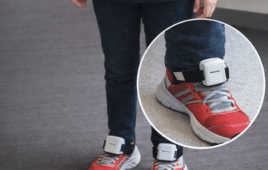
A photo of the wearable gait sensors used in the study.
Yale-led study finds wearable sensors match motion capture for gait tracking in knee osteoarthritis
“mdo
EXPAND YOUR KNOWLEDGE AND STAY CONNECTED
Get the latest medical device business news, application and technology trends.

DeviceTalks Weekly

See More >

MDO Digital Edition

Digital Edition

Subscribe to Medical Design & Outsourcing. Bookmark, share and interact with the leading medical design engineering magazine today.

MEDTECH 100 INDEX

Medtech 100 logo
Market Summary > Current Price
The MedTech 100 is a financial index calculated using the BIG100 companies covered in Medical Design and Outsourcing.

New MedTech Resource

Medical Tubing

MassDevice

Mass Device

The Medical Device Business Journal. MassDevice is the leading medical device news business journal telling the stories of the devices that save lives.

Visit Website
MDO ad
Medical Design and Outsourcing
  • MassDevice
  • DeviceTalks
  • MedTech100 Index
  • Medical Tubing + Extrusion
  • Medical Design Sourcing
  • Drug Delivery Business News
  • Drug Discovery & Development
  • Pharmaceutical Processing World
  • R&D World
  • About Us/Contact
  • Advertise With Us
  • Subscribe to Print Magazine
  • Subscribe to our E-Newsletter
  • Listen to our Weekly Podcasts
  • Join our DeviceTalks Tuesdays Discussion

Copyright © 2026 Arrowfly, LLC. All Rights Reserved. The material on this site may not be reproduced, distributed, transmitted, cached or otherwise used, except with the prior written permission of Arrowfly LLC. Site Map | Privacy Policy | RSS

Search Medical Design & Outsourcing

  • Home
  • Medical Device Business
    • Mergers & Acquisitions
    • Financial
    • Regulatory
  • Applications
    • Cardiovascular
    • Devices
    • Imaging
    • Implantables
    • Medical Equipment
    • Orthopedic
    • Surgical
  • Technologies
    • Supplies and Components Index
    • Contract Manufacturing
    • Components
    • Electronics
    • Extrusions
    • Materials
    • Motion Control
    • Prototyping
    • Pumps
    • Tubing
  • MedTech Resources
    • Medtech Events in 2026
    • The 2026 Medtech Big 100
    • Medical Device Handbook
    • MedTech 100 Index
    • Subscribe to Print Magazine
    • DeviceTalks
    • Digital Editions
    • eBooks
    • Educational Assets
    • Manufacturer Search
    • Podcasts
    • Webinars / Digital Events
    • Whitepapers
    • Voices
    • Views
    • Video
  • 2026 Leadership
    • 2025 Winners
    • 2024 Winners
    • 2023 Winners
    • 2022 Winners
    • 2021 Winners
  • Women in Medtech
  • Advertise
  • Subscribe