Medical Design and Outsourcing

  • Home
  • Medical Device Business
    • Mergers & Acquisitions
    • Financial
    • Regulatory
  • Applications
    • Cardiovascular
    • Devices
    • Imaging
    • Implantables
    • Medical Equipment
    • Orthopedic
    • Surgical
  • Technologies
    • Supplies and Components Index
    • Contract Manufacturing
    • Components
    • Electronics
    • Extrusions
    • Materials
    • Motion Control
    • Prototyping
    • Pumps
    • Tubing
  • MedTech Resources
    • Medtech Events in 2026
    • The 2026 Medtech Big 100
    • Medical Device Handbook
    • MedTech 100 Index
    • Subscribe to Print Magazine
    • DeviceTalks
    • Digital Editions
    • eBooks
    • Educational Assets
    • Manufacturer Search
    • Podcasts
    • Webinars / Digital Events
    • Whitepapers
    • Voices
    • Views
    • Video
  • 2026 Leadership
    • 2025 Winners
    • 2024 Winners
    • 2023 Winners
    • 2022 Winners
    • 2021 Winners
  • Women in Medtech
  • Advertise
  • Subscribe

Low-Cost Paper-Based Skin Patch Monitors Dehydration by Changing Color from Sweat

January 4, 2017 By Perdue University

Researchers have developed a low-cost skin patch that changes color to indicate different levels of hydration, representing a potential new medical technology.

Such an innovation might be used by marathon runners, military personnel and others to help prevent dehydration.

“Hydration in humans is a delicate parameter,” said Babak Ziaie, a professor of biomedical engineering and electrical and computer engineering at Purdue University. “Even small deviations such as 2 percent from normal levels can affect a person’s cognitive and physical performance by more than 30 percent.”

Purdue University researchers show off a newly developed skin patch that changes color to indicate different levels of hydration, representing a potential new medical technology. As sweat secretion increases, the strips are activated sequentially, changing from blue to red and providing easily identifiable levels of moisture loss. Here, the patch is shown recording hydration at specific time intervals. (Credit: Purdue University photo/ Vaibhav Jain, Manuel Ochoa)

The palm-size patch consists of filter paper that is laser-machined to create a radial array of strips, which are laminated with a water-impermeable film to form microchannels. The channels are loaded with a water-activated dye at one end. As sweat secretion increases, the strips are activated sequentially, changing from blue to red and providing easily identifiable levels of moisture loss.

Findings were detailed in a research paper presented during the MicroTAS 2016 Conference in October.

“We have talked to many experts including marathon directors, the Ironman World Championship, Olympic triathlon athletes and many collegiate and professional coaches, athletes, race directors and EMTs to validate the need for this kind of product,” said graduate student Vaibhav Jain. “Also, two industrial companies have shown interest in our technology, and we are in talks with them.”

Conventional methods for monitoring hydration are either invasive, require non-portable equipment or do not yield results immediately. 

“In comparison, our approach is a fast, user-friendly dermal patch for collecting and measuring sweat secretion,” Ziaie said. “And our fabrication process could be scaled up to large-volume manufacturing.”

The patch was tested at a sweating rate of 90 microliters per hour over a square centimeter of skin, which corresponds to normal human sweat rates.

The researchers have filed a patent application for the concept through the Office of Technology Commercialization of the Purdue Research Foundation.

Funding for this work was provided in part by the National Science Foundation. The research is based at the Birck Nanotechnology Center in Purdue’s Discovery Park.


Related Articles Read More >

The most innovative medical devices of 2026
Reconstructed 3D fluorescence image of the stained biohybrid mesh-tissue integration. The red, green, and blue colors correspond to the mesh, F-actin, and nuclei, respectively.
Researchers mesh electronics with human cells to develop living battery
A photo of the Paradromics Connexus brain-computer interface on a fingertip.
How Paradromics designed its Connexus brain-computer interface system
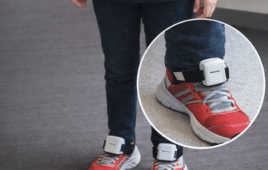
A photo of the wearable gait sensors used in the study.
Yale-led study finds wearable sensors match motion capture for gait tracking in knee osteoarthritis
“mdo
EXPAND YOUR KNOWLEDGE AND STAY CONNECTED
Get the latest medical device business news, application and technology trends.

DeviceTalks Weekly

See More >

MDO Digital Edition

Digital Edition

Subscribe to Medical Design & Outsourcing. Bookmark, share and interact with the leading medical design engineering magazine today.

MEDTECH 100 INDEX

Medtech 100 logo
Market Summary > Current Price
The MedTech 100 is a financial index calculated using the BIG100 companies covered in Medical Design and Outsourcing.

New MedTech Resource

Medical Tubing

MassDevice

Mass Device

The Medical Device Business Journal. MassDevice is the leading medical device news business journal telling the stories of the devices that save lives.

Visit Website
MDO ad
Medical Design and Outsourcing
  • MassDevice
  • DeviceTalks
  • MedTech100 Index
  • Medical Tubing + Extrusion
  • Medical Design Sourcing
  • Drug Delivery Business News
  • Drug Discovery & Development
  • Pharmaceutical Processing World
  • R&D World
  • About Us/Contact
  • Advertise With Us
  • Subscribe to Print Magazine
  • Subscribe to our E-Newsletter
  • Listen to our Weekly Podcasts
  • Join our DeviceTalks Tuesdays Discussion

Copyright © 2026 Arrowfly, LLC. All Rights Reserved. The material on this site may not be reproduced, distributed, transmitted, cached or otherwise used, except with the prior written permission of Arrowfly LLC. Site Map | Privacy Policy | RSS

Search Medical Design & Outsourcing

  • Home
  • Medical Device Business
    • Mergers & Acquisitions
    • Financial
    • Regulatory
  • Applications
    • Cardiovascular
    • Devices
    • Imaging
    • Implantables
    • Medical Equipment
    • Orthopedic
    • Surgical
  • Technologies
    • Supplies and Components Index
    • Contract Manufacturing
    • Components
    • Electronics
    • Extrusions
    • Materials
    • Motion Control
    • Prototyping
    • Pumps
    • Tubing
  • MedTech Resources
    • Medtech Events in 2026
    • The 2026 Medtech Big 100
    • Medical Device Handbook
    • MedTech 100 Index
    • Subscribe to Print Magazine
    • DeviceTalks
    • Digital Editions
    • eBooks
    • Educational Assets
    • Manufacturer Search
    • Podcasts
    • Webinars / Digital Events
    • Whitepapers
    • Voices
    • Views
    • Video
  • 2026 Leadership
    • 2025 Winners
    • 2024 Winners
    • 2023 Winners
    • 2022 Winners
    • 2021 Winners
  • Women in Medtech
  • Advertise
  • Subscribe