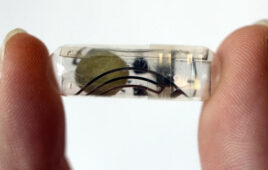
This drug delivery wearable’s micropump needed an engineered solution for both adhesion and slip.
By Philipp Begert, Trelleborg Medical Solutions
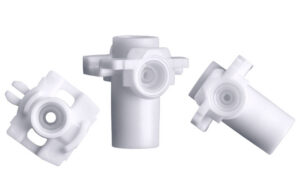
The low-friction micropump is designed with a stiff thermoplastic polybutylene terephthalate (PBT) housing bonded to a complex liquid silicone rubber (LSR) seal. [Image courtesy of Trelleborg]
Working with our customer, we developed a microinjection pump no bigger than your fingernail, entirely lubricant-free and with dead-on dosing accuracy. The brief we received asked us to deliver a 15 mm pump for a wearable device capable of dosing between 2 and 10 microliters per shot. It had to be single use for hygiene, cost-effective for the market and — most critically — not use lubricants to avoid contaminating medication. This pump still needed a perfectly sealed interface and ultra-low friction so a very compact drive mechanism could reliably push and pull the plunger.
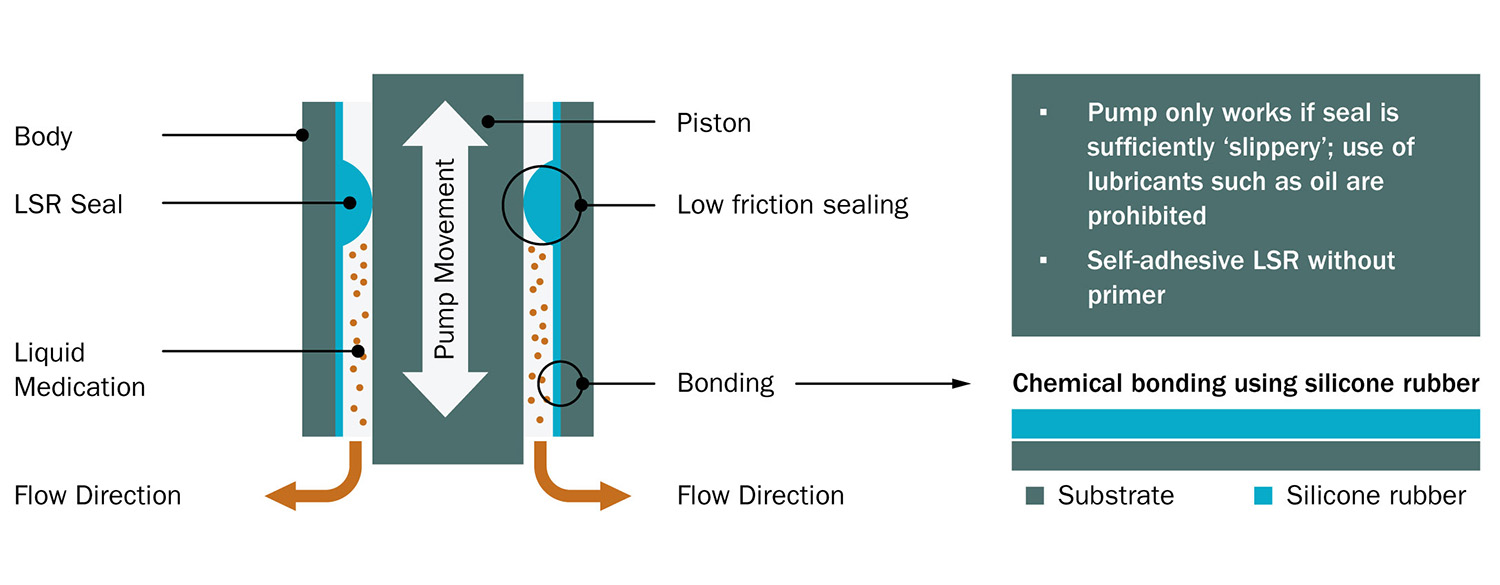
If you’re in device design, you know the contradiction: You want your seal to stick for containment but move freely to minimize friction. That meant finding a solution with the opposing traits of adhesion and slip within one engineered pairing.
A real-world design for manufacturing lesson
Our first reality check came when we examined the initial customer design from a multicomponent molding perspective. The part looked functional on paper, but not for manufacturing. The shut-off areas (essential in two-component molding to control material flow) weren’t designed for the behavior of liquid silicone rubber (LSR). LSR, particularly in high-cavity micro applications, will flash if the tool design doesn’t allow for crisp, steel-to-substrate shut-off.
We collaborated intensively with the customer and reengineered the tool interfaces. This included revising gating strategy and overflow design so the fill could be precisely controlled, and so weld lines would not fall at critical sealing areas. Small tweaks here meant massive impacts at scale.
Engineered materials for both bond and release
No standard material solved both our sealing and sliding needs. Initial runs with off-the-shelf silicone generated two classic failures. We either had stiction so high it demanded an overpowered, oversized drive mechanism, or seals so weak they threatened system reliability.
This forced us into material exploration with a trusted supplier, seeking a friction-modified, self-adhesive LSR. The chemistry had to create a permanent bond on one side while ensuring the opposite face remained slick. We adopted an LSR material with both biocompatibility and performance that checked both the “hold on” and “let go” requirements in one molding step.
[Image courtesy of Trelleborg]
This shrinks
The project’s greatest technical test came not from design or material selection but from the physics of post-molding shrinkage. Our pump included a stiff thermoplastic polybutylene terephthalate (PBT) housing bonded to a complex LSR seal. PBT shrinks less than 1%, while LSR can shrink up to 3%.
We could not rely on simulations to overcome this challenge as even the best software gets lost with complex multicomponent geometries. CT scans revealed the seal had wandered, and with it, all chances of passing leak and friction tests. We took CT scan data from the first molded parts, mapped the deformation and dialed corrections into the mold, not to get the perfect geometry, but to get the perfectly deformed geometry that would produce a balanced part.
If you need tight tolerances in a high-precision multi-material part, I recommend budgeting for at least one or two rounds of pre-distorting your tool based on real-world data. This data-led loop was the true enabler for our project, yielding micron-level accuracy in the final assembly.
Scaling the solution
Why we didn’t solve all this with traditional assembly? In our scenario it was simply impossible. The seal geometry was too intricate for robotic placement at this scale, and the opportunity for cost reduction via part consolidation was too significant.
Integrating seal and housing in one shot delivered multiple advantages: yield improvement of about 15% over an assembly-based process, cost savings of roughly 20% per part, and quality and compliance gains because fewer steps mean fewer risks for contamination and bioburden.
For production, we scaled this design to a four-cavity tool generating four to five million units annually. We relied on an in-mold transfer process to place the part from the thermoplastic side into the LSR portion of the tool for part handling.
Key takeaways for device engineers
Treat your material, tooling and component design as an inseparable set. In multicomponent micro-molding, the boundaries between these disciplines are gone. Always specify your materials with the process and tool in mind, and tune your tool based on final, in-use geometry, not just simulations.
True engineering happens at the intersection of analysis, adaptation and innovation. More than just molding a part, this project was about engineering a solution, collaborating at every turn and never accepting that impossible ought to be the last word.

Trelleborg Medical Solutions Manufacturing Technology Director Philipp Begert [Photo courtesy of Trelleborg]
Read more MDO Contributions and learn how to submit your own
The opinions expressed in this blog post are the author’s only and do not necessarily reflect those of Medical Design & Outsourcing or its employees.