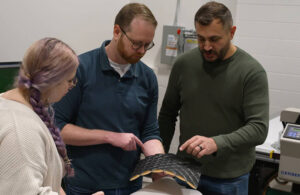
Ford says it has been rehiring experienced engineers to reverse quality issues. In a news release announcing recent progress, the automaker included this photo of members of its Parametric Solutions (Parasol) team, which uses advanced visual coding to “bridge the gap between engineering and aesthetics.” [Photo courtesy of Ford]
And there’s a reason that can help prevent manufacturing problems in our own highly regulated industry where defects can be a matter of life or death.
So far in 2026, Ford leads all automakers for the most recalls in the U.S. according to recent data from the National Highway Traffic Safety Administration.
That’s a dreadful defect distinction that Ford also held in 2025, when the auto manufacturer not only had the most recall campaigns but also represented more than half of all vehicles recalled. (Ford would have also held the most-recalled title the year before if not for Tesla’s recalls, most of which were resolved via over-the-air software updates.)
And all those recalls are adding up to big costs for Ford in the form of recall charges including an expected $1 billion in warranty and material costs this year alone, regulatory penalties and eroded consumer trust.
Related: A boy’s death is a tragic example of foreseeable risk in device design
What’s going on at the company that revolutionized manufacturing with its moving assembly line more than a century ago? Apparently, it has a lot to do with the technology that’s more recently been billed as the next revolution: artificial intelligence.
Ford has been bringing back hundreds of “gray beard” engineers after artificial intelligence tools for automating quality systems fell short, Bloomberg reports.
“Mistakenly we thought that by just introducing artificial intelligence and ingesting the design requirements that we had, that that would produce a high-quality product,” Ford VP of Vehicle Hardware Engineering Charles Poon told reporters. “… We recognized that for us to enhance some of our automation and machine learning and artificial intelligence tools we needed to ensure that they were trained by the most experienced individuals.”
Those tools included 900 AI-powered cameras installed at its plants last year “to detect quality issues at the source and help us mitigate supply disruptions,” said Ford Chief Operating Officer Kumar Galhotra.
Now, the rehired veteran quality inspectors “hunt for failure points before a part ever reaches the plant floor,” Galhotra said. They’re also helping to train the AI systems and younger employees.
Ford cited its renewed appreciation for these engineers’ “hard-earned wisdom of decades of design” in a news release announcing its top ranking among mainstream brands in the J.D. Power initial quality study for the first time since 2010.
“Over the past few years, Ford replaced about two-thirds of the senior leaders in its industrial system across engineering, supply chain and manufacturing,” the company said. “In Vehicle Engineering, leaders saw an opportunity to bring deep, specialized expertise into the design phase early. Ford hired roughly 300 veteran engineers who carry the hard-earned wisdom of decades of design.
“Free from daily production schedules, these engineers now act as internal auditors, running mandatory weekly design reviews to hunt for and eliminate potential failure points before blueprints ever reach the factory floor,” Ford continued.
Ford says it has also changed its supplier relationships in a move that smart medtech developers have already figured out.
“At first, it meant go see, find it, fix it’ missions,” the company said. “Ford teams went directly onto supplier plant floors to address risks alongside their counterparts. … Now, Ford integrates suppliers earlier in the development process for rigorous design validation that helps ensure long-term performance — an effort that drove a 30% reduction in launch issues year over year.”
Said Liz Door, the aptonymous chief supply chain officer, “It’s easy to celebrate heroes fixing problems. What we really want is to celebrate zero defects.”
Related: Recall for devices that ‘exploded’ reminds us patients aren’t the only ones at risk