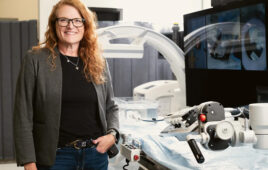
Hyperfine President and CEO Maria Sainz [Photo courtesy of Hyperfine]
But Sainz has been involved with many more device developers and manufacturers over her 30-year medtech career, including a decade at Guidant, where she worked with Lisa Earnhardt, who now leads the medical device business at Abbott.
Sainz previously served as president and CEO of Concentric Medical (sold to Stryker for $125 million in 2011), Edwards Lifesciences-backed heart failure startup
Sainz has also been active in medtech boardrooms, serving on the boards of Spectranetics (sold to Philips for $2 billion in 2017) and Orthofix Medical (which merged with SeaSpine in 2023).
Asked for advice she would offer to device developers, Sainz said her experience has been that you can’t just ask a customer or clinician to tell you what they need or want. Instead, “the most impactful and successful innovation has come out of the most astute observation of a medical need,” she said.
“I subscribe a lot to the biodesign methodology of need finding and need identification and need definition,” Sainz said. ” … By observing the environment, you figure out the ways in which you can improve the procedure, the time it takes for the procedure, the invasiveness of the procedure, the time it takes to recover from the procedure, the ease of use of the tool you use for the procedure, and that triggers the most profound innovation. The closer you are to solving a gap, to solving a need, the more successful.”
“Cool technology is really important … but if it doesn’t fill a gap that is a medical need, it’s going to fall short of really being a widely adopted medical solution for patients,” she continued. “I think it’s getting harder. You need to show safety, of course, you need to show efficacy. Now you need to show cost benefit. People need to understand if they’re going to pay for something, they’re going to get value out of what they pay. To me, that’s a huge lesson.”
The second lesson she offered was about how important it is for medtech professionals to work cross-functionally.
“If you’re a designer, you need to be listening to the regulatory people,” she said. “One day your design is going to be a regulatory filing in front of the FDA with a lot of questions back to you, so you need to be partnering with them, or it’s going to be a solution that goes into a clinical trial run by a clinical department.”
“The cross-functionality of how we do medical device development is probably more critical than in any other industry,” she continued. “I was talking to a Ph.D. student earlier today for some career advice, and I said, ‘Try to be as far away from being an individual contributor as you can in your research efforts, because the world of industry is totally teamwork and cross-functionality.'”
We also asked how medtech can bring more women into the industry and elevate them to positions of leadership to better represent the global patient population.
Women in Medtech 2024 analysis: Gender parity in medtech leadership remains elusive
Sainz co-founded Diversity by Doing (DxD) in 2020, was involved in Guidant Reaches Out to Women (GROW) before the device developer’s sale to Boston Scientific, and lauded MedtechWomen’s annual MedtechVision conference.
“We’ve made a lot of progress, but it’s never enough. … The most important thing is to continue to have the dialogue and find all of the different gaps that exist. Double down on mentoring opportunities, double down on training opportunities. It is not just about training women, it’s also about training men and training men about the unconscious bias around how they choose talent, how they promote talent, how they even mentor talent. It is a lot more comfortable to do it to people like you, that sort of speak at the same level. It may be more intimidating to do it to someone that is very different than you. The same applies to me, [with] a racial minority I may be a little more guarded as to how I can provide feedback. We need to constantly remind people that we’re all equal, and we need to change some things to make a more purposeful, conscious effort around not discriminating, not leaving out, not forgetting, not excluding.”
“Most large corporations in medtech now have their own diversity networks and diversity efforts,” she continued. “I don’t necessarily think that the quotas are the only way to go about it, because that’s a bit of a stick, not a carrot. I think it’s more about sensitizing, educating, reminding, refreshing, mentoring, dialoguing, making it sort of a centerpiece at the table.”
Read more: Hyperfine CEO Maria Sainz is on an MRI-everywhere mission