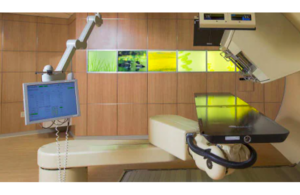
A proton beam therapy treatment room at Mayo Clinic in Rochester, Minnesota [Image courtesy of Mayo Clinic]
Proton beam therapy is a radiation treatment that uses a precise beam of protons to deliver targeted radiation. It’s expensive for health systems to install, with initial facility investment ranging from $25 million to $200 million, and it’s only available in 50 centers across the U.S., including Mayo Clinic facilities in Rochester, Minnesota, and Arizona. It also has the advantage of delivering higher doses of radiation to cancer cells while minimally affecting healthy surrounding tissue.
Generally, healthcare professionals try to avoid the heart when using radiation therapy to treat cancer. However, the targeted nature of proton beam therapy could enable it to treat hard-to-access arrhythmias, researchers explained during a recent episode of Mayo Clinic’s “Tomorrow’s Cure” podcast.
They are currently conducting a clinical trial to explore using proton beam therapy to treat ventricular tachycardia (VT), rapid heartbeat that starts in the ventricles. Standard treatments involve medication, defibrillators and catheter ablation.
“The idea of targeting any-size lesion in the middle of the patient without having to put the patient under anesthesia or any sort of access to veins or chest cavity, sounds like it’s right up our alley,” said Dr. Amanda Deisher, radiation oncology medical physicist, assistant professor of medical physics and researcher at Mayo Clinic’s Comprehensive Cancer Center in Rochester
Dr. Konstantinos Siontis, cardiac electrophysiologist and associate professor of medicine at Mayo Clinic in Rochester, said the clinical study has shown some positive results
“I certainly think that there were some patients who benefited from radiation with protons when everything else that we did for them, including multiple catheter ablation procedures and medications, had failed,” Siontis said. “I think adding noninvasive options generates a broad spectrum of options for patients who have the most difficult arrhythmias.”
Present treatments are working pretty well for atrial fibrillation, the most common type of arrhythmia, but radiation therapy could even become a noninvasive option down the road, according to Dr. William Stevenson, a cardiac electrophysiologist, professor of medicine and director of the Cardiac Arrhythmia Clinical Research Program at Vanderbilt Heart and Vascular Institute.
Watch the full episode below: