This is a manufacturing decision you can’t defer in 2026.
Mark Freitas, Alvarez & Marsal
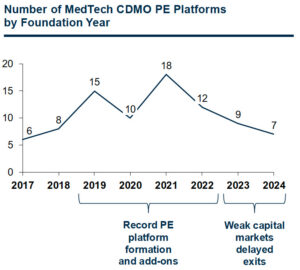
[Chart courtesy of Alvarez & Marsal]
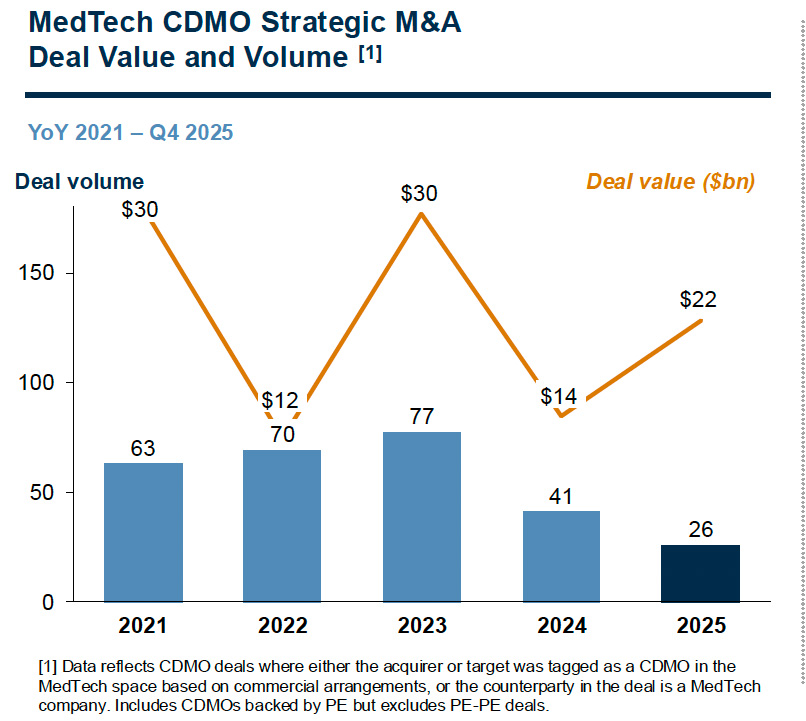
The 2022-2024 structural reset is over and the financing gap is narrowing. The sector has emerged from a period of value depression and as markets stabilize, demand is returning but under a higher-complexity model, creating a once-in-a-cycle moment to reset portfolios and manufacturing strategy.
Recent deal activity underscores this shift. One company’s recent sale of its medical OEM division in December 2025 set the tone for valuations in 2026, particularly for specialized, high barrier manufacturing assets. While the headlines were that those assets sold for $1.5 billion, the real story was the premium this represented over 2022 valuations.
Combined with lowering interest rates and renewed deal momentum, the message to OEM leadership is clear: The window is open for dealmaking, but not indefinitely.
2026 is a decision year, not a planning year
The global medtech CDMO market has grown from $73 billion in 2022 to $91 billion in 2024, driven by OEMs outsourcing complex manufacturing in cardiac, surgical, and orthopedic devices. That growth represented a complexity play. As hardware and software merge in ways that legacy, general-purpose factories simply cannot handle, valuations are rising in specialized platforms as a result.
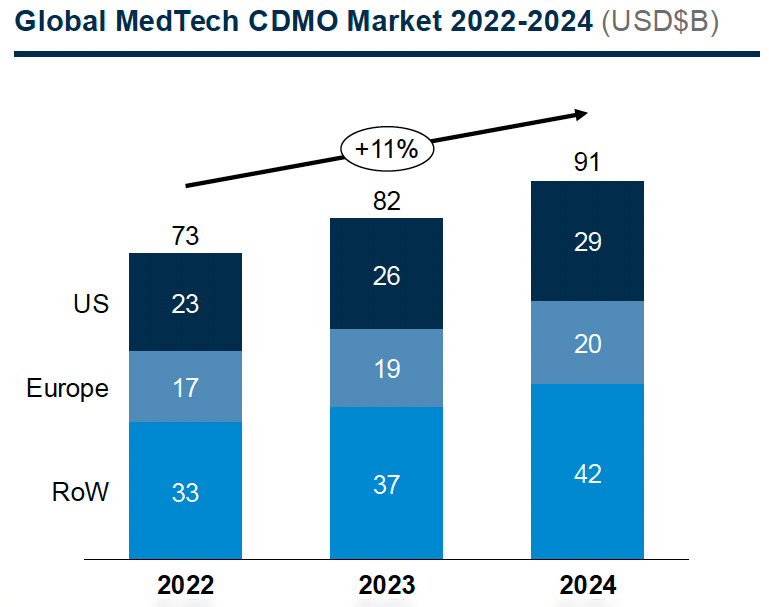
[Chart courtesy of Alvarez & Marsal]
[Chart courtesy of Alvarez & Marsal]
Two plays, one clock
Most leadership teams see the shift. The challenge isn’t awareness. It’s committing to the direction and executing on it.
The first play is divestiture. Interest is particularly acute in structural heart, neurovascular, regenerative materials, and precision diagnostics. Premium assets can always command a top-of-the-range valuation. But frankly, the average assets are the ones that will benefit the most from an active 2026 market.
The catch is that buyers are acquiring platforms rather than projects. That puts a major emphasis on the operational prep needed for divesture to produce clean cost structures, documented processes, and regulatory readiness including MDSAP and MDR. The OEMs who have done the pre-work necessary to divest and can show well under the diligence microscope will be best positioned to maximize deal value.
The second play is acquisition. OEMs can use the current cycle to acquire strategic capabilities that would take years to build internally. But this requires you to go slow so you can go fast. You need patience to identify the capabilities that best suit your strategy, but once found, move with conviction. Every quarter you hesitate increases the risk that valuations rise or the asset goes to a competitor who was ready to act.
Preparation is the transaction
Regardless of which play you pursue, the question remains how to strengthen your core assets while monetizing your non-core assets? If non-core, how easily can it be prepared for divestiture? If core, what is needed to enhance your competitive advantage?
That’s not a question you answer with a market analysis. It requires alignment with your product roadmap, your R&D priorities, and a clear understanding of what you must own to sustain competitive advantage.
The risk is treating this shift as a procurement exercise, divesting to cut costs or partnering with others to minimize to keep costs down. There is a time for that, but this isn’t it. This is a portfolio optimization moment. The OEMs operating in the procurement lane will be structurally slower than those looking at this as a way to optimize the portfolio.
The opportunity is already here, but it won’t stay static. Acting early and with intention is what separates those who capture value from those who watch it pass by.
Well-prepared specialized manufacturing platforms command a premium. Every deal that closes in 2026 will inform the new valuation benchmark and watched closely to see if it raises the bar for the next one. The OEMs positioned to act, on either side, are the ones doing the preparation work today.
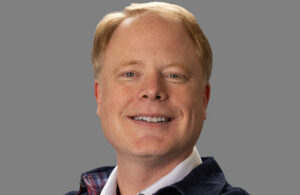
Mark Freitas is a managing director and Life Sciences Practice leader with Alvarez & Marsal. [Photo courtesy of Alvarez & Marsal]
Read more MDO Contributions and learn how to submit your own
The opinions expressed in this blog post are the author’s only and do not necessarily reflect those of Medical Design & Outsourcing or its employees.